
Home > Perform Google Chat Migrations > Create a Migration Policy
Download this articleCreate a Migration Policy
A Google Chat migration policy allows you to configure the conflict resolution, filter policy, user mapping, and other options for Google Chat Migration.
Refer to the following steps to configure a migration policy for Google Chat Migration:
-
Click Policies under Settings in the left pane.
-
Click Migration policies to access the Migration policies page.
-
Click the Google Chat tab.
-
Click Create migration policy. The Create migration policy panel appears.
-
Enter a name and an optional description for the policy, and then click Next.
-
In the What do you want to migrate? section, configure filters to define the objects you want to migrate:
-
Chat scope – Define to migrate direct messages and/or spaces.
-
Chat message format – Define the format of messages to be migrated.
-
Recreate chat messages in Teams – Select this option if you want to recreate the chat messages in the destination, and select an option below to define the migration scope of chat messages.
The screenshots below show the chat messages in the source and destination.
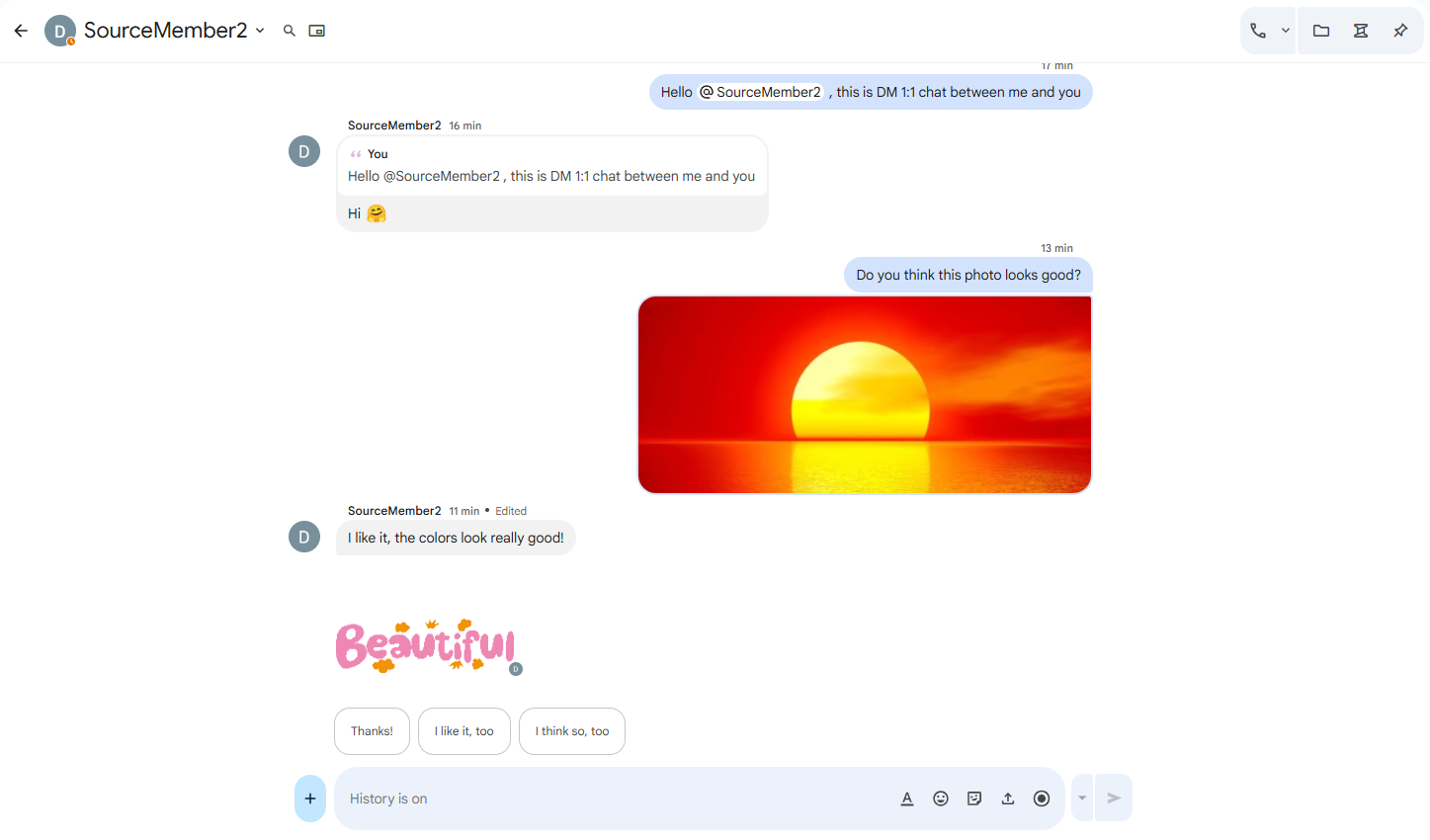
Source 1:1 chat.
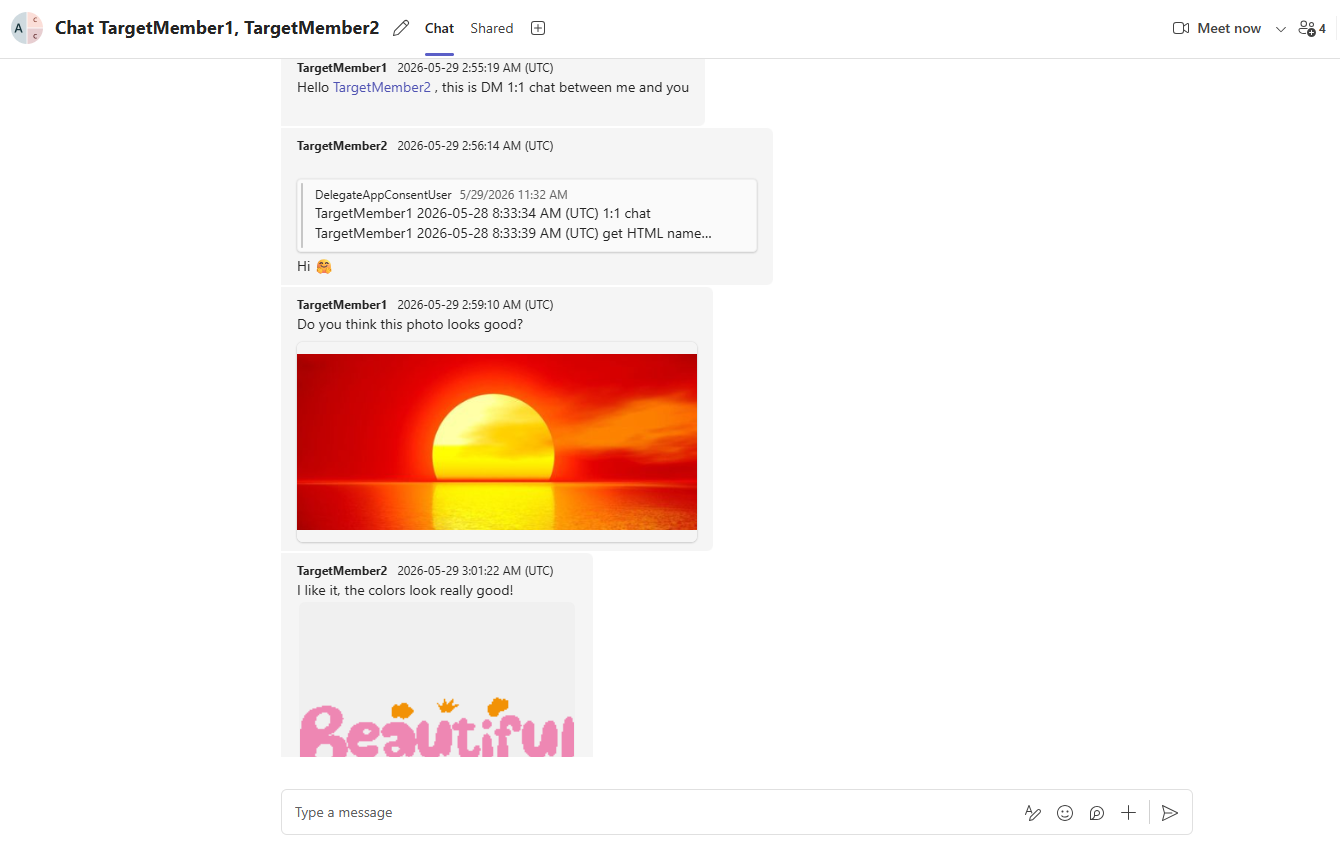
Destination 1:1 chat.
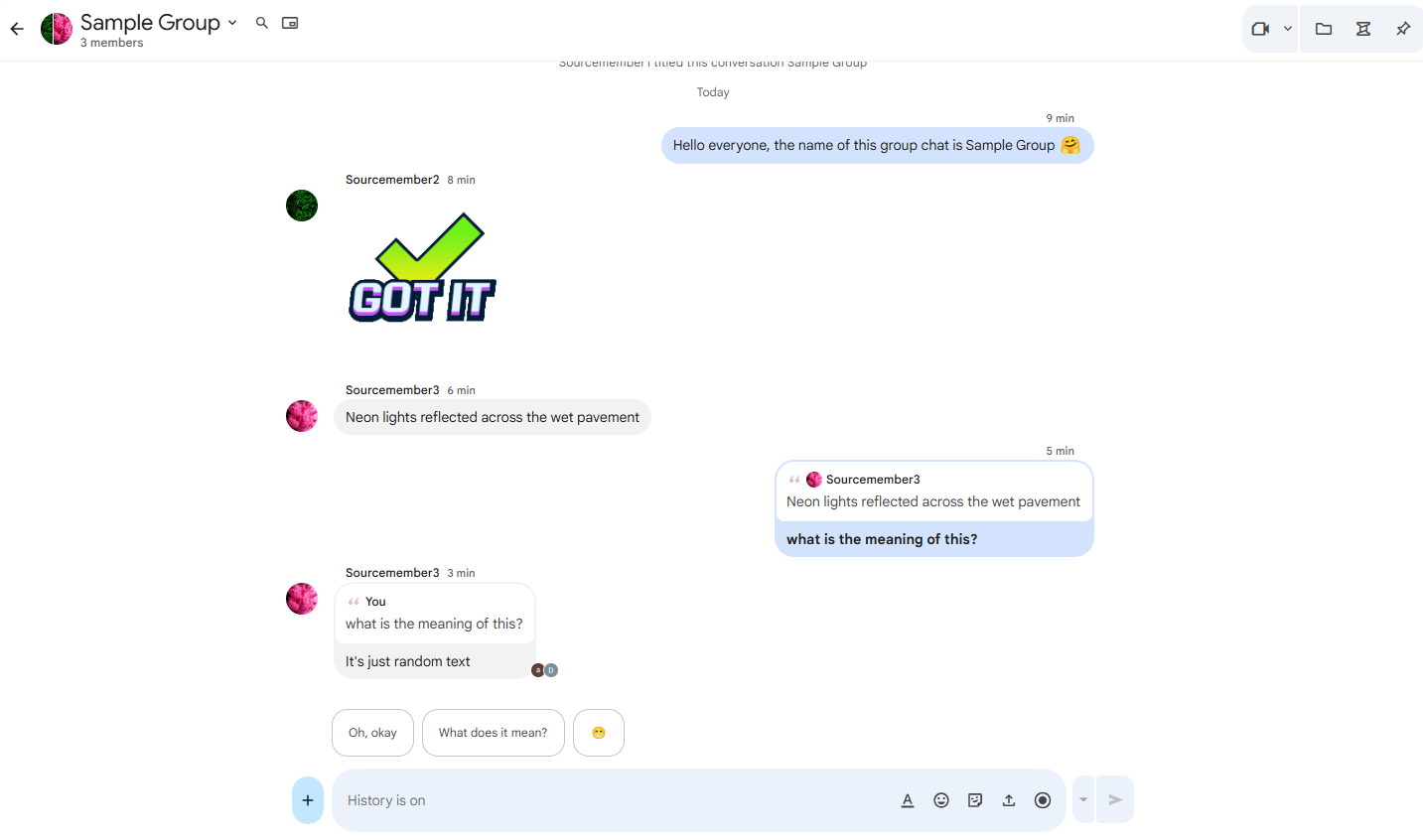
Source group chat.
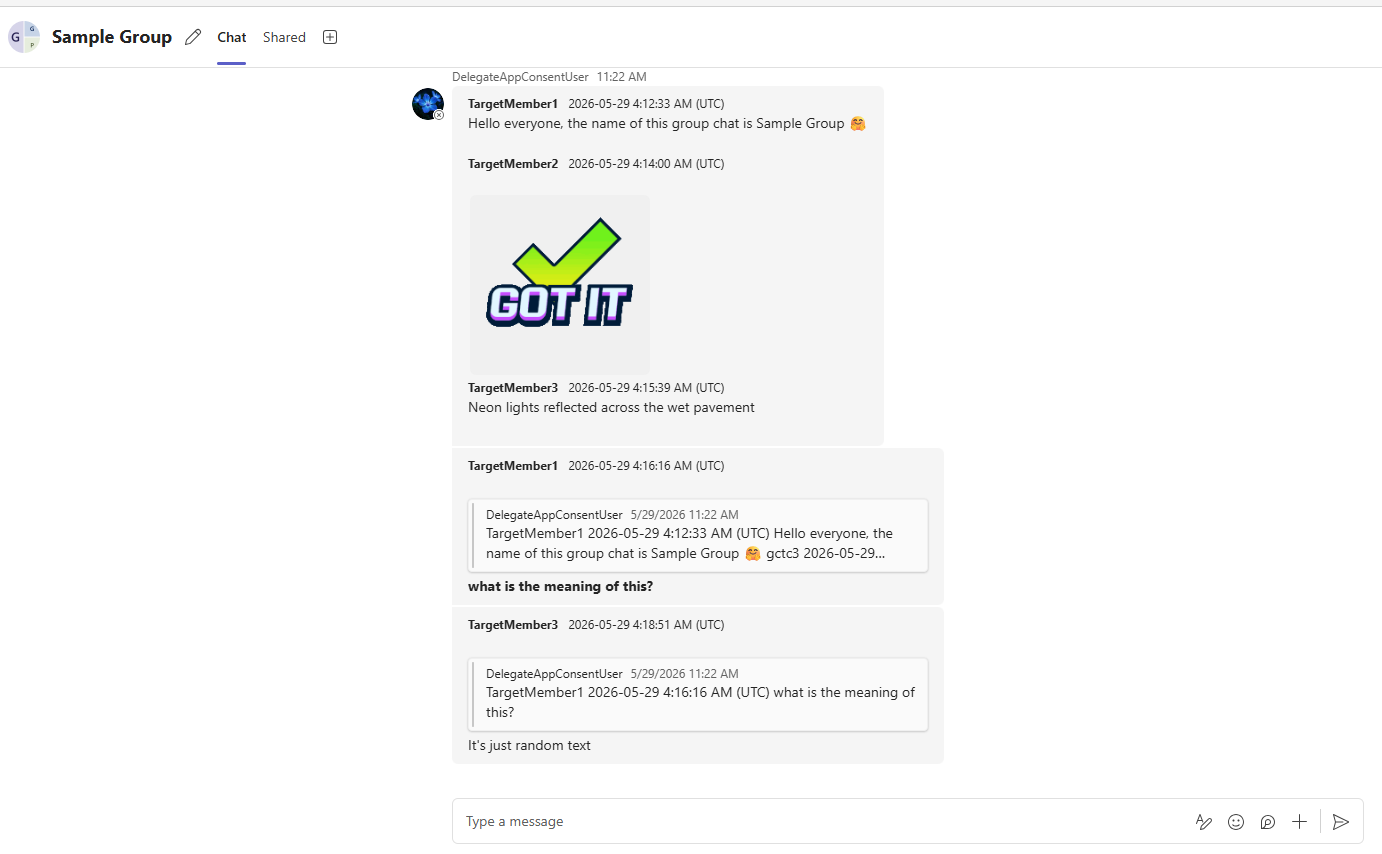
Destination group chat.
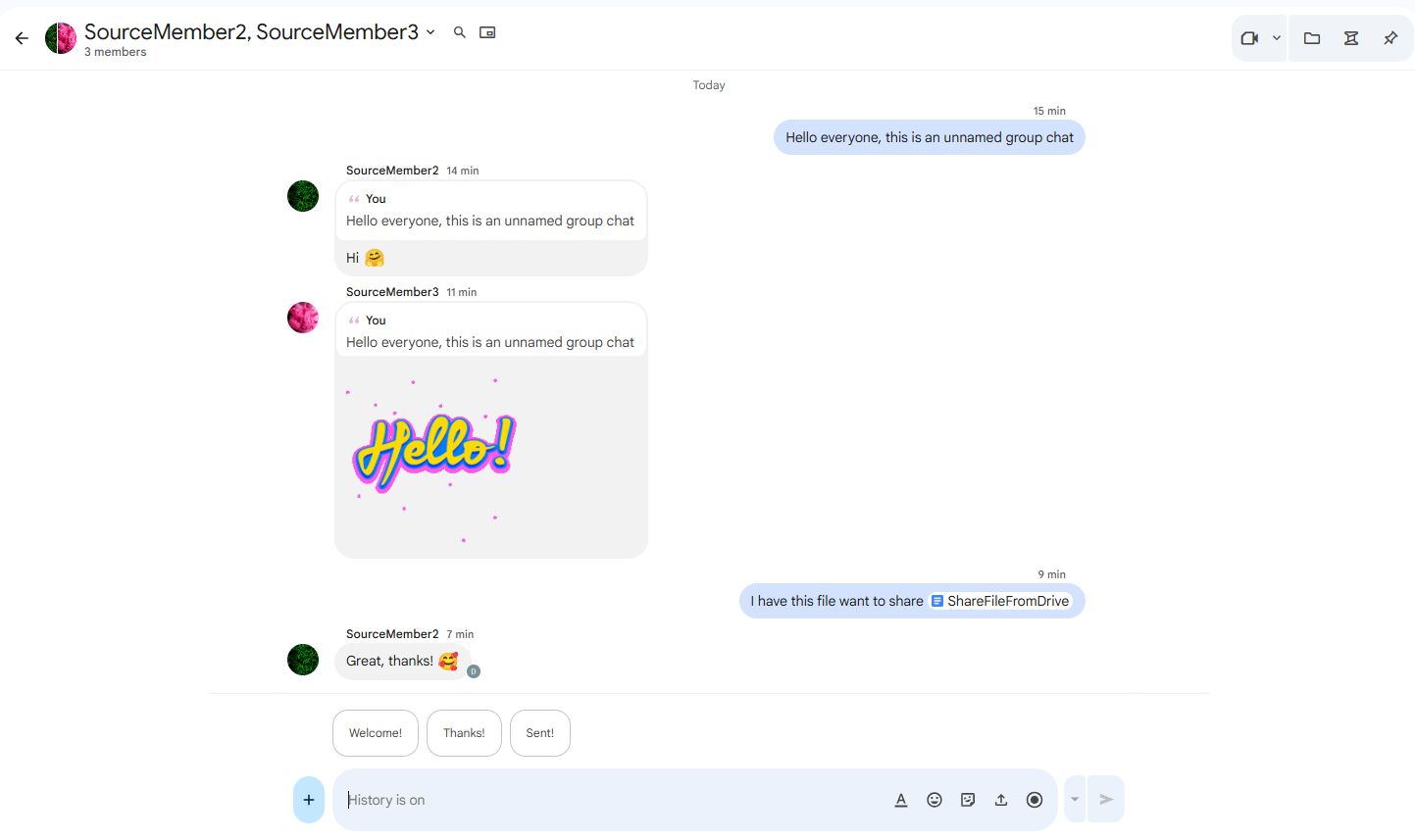
Source group chat without name.
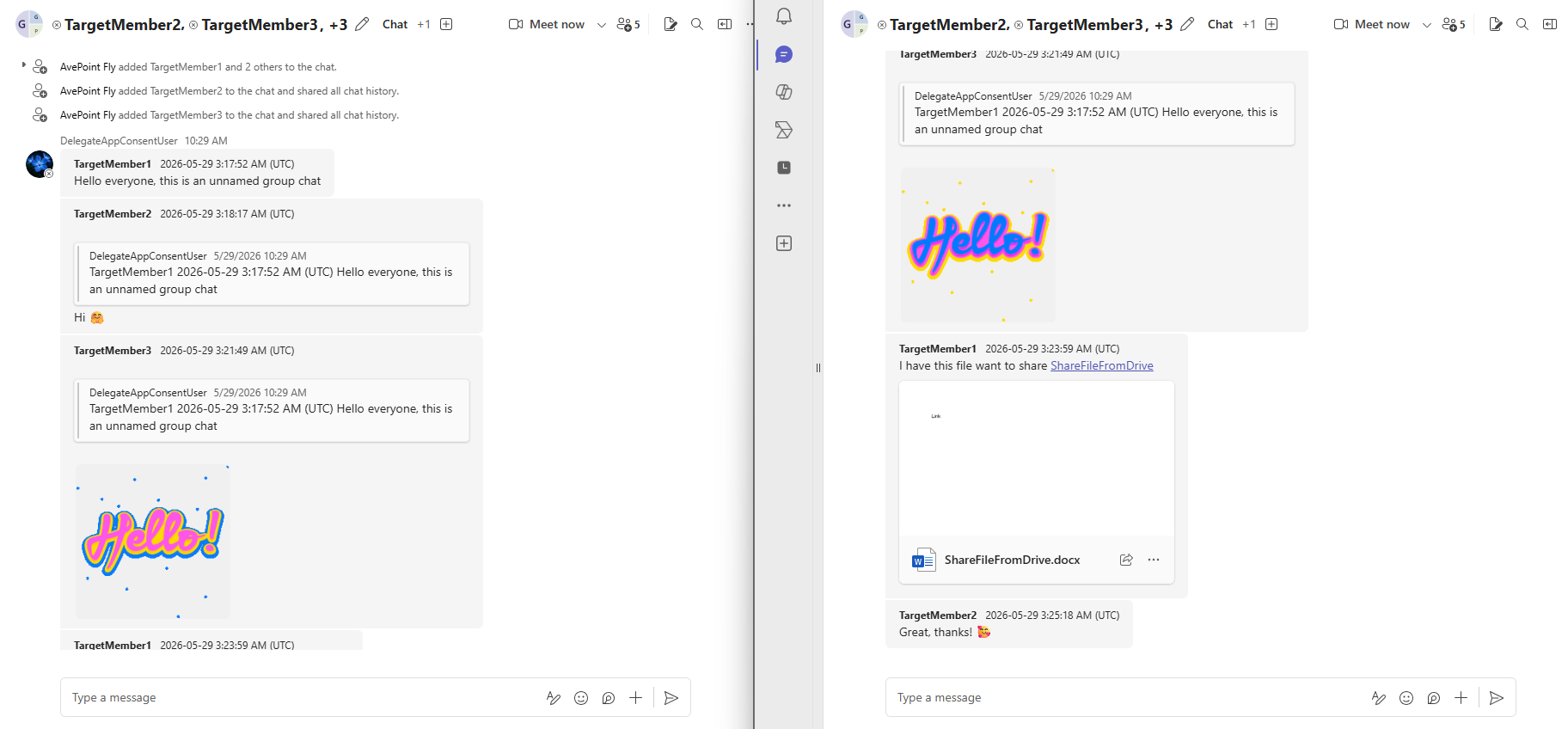
Destination group chat without name.
-
Migrate all chats – Migrate all chats for chat users.
-
Migrate chat on or after – By default, Fly will only migrate the chats posted within the last two months before the current date. If the default date cannot satisfy your requirements, you can specify a different date to migrate the chats after your specified date.
NOTEFor edited chat messages, Fly will still migrate the messages based on the message posted time.
NOTEAfter a migration job, if you extend the date filter to an earlier date, the extension will not work in the next migration job. Fly will migrate chats according to the previous date filter to secure a correct message order.
-
-
Archive all chat messages to HTML files to each mapped user’s OneDrive – Select this option if you want to archive chat messages as HTML files for chat users that are configured in the migration mappings.
The screenshots below show the chat messages in the destination.
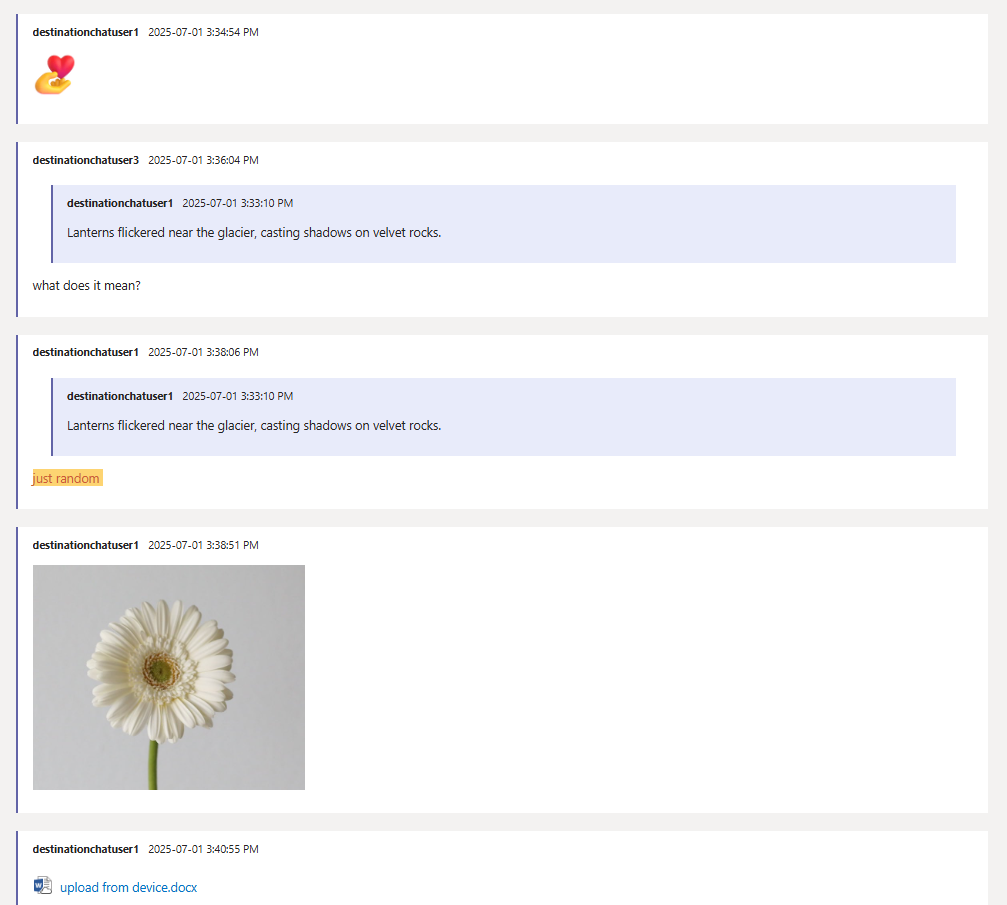
Destination 1:1 chat.
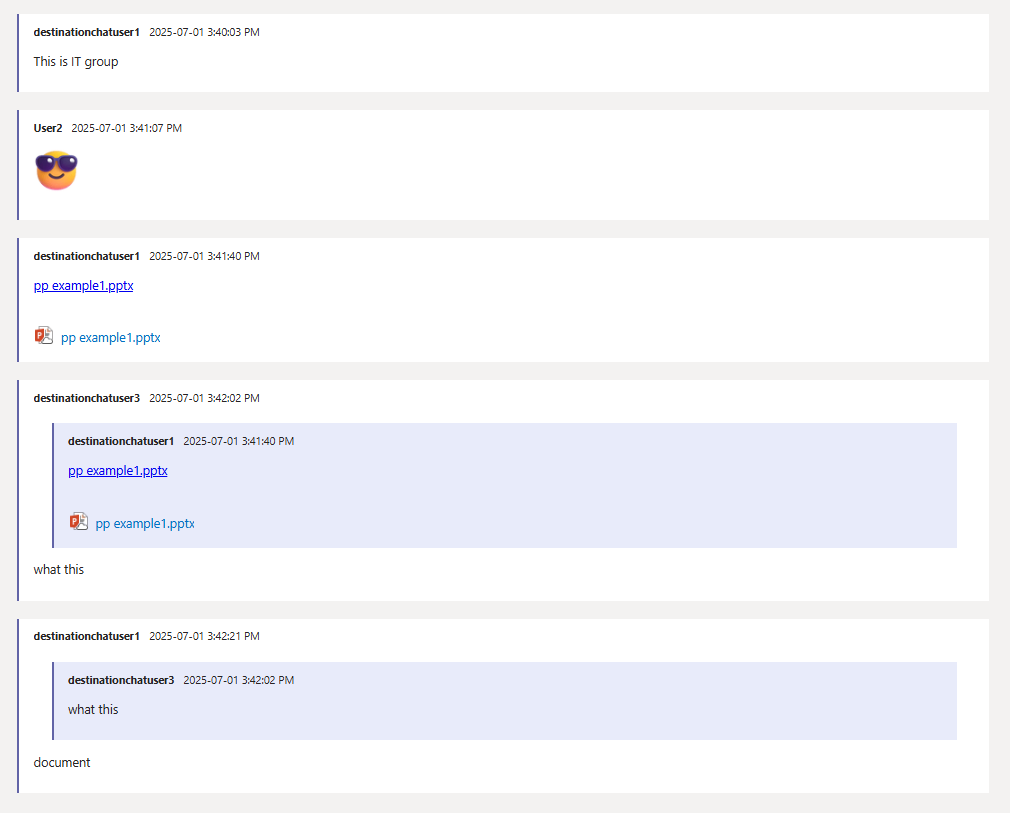
Destination named group chat.
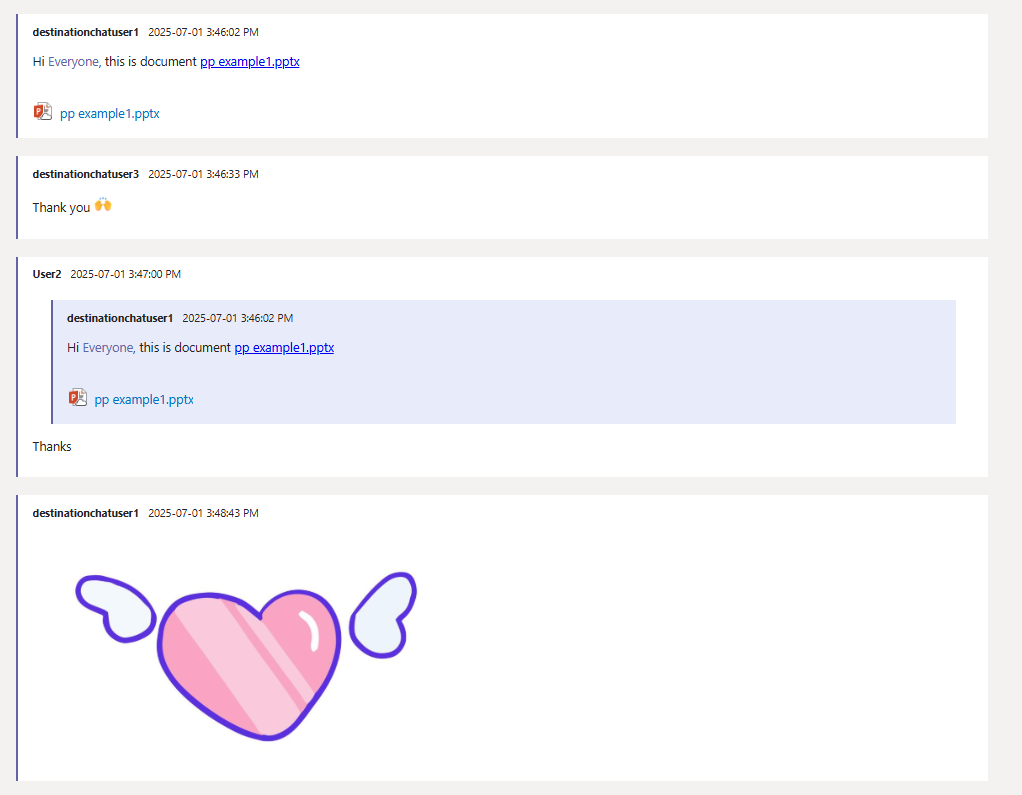
Destination unnamed group chat.
-
Select the sub checkbox if you want to create a Teams chat to show HTML files of archived chat messages.
After the migration, a new chat will be created in the destination. You can click the Microsoft Google Chat_Archived tab to directly access the HTML files under the Microsoft Google Chat_Archived folder in OneDrive.
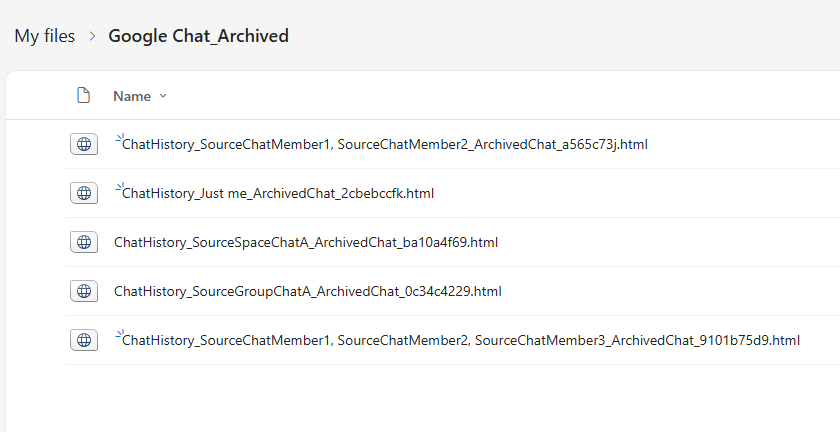
If the source chat is a one-on-one chat and both chat members post messages, the HTML file will be named in the format of ChatHistory _source chat member1 and source chat member2_ArchivedChat_random number.html. If only one member posts messages, the HTML file will be named in the format of ChatHistory_just me_ArchivedChat_random number.html.
If the source chat is a named group chat/space, the HTML file will be named in the format of ChatHistory_chat name/space name_ArchivedChat_random number.html.
If the source chat is an unnamed group chat, the HTML file will be named in the format of ChatHistory_source chat member1, source chat member2, and source chat member3_ArchivedChat_random chat ID.html.
The screenshot of the examples below is for your reference.
-
-
-
Define the time zone for messages – Select a time zone for messages migrated to the destination.
NOTEIf you also define a different time zone by the TimeZone customized feature, Fly will use the time zone defined by the customized feature.
-
-
In the Conflict resolution section, configure the following conflict resolutions when the source chat file attachment conflicts with an existing one in the destination.
Resolution Conflict No Conflict Skip Ignore the conflicting file and do nothing in the destination. A new file will be created. Overwrite Delete the conflicting file in the destination first and overwrite it with the source file. A new file will be created. Overwrite by last modified time The conflicting file with the latest modified time will be preserved in the destination. A new file will be created. -
Click Next after you finish configuring the conflict resolution.
-
In the Additional options & mappings step, configure the following settings for the migration.
-
Stop the migration and report errors if chat user does not have OneDrive – If your destination chat users do not have a OneDrive site, you can select the option to stop the migration job and report errors.
If you want to skip the verification, deselect the option. The migration job will continue, but OneDrive related data or functions will fail, such as migrating chat files and replacing chat file links.
-
Provide the final domain name of the destination tenant to replace file links in chat messages – If you have changed domains for chat users, select this checkbox to replace file links in chat messages. Otherwise, the file links in the destination chat messages may not be opened.
-
Enter the final destination domain name – Select this option if the destination tenant has only one domain, and enter the new destination domain in the text box. This option will apply to all chat users in the migration.
NOTEThe final domain refers to the domain used by your destination tenant that has gone live. For example, contosogsuite.com is used during the migration, and contoso.onmicrosoft.com is used after the destination tenant goes live, you need to enter contoso.onmicrosoft.com here.
-
-
User mapping – With a user mapping, you can map a source user to a destination one. You can also map a domain in the source to a destination domain. Users, securities, and user-related metadata can be migrated based on user mappings. Click Add button to the right of the field to create a new one. Refer to the Create User Mappings section to view how to create a user mapping.
You can also select a previously created user mapping from the drop-down list and click View details to view the detailed information of the selected user mapping. You can enter the keyword of a user mapping in the Search user mapping text box and press Enter on the keyboard to search the user mapping.
NOTEFor the users that have not been configured in user mappings, you can choose to map the users based on User principal name prefix and/or Display name. Refer to the table below for property examples:
Property User Principal Name User Principal Name Prefix Display Name Email Address Email Address Prefix Property Example JohnSimon@onmicrosoft.com JohnSimon@ JohnSimon JohnSimon@onmicrosoft.com JohnSimon@ -
Switch on/off the button of each property to configure whether you want to map users based on that property.
-
Click the Up or Down button of a property to configure the sequence for mapping users.
NOTEIf you need to disable both User principal name prefix and Display name, user mappings are required.
-
-
Customized features – This function is unavailable for Google Chat migration now.
-
-
Click Next after you finish configuring the options and mappings.
-
Configure the Notifications setting to send migration email notifications to specific recipients after the migration.
-
Send project level notifications (all mappings within a project) – The migration email notifications are based on the project level, which summarizes the project name and the mapping count of each migration status.
-
Recurrence – Enter a positive integer to define the recurrence days for the notifications.
-
Start date and time – Select a start date and time to send the first notification. The later notifications will be sent at the selected time based on the recurrence.
If you want to configure the end date and time of the notifications, you can select the Configure end date and time checkbox and select a date and time.
-
Send migration email notifications to – Define the recipients who will receive the notifications.
-
Email template – Create an email template for the notifications by clicking the Add button. Refer to Manage Email Settings for details on how to create an email template. You can also select an existing email template from the drop-down list.
-
-
Send individual mapping level notifications – The migration email notifications are based on the mapping level, which summarizes the migration status, the project name, the source and destination email addresses, the migration start and finish time, and the migration person.
-
Define the notification scope for mappings – Select For failed mappings only to send notifications for the failed mappings only, or select For all mappings to send notifications for all mappings.
-
Send migration email notifications to – Define the recipients who will receive the notifications.
-
Person running the migration – The person who runs the migration will receive the notifications.
-
Additional recipients – Enter the email addresses of other recipients. Separate multiple email addresses with a semicolon (;).
-
-
Email template – Create an email template for the email notifications by clicking the Add button. Refer to Manage Email Settings for details on how to create an email template. You can also select an existing email template from the drop-down list.
-
-
-
Click Save to save the migration policy. After creating the migration policy, you can click Set as default to set the policy as the default policy for migrations.
-
On the Migration policies page, you can manage existing policies.
-
Set as default – Select a policy and click Set as default to set it as the default policy. The default policy will be automatically selected when you create projects.
-
Edit – Click the policy name link to edit the policy.
-
Delete – Select a policy and click Delete to delete it. You can also select one or multiple policies and click Delete to delete them.
-
Copy – This allows you to quickly create a new policy with similar configurations by completing the following steps:
-
Select your target policy, and click Make a copy.
You can also open your target policy, and click Make a copy on the Edit migration policy page.
-
Check the settings and make updates if necessary on the Copy migration policy page.
-
-
-
Click Save.