
Home > Perform Exchange Online Migrations > Create a Migration Policy
Download this articleCreate a Migration Policy
An Exchange Online migration policy allows you to define the migration scope of Exchange Online objects, the conflict resolutions, how to map users/groups, and advanced options for migrations.
Migration to Exchange Online
For Exchange Online to Exchange Online Migration, configure a To Exchange Online migration policy by completing the following steps:
-
Click Policies under Settings in the left pane.
-
Click Migration policies to access the Migration policies page.
-
Click the Exchange Online tab and click To Exchange Online.
-
Click Create migration policy. The Create migration policy panel appears.
-
Enter a name and an optional description for the policy, and then click Next.
-
In the What do you want to migrate? Section, configure filters to define the objects you want to migrate:
-
Objects – Select the source objects you want to migrate.
NOTE- If the source or destination mailbox is a Microsoft 365 Group mailbox or archive mailbox, the Auto-Complete Lists cannot be migrated.
- If you select to migrate Recoverable Items folders, only the Deletions folders are supported to be migrated.
-
Archive mailbox – Select whether to migrate your archive mailboxes. Two options are available:
-
Migrate archive mailbox – With this option selected, archive mailboxes can be migrated together with the user/shared/resource mailboxes. You do not need to configure mailbox mappings for the archive mailboxes.
Selecting this option will automatically select the Auto-provision in-place archive mailbox in the destination option.
-
Auto-provision in-place archive mailbox in the destination – This option will be automatically selected when you select the Migrate archive mailbox option, but you can deselect it or enable it independently. When migrating source archive mailboxes or source mailboxes to destination archive mailboxes or destination mailboxes, Fly can auto-provision the destination archive mailboxes.
-
-
Folders – You can define the mailbox folders you want to include or exclude in the migrations.
-
All – All source folders will be migrated.
-
Include – Enter the folder names you want to migrate in the text box. Separate multiple folder names with a semicolon (;). You can select to migrate only the specified folders or include all their subfolders as well.
If the folders you specify are subfolders, they will be converted to root folders in the destination, and the folder structure will be preserved during migration. Source data will be migrated like the screenshot shown below.
-
Exclude – Enter the folder names you want to filter out in the migration in the text box. Separate multiple folder names with a semicolon (;). These folders, along with their subfolders and all contained items, will not be migrated.
-
-
Email time range – You can select the On or after and/or On or before checkboxes and select a sent time to only migrate items of email type in the specified time range. The item type depends on the folder where the item is stored. The type of meeting requests and items in the Recoverable Items folder are also email, and these items can be filtered by the Email time range filter.
-
-
In the Conflict resolution section, configure the conflict resolution when the source mailbox item conflicts with an existing one in the destination. Refer to the following detailed information on each conflict resolution.
Resolution Conflict No Conflict Skip Ignore the conflicting item and do nothing in the destination. A new item will be created. Overwrite Delete the conflicting item in the destination first and overwrite it with the source content. A new item will be created. -
Click Next after you finish configuring the conflict resolutions.
-
In the Additional options & mappings step, you can configure the following settings for migrations.
-
Synchronize deletion – With this checkbox selected, if source emails/tasks/contacts/contacts lists/journals/notes are deleted after a migration, destination migrated data can also be deleted in subsequent incremental migrations.
NOTEDeletion synchronization for calendar items including recurring occurrences and birthday items is always enforced, regardless of whether this checkbox is selected.
-
Replace email addresses of senders/recipients based on user mappings – Select this checkbox if you want to replace the source email addresses of email senders/recipients with the destination ones. To make this setting available in the migration, you must configure user mappings for the source email addresses.
-
Migrate emails before the specific date to the archive mailbox – Select this checkbox and a sent date to migrate any source emails before that date to the destination archive mailbox. Make sure Archiving is enabled for the destination mailbox in the Exchange Admin center.
NOTEThis setting is unavailable for destination Microsoft 365 Group mailboxes.
-
Replace meeting links with the destination information – With this checkbox selected, the Teams meeting links in emails will be replaced with the destination information and correctly linked to the meeting when users click them. If it is not selected, the meeting links can be kept but will not direct users to the meeting. To make this setting available in the migration, you must configure user mappings for the source meeting organizers. When you select this option, there are some notes that need your attention, refer to the Notes When Replacing Meeting Links section in Support Lists for Exchange Online Migration for details.
-
Migrate source data to a specified destination folder – Select this checkbox and enter a folder name to migrate all data in folders of mail type in the source mailbox to the specified destination folder, including the archive folder, subfolders, deleted data, etc.
-
Select how to manage sensitivity labels of emails – Select a method to define how to manage sensitivity labels applied on emails in the migration:
NOTEIf the source does not have the Microsoft Information Protection (MIP) service implemented or source emails do not have any sensitivity labels applied, select the first option for your migration to ensure a successful job.
-
No label in source, or migrate emails with source label to destination (if email has label encryption, it will be inaccessible in the destination) – Select this option if there is no sensitivity label applied on source emails, or you want to keep the source sensitivity labels of the emails to the destination.
After the migration, the migrated emails may not be accessed in the destination.
-
If a label exists, remove it during the migration (source label remains, it is removed from the email in the destination) – Select this option if you want to remove the source sensitivity labels from the emails.
After the migration, the migrated emails do not have any sensitivity labels and can be accessed in the destination.
-
Apply same label in the destination (same label must exist in the destination) – This option removes the source sensitivity labels from the migrated emails during the migration, and applies existing destination sensitivity labels with the same display name to the migrated emails in the destination. The source sensitivity labels applied to source emails will not be removed from the source tenant.
-
Apply labels in the destination based on label mappings (labels must exist in both source and destination) – With this option, you can configure sensitivity label mappings to replace the source sensitivity labels applied to the migrated emails with existing destination sensitivity labels.
According to the label mappings, Fly will remove the source sensitivity labels from the migrated emails during the migration, and apply the destination sensitivity labels to the migrated emails in the destination. The source sensitivity labels applied to source emails will not be removed from the source tenant.
Click the Add button to Create Sensitivity Label Mappings to map the source and destination labels based on their display names. You can also select a previously created label mapping from the drop-down list to use it (Clicking View details can view and edit the detailed information of the selected label mapping.)
-
-
User mapping – With user mapping, you can map a source user/group to a destination one. You can also map a domain in the source to a destination domain. Permissions of mailboxes/distribution lists/dynamic distribution lists/mail-enabled security groups, owners and members of distribution lists/dynamic distribution lists/mail-enabled security groups, and users of mailbox items can be mapped based on user mappings. Click the Add button to the right of the field to create a new one. Refer to Create User Mappings to view how to create a user mapping.
You can also select a previously created user mapping from the drop-down list and click View details to view the detailed information of the selected user mapping. You can enter the keyword of a user mapping in the Search user mapping text box and press Enter on the keyboard to search the user mapping.
Property User Principal Name User Principal Name Prefix Display Name Email Address Email Address Prefix Property Example JohnSimon@onmicrosoft.comJohnSimon@ JohnSimon JohnSimon@onmicrosoft.comJohnSimon@ -
Customized features – In Exchange Online migrations, you can add an additional customized feature by entering the corresponding customized feature string. Click Add customized feature, and then enter a customized feature string to configure a customized feature. Refer to Customized Features for Exchange Online Migration for details.
-
-
Click Next after you finish configuring the options, mappings, and customized feature strings.
-
Configure the Notifications setting to send migration email notifications to specific recipients after the migration.
-
Send project level notifications (all mappings within a project) – The migration email notifications are based on the project level, which summarizes the project name and the mapping count of each migration status.
-
Recurrence – Enter a positive integer to define the recurrence days for the notifications.
-
Start date and time – Select a start date and time to send the first notification. The later notifications will be sent at the selected time based on the recurrence.
If you want to configure the end date and time of the notifications, you can select the Configure end date and time checkbox and select a date and time.
-
Send migration email notifications to – Define the recipients who will receive the notifications.
-
Email template – Create an email template for the notifications by clicking the Add button. Refer to Manage Email Settings for details on how to create an email template. You can also select an existing email template from the drop-down list.
-
-
Send individual mapping level notifications – The migration email notifications are based on the mapping level, which summarizes the migration status, the project name, the source and destination email addresses, the migration start and finish time, and the migration person.
-
Define the notification scope for mappings – Select For failed mappings only to send notifications for the failed mappings only, or select For all mappings to send notifications for all mappings.
-
Send migration email notifications to – Define the recipients who will receive the notifications.
-
Source end users – The source end users in the migration will receive the notifications.
-
Destination end users – The destination end users in the migration will receive the notifications.
-
Person running the migration – The person who runs the migration will receive the notifications.
-
Additional recipients – Enter the email addresses of other recipients. Separate multiple email addresses with a semicolon (;).
-
-
-
Email template – Create an email template for the email notifications by clicking the Add button. Refer to Manage Email Settings for details on how to create an email template. You can also select an existing email template from the drop-down list.
-
-
Click Save to save the migration policy.
On the Migration policies page, you can manage existing policies.
-
Set as default – Select a policy and click Set as default to set it as the default policy. The default policy will be automatically selected when you create projects.
-
Edit – Click the policy name link to edit the policy.
-
Delete – Select a policy and click Delete to delete it. You can also select multiple policies and click Delete to delete them.
-
Copy – This allows you to quickly create a new policy with similar configurations by completing the following steps:
-
Select your target policy, and click Make a copy.
You can also open your target policy, and click Make a copy on the Edit migration policy page.
-
Check the settings and make updates if necessary on the Copy migration policy page.
-
Click Save.
-
Migration to Gmail
For Exchange Online to Gmail Migration, configure a To Gmail migration policy by completing the following steps:
-
Click Policies under Settings in the left pane.
-
Click Migration policies to access the Migration policies page.
-
Click the Exchange Online tab and click To Gmail.
-
Click Create migration policy. The Create migration policy panel appears.
-
Enter a name and an optional description for the policy, and then click Next.
-
In the What do you want to migrate? Section, configure filters to define the objects you want to migrate:
-
Objects – Select the source objects you want to migrate.
Note the following:
-
If you select to migrate Contacts, contact lists will be migrated as contact labels. The email addresses within these lists will be created as new contacts and automatically applied the corresponding labels. By default, a label named “From Exchange contact list” will also be created and applied to these new contacts.
-
Auto-Complete Lists cannot be migrated.
-
If you select to migrate Recoverable Items folders, only emails in the Deletions folder of Recoverable Items folders can be migrated. The emails will be migrated to the destination system Trash label and applied with a Recoverable items label.
-
-
Archive mailbox – Select whether to migrate your archive mailboxes.
-
Attachments – Select whether to migrate email attachments and event/task attachments to Google Drive.
-
Migrate email attachments to Google Drive for the destination user mailbox – Select this to migrate email attachments to Google Drive for the destination user mailbox. Configure the email size threshold and a folder in the destination user drive. Source email attachments larger than the configured size will be migrated as links to the configured Google Drive folder.
NOTEDue to the differences in data storage methods, the email size in Exchange will increase in the destination Gmail at a ratio of 3:4. The data size mentioned here is calculated based on Gmail’s storage capacity.
-
Migrate event, task, and contact attachments to Google Drive for the destination user mailbox – Select the checkbox and configure a folder in the destination user drive. The event, task, and contact attachments in the source user mailbox will be migrated as links to the configured folder.
-
Migrate email attachments to Google Drive for a destination Google Group – Select this to migrate email attachments to Google Drive for a destination Google Group. Configure the email size threshold, a Google Group shared drive and a folder in the shared drive. Source email attachments larger than the configured size will be migrated as links to the configured Google Drive folder.
The destination Google Group will automatically be granted Viewer permission to the folder containing all email attachments.
NOTEDue to the differences in data storage methods, the email size in Exchange will increase in the destination Google Group at a ratio of 3:4. The data size mentioned here is calculated based on Google’s storage capacity.
-
Migrate event attachments to Google Drive for a destination Calendar resource – Select the checkbox and configure a shared drive and a folder in the shared drive. The event attachments will be migrated as links to the configured folder.
-
-
Folders – You can define the mailbox folders you want to include or exclude in the migrations.
-
All – All source folders will be migrated.
-
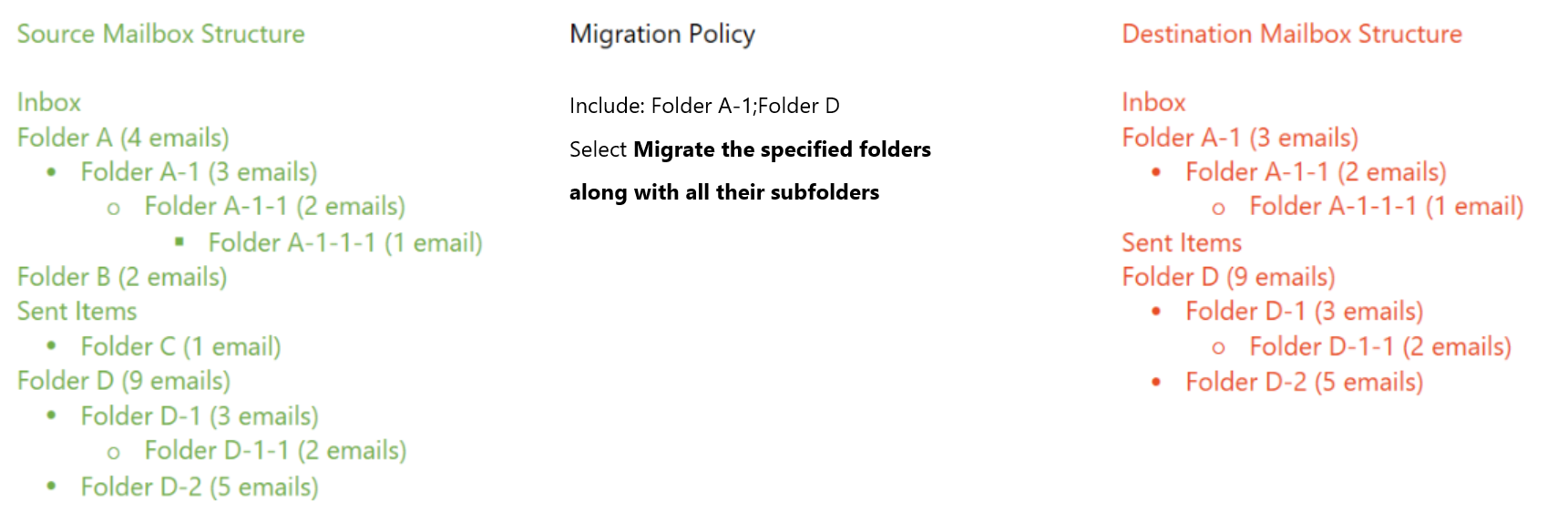
Include – Enter the folder names you want to migrate in the text box. Separate multiple folder names with a semicolon (;).You can select to migrate only the specified folders or include all their subfolders as well.
If the folders you specify are subfolders, they will be converted to root folders in the destination, and the folder structure will be preserved during migration. Source data will be migrated like the screenshot shown below.
-
Exclude – Enter the folder names you want to filter out in the migration in the text box. Separate multiple folder names with a semicolon (;).These folders, along with their subfolders and all contained items, will not be migrated.
-
-
Email time range – You can select the On or after and/or On or before checkboxes and select a sent time to only migrate items of email type in the specified time range. The item type depends on the folder where the item is stored. The type of meeting requests and items in the Recoverable Items folder are also email, and these items can be filtered by the Email time range filter.
-
-
In the Conflict resolution section, configure the conflict resolution when the source mailbox item conflicts with an existing one in the destination. Refer to the following detailed information on each conflict resolution.
NOTEThe conflict resolution cannot take effect in the destination Google group due to API limitations.
Resolution Conflict No Conflict Skip Ignore the conflicting item and do nothing in the destination. A new item will be created. Overwrite Delete the conflicting item in the destination first and overwrite it with the source content. A new item will be created. -
Click Next after you finish configuring the conflict resolutions.
-
In the Additional options & mappings step, you can configure the following settings for migrations.
-
Replace email addresses of senders/recipients based on user mappings – Select this checkbox if you want to replace the source email addresses of email senders/recipients with the destination ones. This option also applies to calendar events. To make this setting available in the migration, you must configure user mappings for the source email addresses.
-
Replace meeting links with the destination information – Select this checkbox if you want to update the source meeting links with the destination information. To replace meeting links successfully, user mappings must be configured for the event organizers.
-
Select how to manage sensitivity labels of emails – Select a method to define how to manage sensitivity labels applied on emails in the migration:
NOTEIf the source does not have the Microsoft Information Protection (MIP) service implemented or source emails do not have any sensitivity labels applied, select the first option for your migration to ensure a successful job.
-
No label in source, or migrate emails with source label to destination (if email has label encryption, it will be inaccessible in the destination) – Select this option if there is no sensitivity label applied on source emails, or you want to keep the source sensitivity labels of the emails to the destination.
After the migration, the migrated emails that have label encryption may not be accessed in the destination.
-
If a label exists, remove it during the migration (source label remains, it is removed from the email in the destination) – Select this option if you want to remove the source sensitivity labels from the emails.
After the migration, the migrated emails do not have any sensitivity labels and can be accessed in the destination.
-
-
Select how to manage the folders of source mailboxes – Select whether to migrate source mailbox folders as labels.
-
Migrate custom folders in the primary mailbox as labels – Custom folders in the primary mailbox will be migrated as labels in the destination.
-
Migrate folders in the archive mailbox as labels – Folders in the archive mailbox will be migrated as labels in the destination. Select one of the following migration options:
-
Create labels from the top level – Folders in the archive mailbox will become top-level labels in the destination. For example, if the source path is Archive mailbox > FolderA, FolderA will be added as a top-level label in the destination.
-
Nest under a specified label – Enter a label or label/sublabel, and the migrated folders will be nested under it in the destination. For example, if the source path is Archive mailbox > FolderA and the label you enter is LabelA, FolderA will be nested as LabelA > FolderA in the destination.
-
-
-
Select how to manage the folder structure – Select an option to migrate custom mailbox folders.
-
Migrate folders and subfolders as parent and nested labels – Items in the source subfolders will be added with a nested label based on the source folder structure. For example, Folder > FolderA, items in the FolderA will be added with a nested label, Folder/FolderA, in the destination.
-
Migrate folders and subfolders as separate labels – Items in the source subfolders will be added with multiple labels in the destination based on the source folder structure. For example, Folder > FolderA, items in the FolderA will be added with 2 labels, Folder and FolderA, in the destination.
NOTEIf the name of a source custom folder is the same as that of a system label in Gmail, a suffix (-migrated) will be added to the destination migrated label to avoid conflicts.
-
-
Additional labeling options – Configure the following additional labeling options for migrations:
-
Add an “Inbox” label to emails in the subfolders of the source built-in“Inbox” folder – With this checkbox selected, emails in the subfolders of the source Inbox folder will be migrated to the destination system Inbox label.
Emails in the subfolders of other source built-in folders (Sent Items, Drafts, Deleted Items, etc.) will be migrated to corresponding system labels in the destination and applied with a destination system label and a subfolder label corresponding to the source built-in folder.
-
Migrate categories as labels – Source categories will be migrated as labels in the destination.
Note the following:
-
Only categories applied to source emails will be migrated.
-
If the source category is a reserved label in Gmail, a suffix (-migrated) will be added to the destination migrated label to avoid conflicts.
-
-
Archive emails in the source built-in “Inbox” folder before a specified date –Select a date, and emails in the source “Inbox” folder that were received prior to the selected date will be archived during migration and apply a “Migrated email” label in the destination.
NOTEThis option does not support subfolder emails in “Inbox”.
-
Apply an additional label for all migrated emails – Enter a label or label/sublabel, and it will be applied to every migrated email in the destination.
-
-
User mapping – With user mapping, you can map a source user/group to a destination one. You can also map a domain in the source to a destination domain. Refer to Create User Mappings to view how to create a user mapping.
You can select a previously created user mapping from the drop-down list and click View details to view the detailed information of the selected user mapping. You can enter the keyword of a user mapping in the Search user mapping text box and press Enter on the keyboard to search the user mapping.
Property User Principal Name User Principal Name Prefix Display Name Email Address Email Address Prefix Property Example JohnSimon@onmicrosoft.comJohnSimon@ JohnSimon JohnSimon@onmicrosoft.comJohnSimon@ -
Customized features – In Exchange Online migrations, you can add an additional customized feature by entering the corresponding customized feature string. Click Add customized feature, and then enter a customized feature string to configure a customized feature. Refer to Customized Features for Exchange Online Migration for details.
-
-
Click Next after you finish configuring the options, mappings, and customized feature strings.
-
Configure the Notifications setting to send migration email notifications to specific recipients after the migration.
-
Send project level notifications (all mappings within a project) – The migration email notifications are based on the project level, which summarizes the project name and the mapping count of each migration status.
-
Recurrence – Enter a positive integer to define the recurrence days for the notifications.
-
Start date and time – Select a start date and time to send the first notification. The later notifications will be sent at the selected time based on the recurrence.
If you want to configure the end date and time of the notifications, you can select the Configure end date and time checkbox and select a date and time.
-
Send migration email notifications to – Define the recipients who will receive the notifications.
-
Email template – Create an email template for the notifications by clicking the Add button. Refer to Manage Email Settings for details on how to create an email template. You can also select an existing email template from the drop-down list.
-
-
Send individual mapping level notifications – The migration email notifications are based on the mapping level, which summarizes the migration status, the project name, the source and destination email addresses, the migration start and finish time, and the migration person.
-
Define the notification scope for mappings – Select For failed mappings only to send notifications for the failed mappings only, or select For all mappings to send notifications for all mappings.
-
Send migration email notifications to – Define the recipients who will receive the notifications.
-
Source end users – The source end users in the migration will receive the notifications.
-
Destination end users – The destination end users in the migration will receive the notifications.
-
Person running the migration – The person who runs the migration will receive the notifications.
-
Additional recipients – Enter the email addresses of other recipients. Separate multiple email addresses with a semicolon (;).
-
-
-
Email template – Create an email template for the email notifications by clicking the Add button. Refer to Manage Email Settings for details on how to create an email template. You can also select an existing email template from the drop-down list.
-
-
Click Save to save the migration policy.
On the Migration policies page, you can manage existing policies.
-
Set as default – Select a policy and click Set as default to set it as the default policy. The default policy will be automatically selected when you create projects.
-
Edit – Click the policy name link to edit the policy.
-
Delete – Select a policy and click Delete to delete it. You can also select multiple policies and click Delete to delete them.
-
Copy – This allows you to quickly create a new policy with similar configurations by completing the following steps:
-
Select your target policy, and click Make a copy.
You can also open your target policy, and click Make a copy on the Edit migration policy page.
-
Check the settings and make updates if necessary on the Copy migration policy page.
-
Click Save.
-
Create Sensitivity Label Mappings
Complete the following settings on the mapping page:
-
Enter a name and an optional description for the mapping.
-
Select the Auto map checkbox to automatically map the label based on the label name if the source label is not configured in label mappings.
-
In the Label mapping section, enter the display names of the source and destination sensitivity labels in the Source label and Destination label text boxes. If the source or destination sensitivity label is a sub label, enter the display name of the sensitivity label in the format of parent sensitivity label name*/*sensitivity label name.
Click Add to add additional sensitivity label mappings.
To delete sensitivity label mappings, select the corresponding checkboxes and click Delete.
-
Click Save to save the settings for this mapping.