
Home > Perform Google Drive Migrations > Create Migration Mappings
Download this articleCreate Migration Mappings
After creating a Google Drive migration project, create migration mappings to define the source and destination objects.
You have two accesses to create mappings for a project.
-
You can create mappings directly after creating the project using any of the following methods.
-
Add mappings
-
Import mappings
-
Auto map (Only available for Google Drive to OneDrive migrations)
-
-
You can also click Projects in the left pane to access the Projects page, and click the project name of the project for which you want to create mappings.
On the Project mappings page, click Create mapping to add mappings one by one or import mappings in bulk; or click the down arrow next to Create mapping, and then select Add/Import mapping or Auto map to create mappings. The Auto map method automatically maps source user drives and destination users’ OneDrive based on their login name prefixes.
NOTETo use the Auto map method, the source and destination connections must have a container selected.
Add mappings
To manually add mappings, refer to the following steps:
-
Click Add on the Add/Import mapping page.
-
Enter the source path in one of the following formats:
If multiple shared drives have the same name in the source, Fly will randomly select one to migrate.
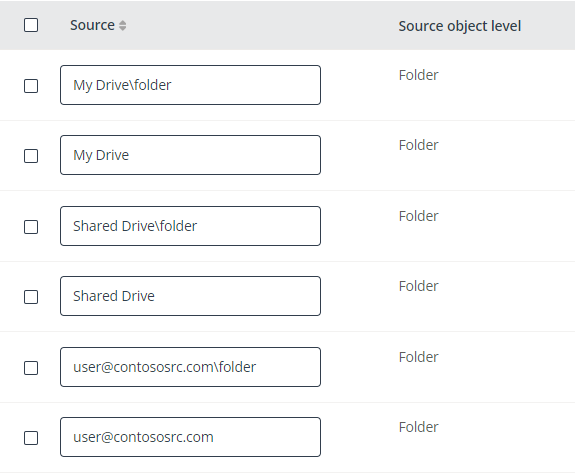
-
If you select a SharePoint Online connection as the destination, enter the full URL of a SharePoint folder or library as the destination, and select the corresponding destination object level from the drop-down list.
If you select a OneDrive connection as the destination, enter the user principal name of a destination OneDrive user in the format of
user@contosodest.comoruser@contosodest.com\folder, and select the corresponding destination object level from the drop-down list. Source data will be migrated to the My files document library and folders under the library. -
Select Merge or Attach as the migration method.
-
Click Save to save the new mapping.
Repeat the steps above to add additional mappings.
If there are mappings that already exist in another project, the Alert panel will appear. You can select to remove duplicate mappings from the current project, or move duplicate mappings found in other projects to the current project. Then, click Save to save the updates.
Import mappings
To import mappings in bulk by importing a configured Excel file, refer to the following steps:
-
Click Import on the Add/Import mapping page.
-
In the Import panel, you can download the template for mapping examples and configure mappings directly in the file; or you can click Export on the Add/Import mapping page to export a mapping file and modify it.
-
In the Excel file, configure the information of each mapping in one row, and save the file. You can refer to the table below for how to configure the mappings.

Column Value Source My Drive name; My Drive name\folder name; Google Drive user email address; Google Drive user email address\folder name; Shared Drive name; Shared Drive name\folder name; Shared Drive ID; Shared Drive ID\folder name Source object level Folder Destination SharePoint Online: The full URL of the destination folder or library; OneDrive: The user principal name of destination OneDrive user in the format of user@contosodest.comoruser@contosodest.com\folderDestination object level Folder / Library Method Merge / Attach -
After the configurations, import the mapping file by dragging the file or browsing the file from the local location. Click Save to save the mapping file to the project.
-
Click Save after you finish adding mappings to the project.
Auto map
If the destination connects to OneDrive, you can use the Auto map method to automatically map source user drives to destination OneDrive based on their login name prefixes. Make sure you have configured Scan Profiles in AvePoint Online Services.
Other Actions
You can also perform the following actions to manage migration mappings in the project.
-
Refresh stage status – Click Refresh to retrieve the stage’s latest status of the mappings.
-
Prioritize mapping job – Select desired in queue mappings under the Migration stage, click the More button, and click Prioritize mapping job to move the mappings to the front of the queue. Fly will prioritize running migration jobs for these mappings when resources are available.
-
Edit Mapping – Select a mapping, click the More button, and click Edit mapping to update the source, source type, destination, and destination type of the mapping.
NOTEIf a mapping contains successfully migrated data or is running, the mapping cannot be edited.
-
Clear mapping report – To clear the migration details of mappings, select the mappings, click the More button, and click Clear mapping report. Once finished, Source data scan report, Google Drive objects, Error statistics, and Migration errors on the View mapping report page of the selected mappings are cleared.
-
Move mappings – To move mappings from the current project to a different project, select the mappings, click the More button, and click Move mapping. Select a project and click Move in the Move mapping panel. You can enter the keyword of a project in the Search project text box and press Enter on the keyboard to search the project.
-
Generate migration report – When the migration jobs are finished, you can generate summary reports and detailed reports of objects for selected mappings. Refer to Generate Report for details.
-
Delete mappings – To delete mappings that are not needed, select the mappings, click the More button, and click Delete mapping.
-
Categorize with color – You can categorize your mappings with a desired color. What the applied color represents is left up entirely to your organization.
-
You can hover your mouse over a mapping and click the apply color button. Select a color in the Select a color window to apply to the mapping.

Apply color button.
-
You can also select one or multiple mappings, click the More button, and click Categorize with color. In the Select a color window, select a color and click Apply.
-
-
Export mapping – To export mappings in a project to an Excel file, select desired mappings, click the More button, and click Export mapping.
-
Manage columns – Click Column to select the columns you want to display on the page, and click Apply to apply the display conditions. The Source column cannot be deselected.
-
Filter mappings – Click Filter to filter mappings by desired conditions.
-
Create personal view – This allows you to create a personal view for the configuration of filters or displayed columns for convenience. Click the System view drop-down list behind Filter, and click Save as. In the Save as window, enter a name for your view. To make this view available only to you, enable the Make this a private view button to save it as a private view. To make it available to all accounts of your AOS tenant, leave the Make this a private view button disabled to save it as a public view.
After creation, either a private or public view can be set as default, renamed, or deleted. A private view can also be made public.
-
Search mappings – Search mappings by entering the keyword of the source/destination in the search box.