
Home > Perform Microsoft 365 Groups Migrations > Required Permissions for Microsoft 365 Groups Migration > Source Permissions When Destination is Google Groups
Download this articleSource Permissions When Destination is Google Groups
Fly App Profile Permissions
With the Tenant Owner or Service Administrator role, you can create a Fly app profile in AvePoint Online Services > Management > App management to connect to the Microsoft 365 tenant using the Fly app.
Refer to Fly App Profile Permissions about how to create a Fly app profile and the required permissions of the Fly app profile.
Custom App Profile Permissions
With the Tenant Owner and Service Administrator role, you can create a custom app profile in AvePoint Online Services > Management > App management to connect to the Microsoft 365 tenant using a custom Azure app.
Refer to the following procedures to create a custom app profile:
-
Prepare a certificate in Microsoft Entra ID. Refer to Prepare a Certificate for the Custom Azure App for more information.
You can ignore this step if you have a certificate.
-
Create a custom Azure app in Microsoft Entra ID. Refer to Create Custom Azure Applications for more information.
-
Create an App Profile for a Custom Azure App in AvePoint Online Services.
After you re-authorize the app profile, you need to wait about one hour before using the app profile for your migration to refresh the token if there are permissions updated.
Refer to the following tables to add API permissions required by Microsoft 365 Groups to Google Groups Migration to the custom Azure app.
| API | Permission | Type | Purpose |
|---|---|---|---|
| Microsoft Information Protection Sync Service | UnifiedPolicy.Tenant.Read (Read all unified policies of the tenant.) | Application | Only required if you want to manage the sensitivity labels of files/emails/Groups. |
| Microsoft Graph | Domain.Read.All | Application | Retrieve tenant domain. |
| Microsoft Graph | RoleManagement.Read.Directory | Application | Retrieve directory roles. |
| Microsoft Graph | Group.Read.All (Read all groups) | Application | Retrieve Microsoft 365 Groups and Group members. |
| Microsoft Graph | Group.ReadWrite.All (Read and write all groups) | Application | Only required if you use both the app profile and the service account in the source connection and the source service account is not the Group owner, to automatically ensure the service account as the Group owner. |
| Microsoft Graph | Sites.Read.All (Read items in all site collections) | Application | Retrieve files of team sites. |
| Microsoft Graph | User.Read.All (Read all users’ full profiles) | Application | Retrieve information of Microsoft 365 user profiles. |
| Microsoft Graph | InformationProtectionPolicy.Read.All (Read all published labels and label policies for an organization.) | Application | Only required if you want to manage the sensitivity labels of files/emails/Groups. |
| Microsoft Graph | Reports.Read.All (Read all usage reports) | Application | Only required by tenant discovery. |
| Microsoft Graph | ReportSettings.Read.All (Read all admin report settings) | Application | Retrieve the Reports setting of the Microsoft 365 admin center. |
| Azure Rights Management Services *Note: For 21Vianet tenants, the API name is Microsoft Rights Management Service. | Content.SuperUser (Read all protected content for this tenant) | Application | Only required if you want to manage the sensitivity labels of files/emails/Groups. |
| Office 365 Exchange Online | Full_access_as_app (Use Exchange Web Services with full access to all mailboxes) | Application | Retrieve items from all mailboxes. *Note: If you do not want to add this permission to the app, you can create an RBAC assignment for the app to only access to specified mailboxes. Refer to the option 3 in the How to Migrate Mailboxes without the ApplicationImpersonation Role? section for details. |
| SharePoint/Office 365 SharePoint Online | Sites.FullControl.All (Have full control of all site collections) | Application | Retrieve settings and permissions of team sites. |
For easy use, you can directly use the following commands to add required API permissions through Manifest for Microsoft 365 Commercial tenants.
Service Account Permissions
If you only use service account authentication for source Groups, the service account must meet the following requirements:
Users with Multi-Factor Authentication (MFA) enabled cannot be used as the service account to perform migrations. You can use a delegated app profile instead.
-
Licenses for Exchange Online
NOTETo assign the licenses to the service account, go to the Microsoft 365 admin center > Users > Active users, and select Exchange Online under the Licenses and apps tab of the service account.
-
Group owner of source Groups
You can manually add the service account as the group owner. For easy use, if you grant Groups Administrator or Global Administrator for the service account, Fly can automatically add the service account as the group owner.
After the migration, you can remove the service account from the group owner using PowerShell or block the service account directly. To remove the account, refer to Remove the Service Account for details. To block the account, go to Microsoft 365 Admin Center > Users and click the display name of the user. Click the Block this user icon, select Block the user from signing in, and save the changes.
-
If the service account is SharePoint Administrator or Global Administrator, during the full migration job, the service account will be automatically added as Site Collection Administrator of the team sites of source Groups. After the migration, you can remove the service account from the team sites.
-
Service account pool is no longer available in migrations. If you have used the service account pool for the source before, and you want to continue using the service account pool, you can select multiple service accounts when creating Groups connections, and make sure all selected service accounts meet the requirements mentioned above.
What permissions are required if I also use an app profile?
If you use both service account and app profile authentications for source Groups, the service account must meet the following requirements:
Users with Multi-Factor Authentication (MFA) enabled cannot be used as the service account to perform migrations. You can use a delegated app profile instead.
-
Licenses for Exchange Online
NOTETo assign the licenses to the service account, go to the Microsoft 365 admin center > Users > Active users, and select Exchange Online under the Licenses and apps tab of the service account.
-
Group owner of source Groups.
You can manually add the service account as the group owner. For easy use, if you provide both a service account and app profile using the default Fly app or custom app with required permissions, Fly can automatically add the service account as the group owner.
After the migration, you can block the service account directly. To block the account, go to Microsoft 365 Admin Center > Users and click the display name of the user. Click the Block this user icon, select Block the user from signing in, and save the changes.
-
During the full migration job, the service account will be automatically added as Site Collection Administrator of the team sites of source Groups. After the migration, you can remove the service account from the team sites.
-
Service account pool is no longer available in migrations. If you have used the service account pool for the source before, and you want to continue using the service account pool, you can select multiple service accounts when creating Groups connections, and make sure all selected service accounts meet the requirements mentioned above.
Delegated App Profile Permissions
Fly allows you to use the Fly delegated app profile or custom delegated app profile to connect to your workspace.
The license and permission requirements for the consent user are the same as those for the service account. For details, refer to Service Account Permissions.
If the consent user of the delegated app profile has Multi-Factor Authentication (MFA) enabled, you must authorize or re-authorize the delegated app profile after MFA is enabled. Otherwise, the migration jobs using the delegated app profile will fail.
If you re-authorize the app profile, you need to wait about one hour before using the app profile for your migration to refresh the token when there are permissions updated.
To use the Fly delegated app profile with required permissions, refer to Fly Delegated App Profile Permissions.
To use a custom delegated app profile with required permissions, refer to the following steps:
-
After registering an app in Microsoft Entra ID, add the permissions in the table below to the app.
API Permission Type Purpose Microsoft Information Protection Sync Service UnifiedPolicy.User.Read Delegated Only required if you want to manage the sensitivity labels of files/emails/Groups. Microsoft Graph Domain.Read.All Delegated Retrieve tenant domain. Microsoft Graph RoleManagement.Read.Directory Delegated Retrieve directory roles. Microsoft Graph Group.Read.All Delegated Retrieve Microsoft 365 Groups and group members. Microsoft Graph Group.ReadWrite.All Delegated Required if you only use the delegated app profile and the consent user is not the group owner of source Groups. Meanwhile, the consent user must have the Groups Administrator role. This can automatically add the consent user as the group owner.
If the consent user is already the group owner, you can change this permission to Group.Read.All.Microsoft Graph Sites.Read.All Delegated Retrieve files of team sites. Microsoft Graph User.Read.All Delegated Retrieve information of Microsoft 365 user profiles. Azure Rights Management Services
*Note: For 21Vianet tenants, the API name is Microsoft Rights Management Services.user_impersonation Delegated Only required if you want to manage the sensitivity labels of files/emails/Groups. Office 365 Exchange Online EWS.AccessAsUser.All Delegated Use Exchange Web Services with full access to user data via impersonation. SharePoint/Office 365 SharePoint Online AllSites.FullControl Delegated Retrieve settings and permissions of team sites. For easy use, you can directly use the following commands to add required API permissions through Manifest for Microsoft 365 Commercial tenants.
-
Click Authentication in the left navigation of the app.
-
Click Add a platform.
-
Select Web in the Configure platforms panel.
-
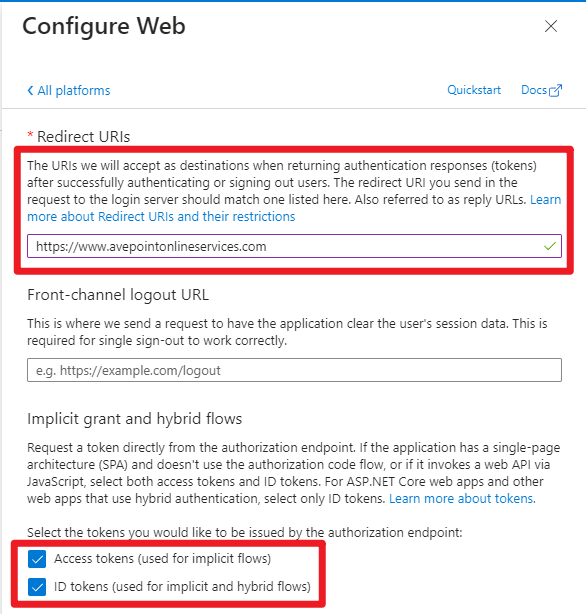
In the Configure Web panel, enter the AvePoint Online Services URL:
https://www.avepointonlineservices.comfor your commercial environment orhttps://usgov.avepointonlineservices.comfor your U.S. Government environment in the Redirect URIs field. -
Select the Access tokens and ID tokens checkboxes in the Implicit grant and hybrid flows field.
-
Click Configure.
-
Click Save.
-
Create an app profile for the app using the Custom mode in AvePoint Online Services by referring to Consent to a Custom Azure App with Delegated Permissions.
NOTEWhen consenting to the app, if you have granted the admin consent and allowed public client flows for the permissions, you can choose to use the Global Administrator consent or the User consent method. If not, you can only use the Global Administrator consent method.