
Home > Workspace Management > Optimization Profile Management
Download this articleOptimization Profile Management
On the Optimization profiles page, existing profiles are listed in the Discovery profile and Archive profile tabs separately.
The following actions are available for both types of profiles:
-
Create – To create a new profile, click Create under each tab, and then complete the settings to create the profile.
-
Duplicate – To create a new profile based on an existing profile, select the profile in the table and click Duplicate. In the Duplicate discovery profile or Duplicate archive profile window, enter the name and optional description for the new profile, and then click Save. The new profile will have the same settings as the existing profile. You can then edit the new profile to make changes without affecting the existing profile.
-
Edit – To edit settings of a profile, you can click the profile name to access the profile details page and edit settings as needed. The changes will affect all tenants where this profile is used and will take effect in the next discovery or archive.
-
Delete – To delete existing profiles, select the profiles in the table and click Delete.
NOTEA profile cannot be deleted if it is being used in a tenant. Built-in profiles cannot be deleted.
Discovery Profile
In the Discovery profile tab, you can view the profile name, description, last modified time, and the user who last modified the profile.
Create a Discovery Profile
In the Discovery profile tab, click Create to access the Create discovery profile page.
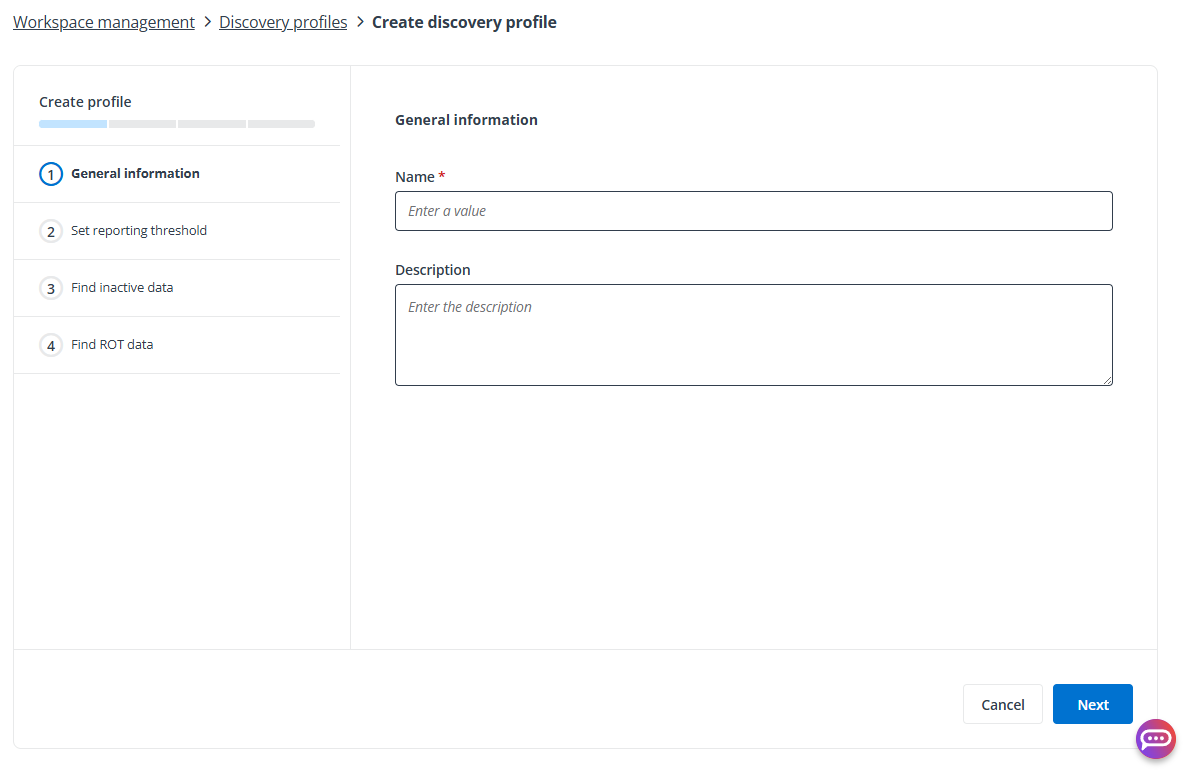
Complete the following settings to create the discovery profile.
-
In the General information step, enter a name and optional description for the profile, and click Next.
-
In the Set reporting threshold step, predefined filters based on file size and modified time are displayed. You can customize these filters to meet your special requirements.
-
Click Next to go to the next step.
-
In the Find inactive data step, create rules to find inactive data in the scope that you defined above:
-
Select a time range to mark data as inactive if last modified before the configured time range.
-
Turn on the toggle to analyze the data size of inactive versions.
-
There are built-in rules for you to select.
-
To add a rule, click Add rule. In the Add rule window, enter the name and description, configure rule criteria, and then click Add.
-
Select the rules that you want to use to find inactive data.
-
-
Click Next to go to the next step.
-
In the Find ROT data step, configure rules to find redundant, obsolete, and/or trivial data in the scope that you defined above:
-
Turn on the toggle to analyze the data size of ROT data.
-
There are built-in rules for you to select. You can also delete the built-in rules or modify the rule criteria based on your needs.
NOTEThe file types docx, dotx, xlsx, xltx, pptx, and potx have been removed from the Legacy Office files rule.
-
To add a rule, click Add rule under an ROT category. Enter the rule name and description, configure rule criteria, and then click Add to add the rule. Refer to the table below for detailed rule criteria.
-
Select the rules that you want to use to find ROT data.
-
-
Click Create to create the discovery profile.
Rule Criteria for Inactive Data
The following table lists the rule criteria that you can use when adding rules to find inactive data.
| Criterion | Condition | Description |
|---|---|---|
| Keep the latest version *Note: Current version, current approved version, and published major version are not collected. | Major and minor versions | Collect all previous versions, excluding the defined number of major and minor versions. |
| Keep the latest version *Note: Current version, current approved version, and published major version are not collected. | Major versions only | Collect all previous versions, excluding the defined number of major versions. |
| Keep the latest version *Note: Current version, current approved version, and published major version are not collected. | Minor versions of each major (with all major versions) | Collect all previous versions, excluding the defined number of minor versions in each major version. |
| Keep the latest version *Note: Current version, current approved version, and published major version are not collected. | Minor versions of the latest major (with all major versions) | Collect all previous versions, excluding the defined number of minor versions in the latest major version. |
| Modified time | Before | Collect versions whose last modified time is before the configured time. |
| Modified time | Older than | Collect versions whose last modified time exceeds the configured time range. |
| Type | In | Collect versions whose type is one of the configured file types. |
| Type | Not in | Collect versions whose type is not any of the configured file types. |
| Type | Empty | Collect versions whose type is empty. |
| Size | >= | Collect versions whose size is not smaller than the configured size. |
| Size | <= | Collect versions whose size is not larger than the configured size. |
Rule Criteria for ROT Data
The following table lists the rule criteria that you can use when adding rules to find ROT data.
| Data Type | Criterion | Condition | Description |
|---|---|---|---|
| File | Name *Note: The wildcard * is supported here. | Matches | Collect files whose name matches the entered value. |
| File | Name *Note: The wildcard * is supported here. | Does not match | Collect files whose name does not match the entered value. |
| File | Parent folder name (including subfolders) *Note: The wildcard * is supported here. | Matches | Collect files whose parent folder name matches the entered value. |
| File | Parent folder name (including subfolders) *Note: The wildcard * is supported here. | Does not match | Collect files whose parent folder name does not match the entered value. |
| File | Created time | Before | Collect files whose created time is before the configured time. |
| File | Created time | Older than | Collect files whose created time exceeds the configured time range. |
| File | Modified time | Before | Collect files whose last modified time is before the configured time. |
| File | Modified time | Older than | Collect files whose last modified time exceeds the configured time range. |
| File | Type | In | Collect files whose type is one of the configured file types. |
| File | Type | Not in | Collect files whose type is not any of the configured file types. |
| File | Type | Empty | Collect files whose type is empty. |
| File | Size | >= | Collect files whose size is not smaller than the configured size. |
| File | Size | <= | Collect files whose size is not larger than the configured size. |
| Version | Keep the latest version *Note: Current version, current approved version, and published major version are not collected. | Major and minor versions | Collect all previous versions, excluding the defined number of major and minor versions. |
| Version | Keep the latest version *Note: Current version, current approved version, and published major version are not collected. | Major versions only | Collect all previous versions, excluding the defined number of major versions. |
| Version | Keep the latest version *Note: Current version, current approved version, and published major version are not collected. | Minor versions of each major (with all major versions) | Collect all previous versions, excluding the defined number of minor versions in each major version. |
| Version | Keep the latest version *Note: Current version, current approved version, and published major version are not collected. | Minor versions of the latest major (with all major versions) | Collect all previous versions, excluding the defined number of minor versions in the latest major version. |
| Version | Modified time | Before | Collect versions whose last modified time is before the configured time. |
| Version | Modified time | Older than | Collect versions whose last modified time exceeds the configured time range. |
| Version | Type | In | Collect versions whose type is one of the configured file types. |
| Version | Type | Not in | Collect versions whose type is not any of the configured file types. |
| Version | Type | Empty | Collect versions whose type is empty. |
| Version | Size | >= | Collect versions whose size is not smaller than the configured size. |
| Version | Size | <= | Collect versions whose size is not larger than the configured size. |
| Duplicate files | Duplicate | In | Files in the same content source with the same name including file extension and size are seen as duplicate files. |
Archive Profile
In the Archive profile tab, you can view the profile name, description, object level, and the modified time and the user who modified the profile.
Create an Archive Profile
In the Archive profile tab, click Create to access the Create archive profile page.
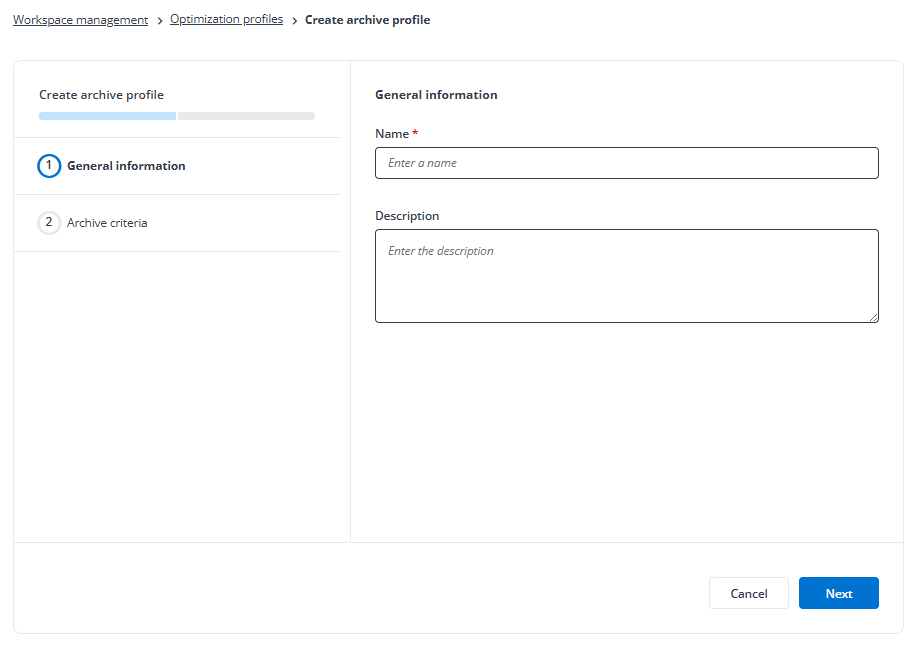
Complete the following settings to create the archive profile.
-
In the General information step, enter a name and optional description for the profile, and click Next.
-
In the Archive criteria step, click Add rule. The Add rule window appears.
-
Enter the rule name and description.
-
Select an object level for the rule, Document or Document version. The available criteria vary based on the selected object level.
-
Configure rule criteria.
-
Click the + button to add a criterion.
-
Multiple criteria can be added in a rule. By default, the relationship between multiple criteria in a rule is And, which means that data must meet all the criteria to be collected by the rule. To change the relationship between criteria to OR, click Or between criteria.
-
Click the remove button to the right of a criterion to remove the criterion from the rule.
-
-
Select the action for the rule, Archive and destroy files or Destroy files.
If you select Archive and destroy files, you can choose whether to leave a stub in place for the archived files.
-
Select HTML or TXT as the stub type, and you can customize and preview the message displayed for end users when they access the stub.
-
Alternatively, select Restore link to provide a link for end users to restore the archived files.
-
-
Click Add to add the rule.
-
-
You can add multiple rules in the archive profile. After adding rules, click Create to create the archive profile.
Rule Criteria for Document
The following table lists the rule criteria that you can use when adding rules to archive documents.
Note the following:
-
It is not case-sensitive when entering the Name value.
-
Wildcards such as * and ? are available when using the Matches and Does not match conditions.
| Criterion | Description | Condition |
|---|---|---|
| Name | Manages documents whose name meets the configured condition. | Contains |
| Name | Manages documents whose name meets the configured condition. | Does not contain |
| Name | Manages documents whose name meets the configured condition. | Matches |
| Name | Manages documents whose name meets the configured condition. | Does not match |
| Name | Manages documents whose name meets the configured condition. | Equals |
| Name | Manages documents whose name meets the configured condition. | Does not equal |
| Document size | Manages documents whose size meets the configured condition. | >= |
| Document size | Manages documents whose size meets the configured condition. | <= |
| Modified time | Manages documents whose modified time meets the configured condition. | From - To |
| Modified time | Manages documents whose modified time meets the configured condition. | Before |
| Modified time | Manages documents whose modified time meets the configured condition. | Older than |
| Created time | Manages documents whose created time meets the configured condition. | From - To |
| Created time | Manages documents whose created time meets the configured condition. | Before |
| Created time | Manages documents whose created time meets the configured condition. | Older than |
| Created by | Manages documents whose creator’s name meets the configured condition. | Contains |
| Created by | Manages documents whose creator’s name meets the configured condition. | Equals |
| Modified by | Manages documents whose modifier’s name meets the configured condition. Note that the username has two different forms: Log on Name (Domain\Username) and Displayed Name. | Contains |
| Modified by | Manages documents whose modifier’s name meets the configured condition. Note that the username has two different forms: Log on Name (Domain\Username) and Displayed Name. | Equals |
Rule Criteria for Document Version
The following table lists the rule criteria that you can use when adding rules to archive document versions.
Note the following:
- It is not case-sensitive when entering the Name/Title value.
- Wildcards such as * and ? are available when using the Matches and Does not match conditions.
| Criterion | Description | Condition |
|---|---|---|
| Name | Manages document versions whose name meets the configured condition. | Contains |
| Name | Manages document versions whose name meets the configured condition. | Does not contain |
| Name | Manages document versions whose name meets the configured condition. | Matches |
| Name | Manages document versions whose name meets the configured condition. | Does not match |
| Name | Manages document versions whose name meets the configured condition. | Equals |
| Name | Manages document versions whose name meets the configured condition. | Does not equal |
| Title | Manages document versions whose title meets the configured condition. | Contains |
| Title | Manages document versions whose title meets the configured condition. | Does not contain |
| Title | Manages document versions whose title meets the configured condition. | Matches |
| Title | Manages document versions whose title meets the configured condition. | Does not match |
| Title | Manages document versions whose title meets the configured condition. | Equals |
| Title | Manages document versions whose title meets the configured condition. | Does not equal |
| Document size | Manages document versions whose document size meets the configured condition. | >= |
| Document size | Manages document versions whose document size meets the configured condition. | <= |
| Document modified time | Manages document versions whose document modified time meets the configured condition. | From - To |
| Document modified time | Manages document versions whose document modified time meets the configured condition. | Before |
| Document modified time | Manages document versions whose document modified time meets the configured condition. | Older than |
| Version modified time | Manages document versions whose version modified time meets the configured condition. | From - To |
| Version modified time | Manages document versions whose version modified time meets the configured condition. | Before |
| Version modified time | Manages document versions whose version modified time meets the configured condition. | Older than |
| Modified by | Manages document versions whose modifier’s name meets the configured condition. | Contains |
| Modified by | Manages document versions whose modifier’s name meets the configured condition. | Equals |
| Keep the latest version | Keeps the number of the document versions you set. | Major and minor versions |
| Keep the latest version | Keeps the number of the document versions you set. | Major versions only |
| Keep the latest version | Keeps the number of the document versions you set. | Minor versions of each major (with all major versions) |
| Keep the latest version | Keeps the number of the document versions you set. | Minor versions of the latest major (with all major versions) |