
Home > Manage the Backup Scopes for Google Cloud Storage > Create a New Backup Scope for Google Cloud Storage
Download this articleCreate a New Backup Scope for Google Cloud Storage
The Google Cloud Storage service supports two modes for backup scope configuration:
-
SaaS infrastructure mode - Provides centralized management, automation, and robust data protection to empower organizations with scalable, policy-driven backup solutions. For details, refer to Use the SaaS Infrastructure Mode.
-
CAP Gateway mode - Reduces network latency while enhancing backup performance. Create a CAP Gateway and use this mode for your backup operations. For details, refer to Use the CAP Gateway Mode and Manage CAP Gateways.
For details on choosing a backup mode, you can see How to choose a backup mode: SaaS infrastructure mode VS CAP Gateway mode in the Best Practices section.
Use the SaaS Infrastructure Mode
To create a new backup scope, follow the steps below:
-
Go to the Backup page on the new UI.
-
Click on the Google Cloud Storage service tile or click the More actions button on the upper-right corner of the Google Cloud Storage service tile and click Configure backup scope from the drop-down list.
-
In the Configure backup scope for Google Cloud Storage page, all the existing backup scopes for Google Cloud Storage are listed in the table. You can use the search box to search for the backup scopes by name and manage the columns to adjust the view of the backup scopes.
NOTEYou can click the Refresh button in the upper-right corner of this page to retrieve the latest data list Google Cloud Storage. The Last refreshed time is displayed next to the Refresh button. Additionally, the data list will be automatically refreshed daily at 00:00 local time.
-
Click the Create button.
-
In the Choose a mode for Google Cloud Storage page, select SaaS infrastructure mode.
-
Then, choose a method. You can choose to manually select the buckets that you want to add to the backup scope, or you can configure a dynamic scope to use attribute-based rules to include the buckets that meet your conditions to the backup.
-
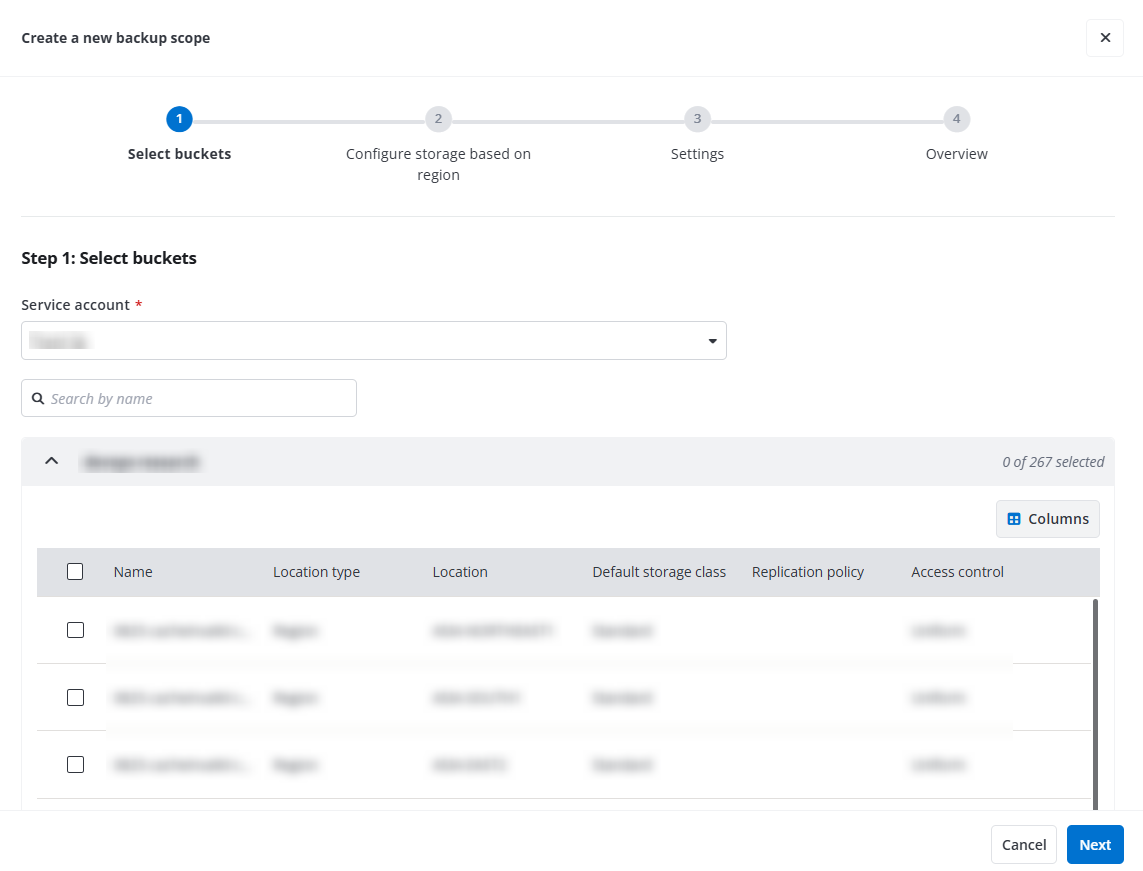
Manually Select - In the Select buckets step, select the service account and select the buckets that you want to add to the backup scope.
You can use the Search box to search for the buckets via the keywords.
The buckets are grouped by projects. Selecting the checkbox in the column header will select all the buckets on the current page. You can turn to the next page and select more buckets. Your selection will be kept, and the number of your selection will be displayed next to the tenant's name.
-
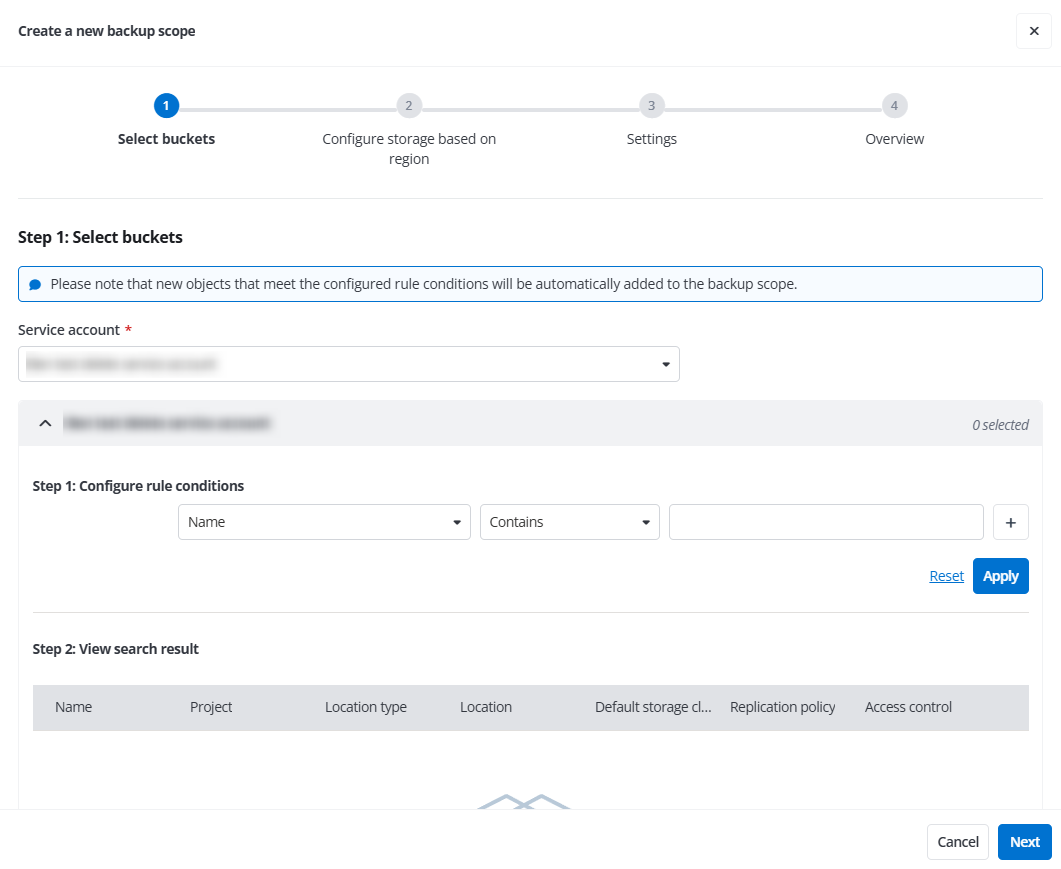
Dynamic rules - In the Select buckets step, define the rule conditions for the buckets that you want to include in this backup scope. You can add multiple rules to filter the name, location, or project of the buckets. Click Apply when you complete the rule configuration, and then the buckets that meet your rules will be displayed in the table and included for backup. The dynamic scope will automatically add or remove the buckets according to your rules. The new buckets that meet the configured rule conditions will also be automatically added to the backup scope.
-
-
Click Next and you will go to the Configure storage based on region step to configure a storage profile for each region. You can select a storage type and then select storage profiles. You can use an existing storage profile or create a new storage profile to store the backup data for the databases in the same region. For details on configuring storage location, refer to Manage Your Storage.
-
After you finish the storage configuration for each region, click Next to configure the scope information, schedule, and data retention settings. Refer to the following:
-
Scope information - Enter a name and description for the scope you are creating. The description is optional.
-
Schedule - Select days, weeks, months, or years as the unit of time for the backup interval, enter a number in the text box after Every, and then configure the start time for your first backup job.
-
Notification - Check the notification profiles which will be applied to the backup scope.
-
Retention policy - Configure the retention period to keep the backup data in the storage. Configure when to prune the backup data from the storage location. Note that if you are using AvePoint storage, the retention policy for backup data is subject to your agreement and you can configure a custom retention period up to the retention policy in your subscription. If you are using AvePoint default storage with unlimited retention period, the Unlimited option is selected automatically in the list. If you want to use a custom retention period, select Custom from the list, enter a number in the text box and select weeks, months, or years from the drop-down list. The retention period cannot be less than 2 weeks. Note that if you have a retention policy with a fixed year in your subscription, the maximum retention period that you can configure will be displayed under this field.
NOTEWhen you configure the retention period for backup data using the Year unit, the Configure Full Backup Frequency section will appear. You can then select a number from the drop-down list to set the full backup frequency. If the retention period is set to more than three months using the Month or Week unit, the full backup frequency will automatically be set to three months and cannot be changed. For retention periods of less than three months, the full backup frequency will be adjusted accordingly and cannot be modified.
-
-
Click Next to review your settings.
-
Click Save to save this backup scope. The backup for the buckets in this backup scope will roll out as scheduled. For more details about monitoring the backups, refer to Monitor Your Backup.
Use the CAP Gateway Mode
To create a new backup scope, follow the steps below:
-
Go to the Backup page on the new UI.
-
Click on the Google Cloud Storage service tile or click the More actions button on the upper-right corner of the Google Cloud Storage service tile and click Configure backup scope from the drop-down list.
-
In the Configure backup scope for Google Cloud Storage page, all the existing backup scopes for Google Cloud Storage are listed in the table. You can use the search box to search for the backup scopes by name and manage the columns to adjust the view of the backup scopes.
NOTEYou can click the Refresh button in the upper-right corner of this page to retrieve the latest data list for Google Cloud Storage. The Last refreshed time is displayed next to the Refresh button. Additionally, the data list will be automatically refreshed daily at 00:00 local time.
-
Click the Create button.
-
In the Choose a mode forGoogle Cloud Storage page, select CAP Gateway mode and click Continue. The Create a new backup scope panel appears.
-
In the Select buckets step, select the service account and select the buckets that you want to add to the backup scope. You can use the Search box to search for the buckets via the keywords in the name. The number of your selection will be displayed on the row of the project name.
-
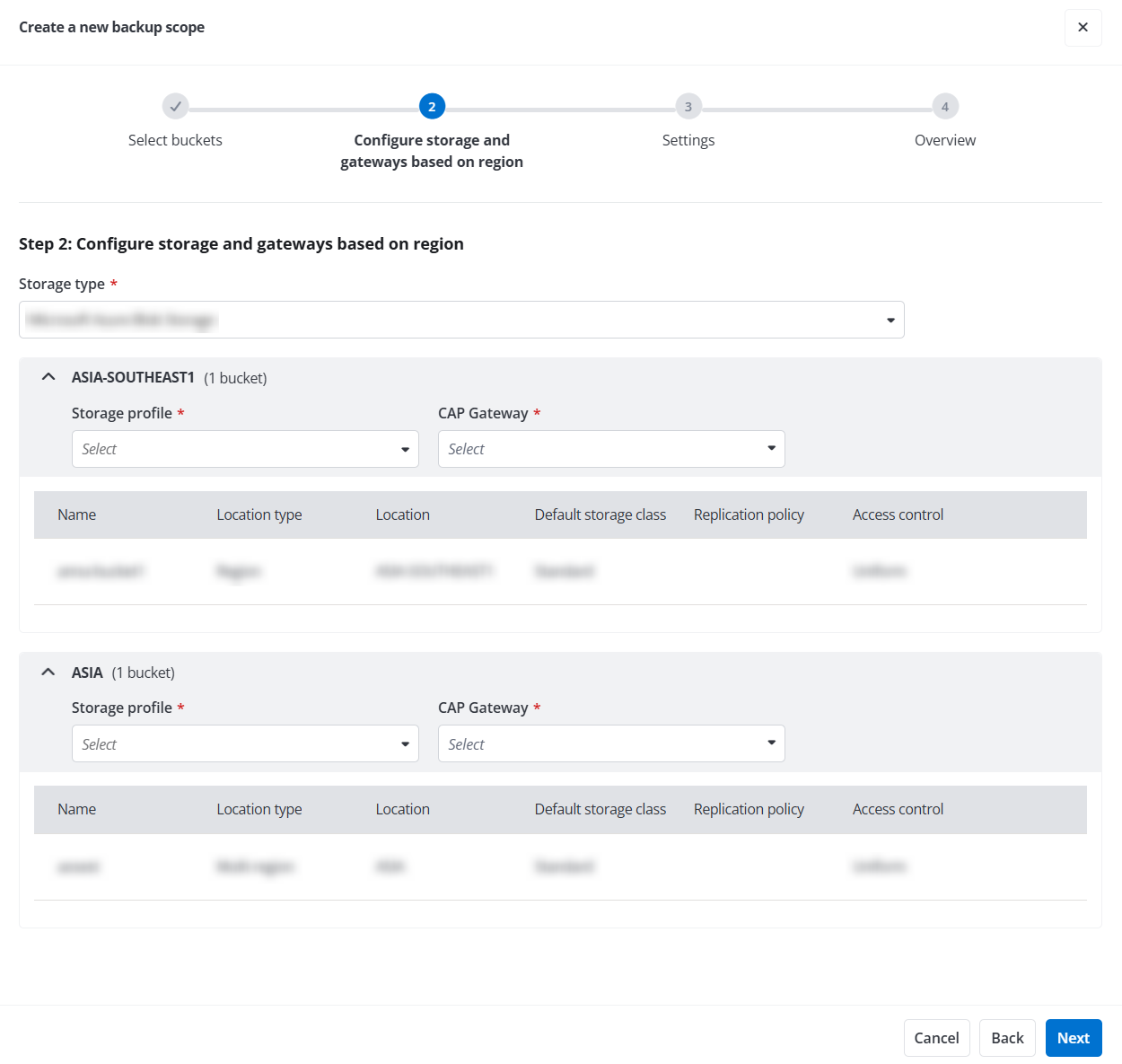
Click Next and you will go to the Configure storage based on region step to configure a storage profile and CAP Gateway for each region. You can select a storage type and then select storage profiles.
-
You can use an existing storage profile or create a new storage profile to store the backup data for the databases in the same region. For details on configuring storage location, refer to Manage Your Storage.
-
For details on configuring CAP gateways, refer to Manage CAP Gateways.
-
-
After you finish the storage configuration for each region, click Next to configure the scope information, schedule, and data retention settings. Refer to the following:
-
Scope information - Enter a name and description for the scope you are creating. The description is optional.
-
Schedule - Select days, weeks, months, or years as the unit of time for the backup interval, enter a number in the text box after Every, and then configure the start time for your first backup job.
NOTEThe days option is only available if you use your own storage to store backup data.
-
Notification - Check the notification profiles which will be applied to the backup scope.
-
Retention policy - Configure the retention period to keep the backup data in the storage. Configure when to prune the backup data from the storage location. Note that if you are using AvePoint storage, the retention policy for backup data is subject to your agreement and you can configure a custom retention period up to the retention policy in your subscription. If you are using AvePoint default storage with unlimited retention period, the Unlimited option is selected automatically in the list. If you want to use a custom retention period, select Custom from the list, enter a number in the text box and select weeks, months, or years from the drop-down list. The retention period cannot be less than 2 weeks. Note that if you have a retention policy with a fixed year in your subscription, the maximum retention period that you can configure will be displayed under this field.
NOTEWhen you configure the retention period for backup data using the Year unit, the Configure Full Backup Frequency section will appear. You can then select a number from the drop-down list to set the full backup frequency. If the retention period is set to more than three months using the Month or Week unit, the full backup frequency will automatically be set to three months and cannot be changed. For retention periods of less than three months, the full backup frequency will be adjusted accordingly and cannot be modified.
-
-
Click Next to review your settings.
-
Click Save to save this backup scope. The backup for the buckets in this backup scope will roll out as scheduled. For more details about monitoring the backups, refer to Monitor Your Backup