
Home > Restore and Recover Your Data > Restore Azure PostgreSQL Databases
Download this articleRestore Azure PostgreSQL Databases
Azure PostgreSQL service protects Azure database for PostgreSQL flexible servers.
To restore servers, follow the steps below:
-
Go to the Restore page and click the Azure PostgreSQL tile.
-
In the Restore wizard, the calendar displays the data recovery points of Azure PostgreSQL by default. You choose whether to display the jobs finished with exceptions in the calendar by selecting the Include jobs with only partial backup data option.
-
Hover over the data recovery point to view the job details, including the job status, job start time, scope name, scope ID, job ID, backup size, and the number of objects in a backup.
-
Click the data recovery point that you want to use in the calendar. The objects backed up in the selected backup job are displayed in the table.
-
You can use the Subscription filter, the Resource group filter, and the Region filter to find the specific server or use the Search box to search for servers via keywords in the name.
-
Find the servers that you want to restore or click the server name to browse down to the databases.
-
Select the database that you want to restore and click Restore.
-
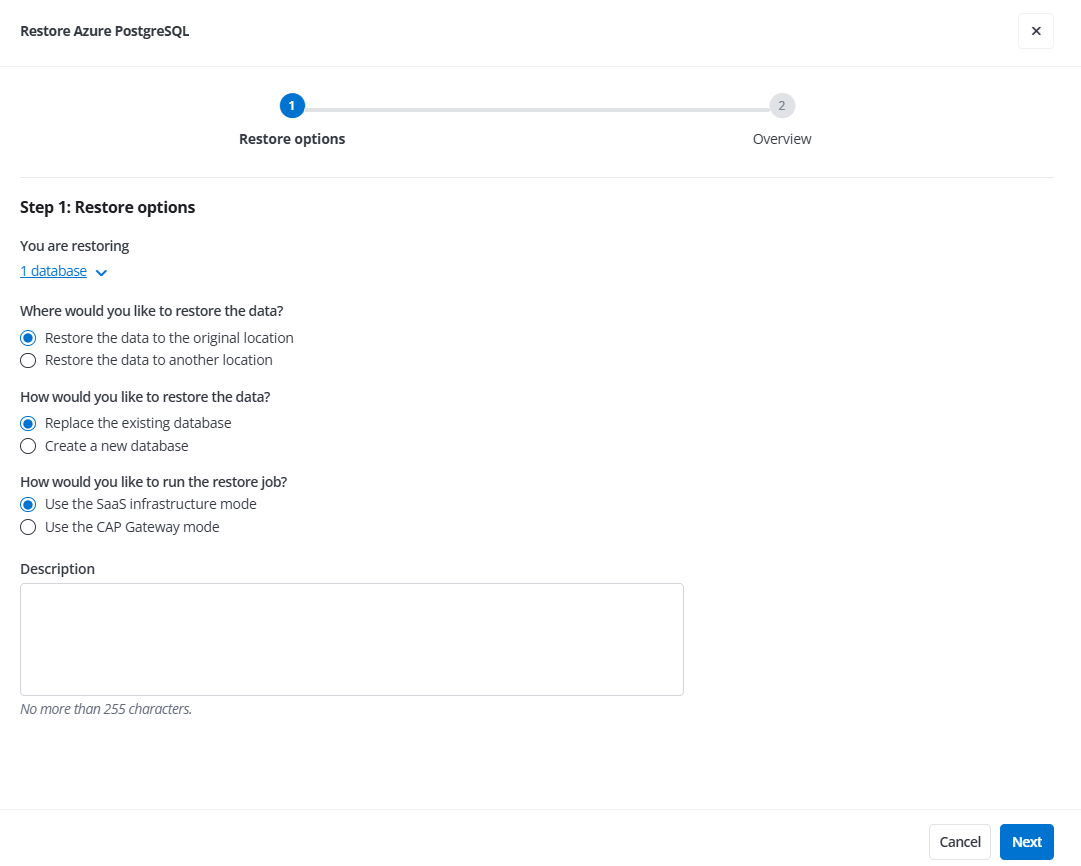
In the Restore options step, select where you would like to restore the database data and how would you like to restore the data, choose a mode you want to use to run the restore job, and provide an optional description for further reference.
-
Where would you like to restore the data? - You can choose to restore the data to the original location or to a new location.
-
Restore the data to the original location - To restore the data to its original location, you must note that the database in the original location will be overwritten, and the database will be stopped (deallocated) if it is running.
-
Restore the data to another location - Complete the following settings in the Destination step to configure destination location settings for the database being restored.
-
Subscription - Select a destination subscription for the database being restored. You can choose to restore this database to the same subscription when it is being backed up or select a new subscription.
NOTEIf your subscription is added to your tenant after the initialization of Cloud Backup for IaaS + PaaS, you must follow the steps in Add to Subscriptions and Assign the Contributor Role to add the consent user of the AvePoint Online Services - Delegated App to your subscription and grant this user the Contributor role at the same time.
-
Resource group - Select a resource group for the destination database.
-
Region - Select a region for the destination database.
-
Server - Select a server for the destination database.
-
-
-
How would you like to restore the data - You can choose to replace the existing database or create a new database. If you choose to create a new database, you need to provide a new database name in the Destination step.
- How would you like to run the restore job - You can choose to run the restore job using the SaaS infrastructure mode or the CAP Gateway mode. If you choose to use the CAP Gateway mode, select a gateway from the drop-down list.
-
-
Click Next to continue.
-
Review the restore settings in the Overview step and click Restore to run the restore job.