
Home > Manage the Backup Scopes for SQL Server > Create a New Backup Scope for SQL Server
Download this articleCreate a New Backup Scope for SQL Server
-
Go to the Backup page on the new UI.
-
Click on the SQL Server service tile or click the More actions button on the upper-right corner of the SQL Server service tile and click Configure backup scope from the drop-down list.
-
In the Configure backup scope for SQL Server page, all the existing backup scopes for SQL Server are listed in the table. You can use the search box to search for the backup scopes by name and manage the columns to adjust the view of the backup scopes.
-
Click the Create button. The Create a new backup scope panel appears.
-
In the Define scope step, select a SQL Server type.
-
Managed - Select your tenant, SQL VM/Server, and CAP Gateway.
-
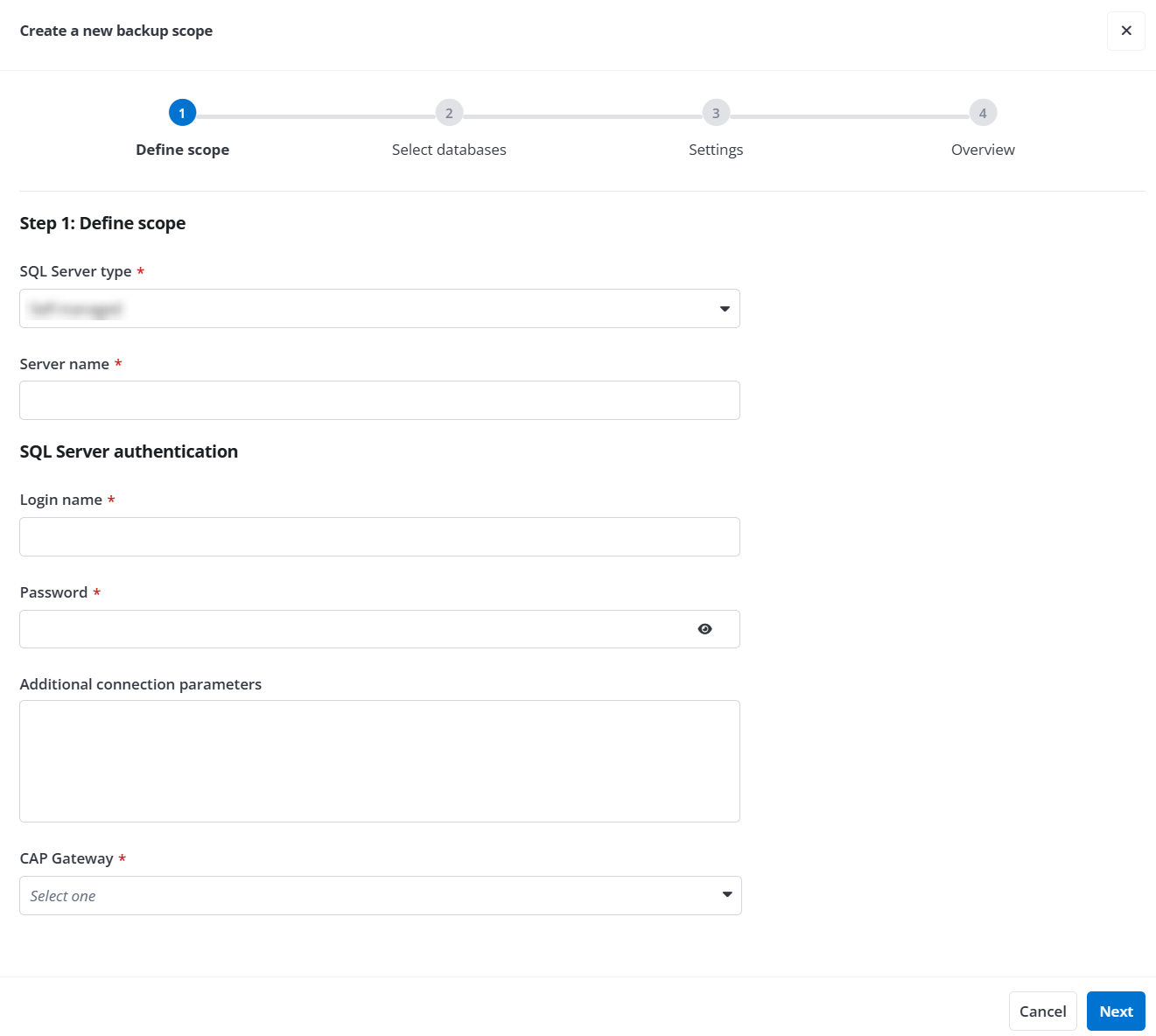
Self-managed - Enter your server name, complete the SQL Server authentication, define additional connection parameters and select a CAP Gateway. Refer to the following:
-
Server name - Enter your SQL Server name.
-
SQL Server authentication - Enter your login name and password to complete the authentication process.
-
Additional connection parameters - Enter the connection parameters if needed.
-
CAP Gateway - Select a CAP Gateway.
-
-
-
Click Next.
-
In the Select databases step, select an instance from the drop-down list and then select the databases that you want to add to this backup scope.
-
Selecting the checkbox in the column header will select all the databases on the current page. You can turn to the next page and select more databases. Your selection will be kept, and the number of your selection will be displayed next to the instance-s name.
-
In the Settings step, complete the following settings:
-
Scope information - Enter a name and description for the scope you are creating. The description is optional.
-
Storage profile - The storage profile configuration depends on the SQL Server type.
-
Managed SQL Server- The storage profile is automatically set to default storage and cannot be changed.
-
Self-managed SQL Server- You can select a storage profile from the drop-down list to use or click the + Create a storage profile link next to the list to create a new storage profile for this backup scope. For details on configuring storage profiles, refer to Manage Your Storage.
-
-
Schedule - Click hours, days, weeks, or months as the unit of time for the backup interval, enter a number in the text box after Every, and then configure the start time for your first backup job. By default, the backup job will run once a day. Backing up SQL Server databases at the same time may cause traffic jams. You are recommended to configure backup schedules for different backup scopes at different times of the day and make sure the times do not overlap.
-
Notification - Check the notification profiles which will be applied to the backup scope.
-
Retention policy - Configure the retention period to keep the backup data in the storage.
-
Hourly recovery point - Enter a number in the text box and select days or weeks from the drop-down list. The retention period must be between 7 and 28 days.
-
Weekly recovery point - Enter a number in the text box and select weeks or months from the drop-down list. The retention period must be between 2 and 12 weeks.
-
Monthly recovery point - Enter a number in the text box. The retention period must be between 1 and 12 months.
-
Yearly recovery point - If you are using AvePoint default storage with unlimited retention period, the Unlimited option is selected automatically. If you want to use custom retention period, select Custom.
-
-
-
Click Next to review your settings.
-
Click Save to save this backup scope. The backup for the SQL Server databases in this backup scope will roll out as scheduled. For more details about monitoring the backups, refer to Monitor Your Backup.