
Dashboard
When workspaces are enabled and the administrator configures the data scope, you can view Insights data on the dashboard for the data you have access to. In the upper-right corner of the dashboard, you can select to view statistics for a specific date range: last 7 days, 3 months, or 6 months.
You can view the tenant drop-down list in the upper-right corner if there are multiple tenants in your organization. You can select All tenants to view the corresponding dashboard of all your tenants or select a tenant to only view dashboard of the tenant.
Contributing factors
On the top of the dashboard page, you can view the Contributing factors section.
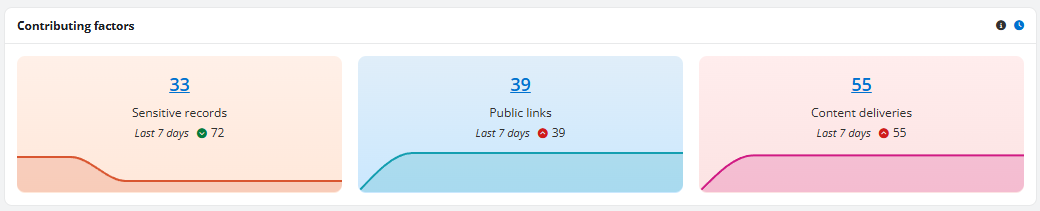
There are three charts in the Contributing factors section.
-
Sensitive records – This chart displays the trends of sensitive records in the configured data scope in the selected date range.
-
Public links – This chart displays the trends of public links in the selected date range.
-
Content deliveries – This chart displays the trends of content deliveries in the selected date range.
Hover your mouse over a trend to view the number of sensitive records, public links, or content deliveries of the day/month. You can also view the changes in numbers in the selected date period above the trends.
Click the sensitive records number link to access the Risk analysis > Detailed records page; click the public links / content deliveries number to access the Exposure > Public links/Content deliveries page.
Overall risk
The Overall risk section shows the calculated risk using the configured exposure and sensitivity definitions.
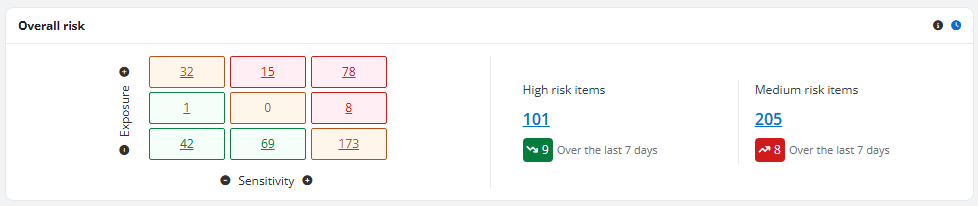
You can view a matrix that contains nine cells in three colors. Hover your mouse over a cell, and the exposure and sensitivity levels are displayed. You can also view the number of items that match the exposure and sensitivity definitions.
To the right of the matrix, you can view High risk items and Medium risk items. You can view the number of records with high/medium risk of the day or month. The changes in numbers for the last 7 days, last 3 months, or last 6 months can also be found below. Good Job! is shown if no risk items are discovered in the data scope. Click the number link to access the Risk analysis > Detailed records report page of the high/medium risk items.
The table below illustrates the risk level calculation based on sensitivity level and exposure level:
| Exposure level \ Sensitivity level | High | Medium | Low | Not sensitive |
|---|---|---|---|---|
| High | High Risk | High Risk | Medium Risk | No risk |
| Medium | High Risk | Medium Risk | Low Risk | No risk |
| Low | Medium Risk | Low Risk | Low Risk | No risk |
Objects

In the Objects section, the number of total objects in the configured data scope, the number of objects with high risk records, and the number of objects with sensitive fields are displayed. Click a number link to access the Risk analysis > Overview > Details page with the corresponding objects listed in the table.
Users
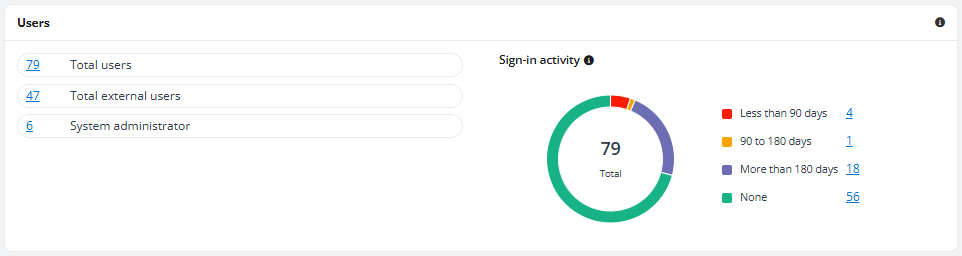
In the Users section, you can view the summary information of users, including total number of users in the configured data scope, the total number of external users, and the number of system administrators. In the doughnut chart to the right, you can view the number of users by sign-in activity. Click a number link to access the Access > Users page with the corresponding users displayed.
Users with high-privilege system permissions

This section shows the number of users with each high-privilege system permission. Click a number link to access the Access > Users page with the corresponding users displayed.
Third-party apps
In the Third-party apps section, the summary for connected apps and packages is displayed.
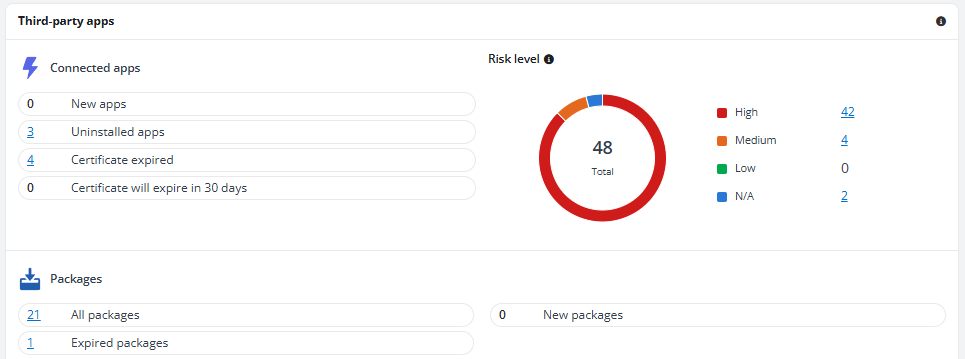
-
Connected apps – The number of new apps, the number of uninstalled apps, the number of apps of which the certificate will expire in 30 days, and the number of apps of which the certificate has expired are displayed.
-
Risk level – In the doughnut chart, you can view the number of apps by risk level.
-
Package – The total number of packages, the number of new packages, and the number of expired packages are displayed.
Click a number link to access the Risk analysis > Third-party apps > Details page with the corresponding apps or packages listed.