
Home > Use Insights for Salesforce (Preview) > Risk Analysis
Download this articleRisk Analysis
Click Risk analysis on the left navigation, and you can select to view the Overview, Detailed records, or Third-party apps risk analysis report.
Overview Report
If your organization has multiple tenants, select a tenant or All tenants from the tenant drop-down list to view an overview report of the selected tenants.
On the Overview page of risk analysis, all built-in views provided for Salesforce are displayed under All views. You can click the gray heart icon in the lower-right corner of a view card to add the view as a favorite view, and it will be displayed under My favorite views. To remove a view from favorites, click the red heart icon. You can view the statistics of each view and click the view card or number link to access the details page.
All objects in the selected containers are the data scope of the overview report under each view, and each view shows the risk analysis statistics from different perspectives. You can view the completed statistics for all views below:
-
Object label – The label of the object. Click the label to view all objects with this object label on the Detailed records page.
-
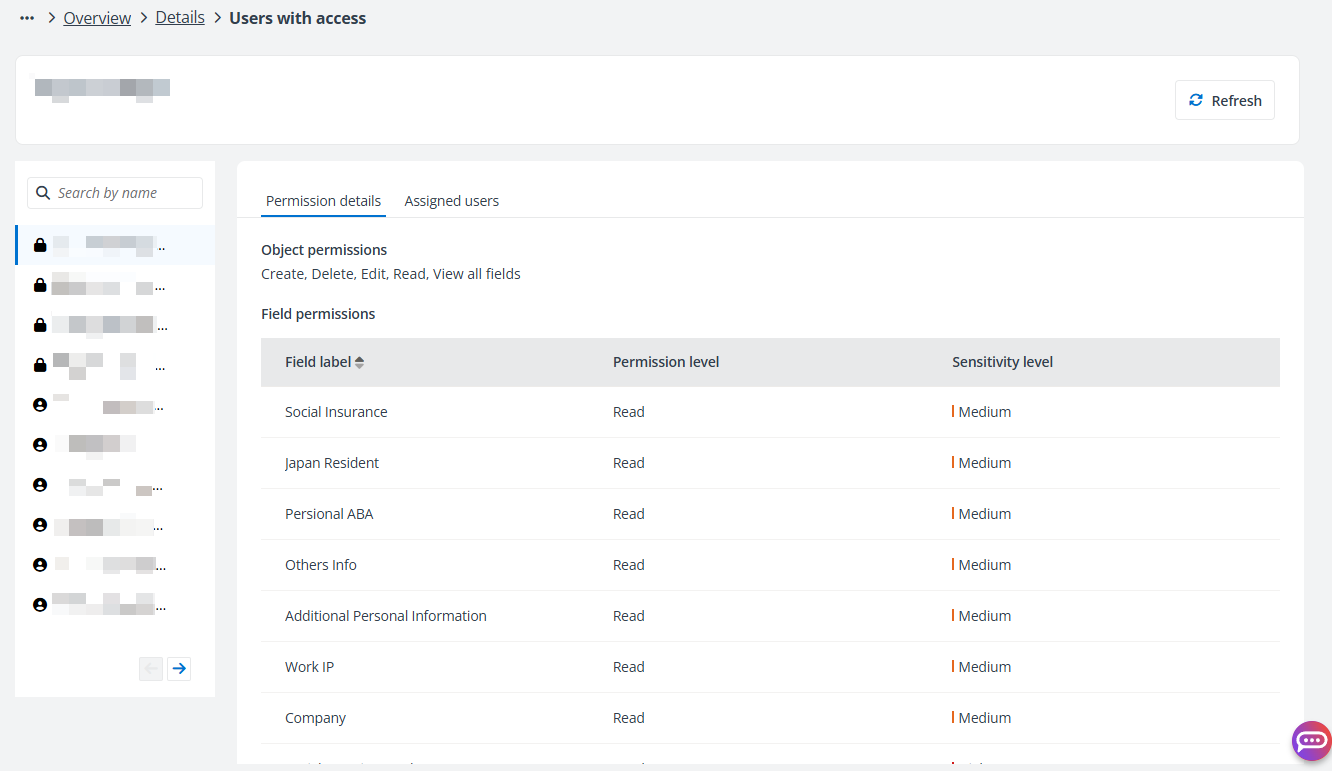
Users with access – The number of access controls that grant access to the object and the number of assigned users. Click the number link to view all access controls on the Overview > Details > Users with access page.
Click an access control on the left pane to view the permission details and assigned users.
-
Users with access to records – The number of users who have access to records of the object. Click the number link to view all users who have access to records of the object on the Overview > Details > Users with access to records page.
Click a user on the left pane to view the permission details of the user.
-
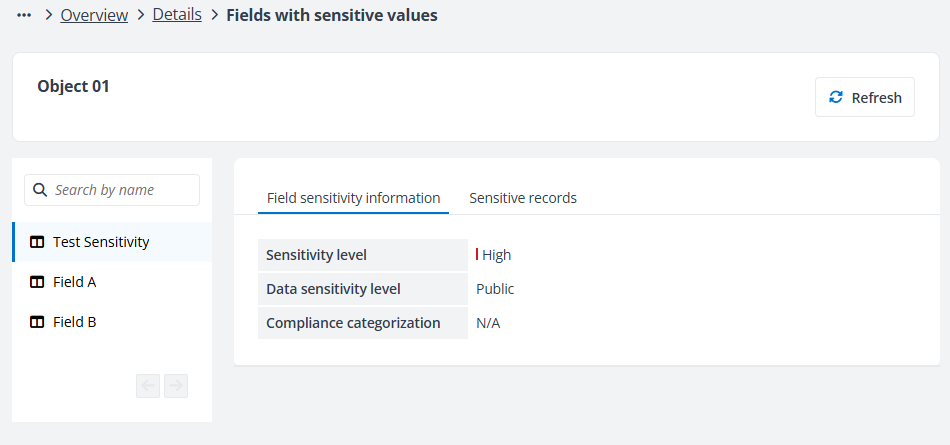
Fields with sensitive values – The number of fields of which values are sensitive. Click the number link to view all fields on the Overview > Details > Fields with sensitive values page.
Click a field on the left to view the field sensitivity information and sensitive records.
-
High risk records – The number of high risk records in the object. Click the number to view the record list on the Detailed records page.
-
Exposure level – The exposure level of the object, High, Medium, or Low. Click it to view the matched exposure rule.
The exposure level is calculated based on the exposure level settings. For details, refer to Risk Definition Profiles.
-
Last discovered time – The time when this object is discovered.
-
Last modified time – The last modified time of the object.
The following actions are available above the table on the details page:
-
Save as new view – Click Save as new view, and the Save as new view window appears. Enter a name for the new view in the text box and click Save to save the new view. Selecting the Set as favorite option allows you to add the new view to your favorite views.
-
Manage columns – Click Columns in the upper-right corner of the table, and the drop-down list where all available columns are displayed appears. Select the columns that you want to display in the table and click Apply to apply the column selection. You can also choose Select all to show all columns in the table.
-
Filter – Click Filter in the upper-right corner of the table, and the Filter window appears in the right pane. All columns that are available for the filter are listed below. Click the down arrow button to the right of a column to show the text box or selectable options. Enter keywords in the text box and/or select desired options to define the filter conditions.
You can also click Reset to default to clear your input and selections and reset the filters to their default state.
Click Apply changes to filter items displayed in the table based on the configured filters.
-
Export – You can export reports using one of the following methods:
-
Click Export for all to export the report of all objects.
-
Filter objects and then click Export for all to export the report of the filtered objects.
-
Select one or multiple objects and then click Export for selected items to export the report of the selected objects.
In the export window, a default report name is automatically filled in, and you can edit it if desired. Click Export to start exporting the report.
When the export process begins, you can monitor its progress by navigating to Job monitor > Download center or by clicking the Download center link in the prompted message.
-
-
Refresh – Click Refresh above the table to refresh the objects displayed in the table.
Detailed Records Report
If your organization has multiple tenants, select a tenant or All tenants from the tenant drop-down list to view the risk analysis detailed report of the selected tenants.
On the Detailed records page, all records in the configured objects are listed in the table. If you access this page by clicking an object label link on the Risk analysis > Overview > Details page, only records in this object are listed.
-
Record – The record name.
-
Created by – The creator of the record.
-
Created time – The created time of the record.
-
Object label – The object label of the record.
-
Users with direct access – The number of users who have direct access to the record.
-
Sensitivity level – The sensitivity level of the record, High, Medium, or Low. Not sensitive is displayed for the record that does not match any of the configured sensitivity levels.
The sensitivity level is calculated based on the sensitivity level settings. For details, refer to Risk Definition Profiles.
Click the sensitivity level to view the sensitivity details in the right panel. The Matched conditions section displays the conditions from the risk definition profile that the record meets with the matched text displayed underneath.
-
Data type – The data types, both built-in conditions and custom conditions that the object matches. At most, three data types can be displayed. If more than three data types are matched, the More link will be displayed below. Click it, and the Details window appears in the right pane. You can view the total number and names of the data types that the object matches.
-
Exposure level – The exposure level of the record, High, Medium, or Low. Click it to view the matched exposure rule.
The exposure level is calculated based on the exposure level settings. For details, refer to Risk Definition Profiles.
-
Risk level – The risk level of the record, High, Medium, or Low. The risk level is calculated based on sensitivity level and exposure level. No risk is displayed when the sensitivity level of the record is Not sensitive.
-
Last discovered time – The time when this record is discovered.
-
Modified by – The user who modified the record.
-
Last modified time – The last modified time of the record.
The following actions are available above the table on this page:
-
Manage views – You can use the built-in views to view records. You can also create custom views by updating built-in views and saving them as new views.
When you select a view from the views drop-down menu, and then make changes to the view, an asterisk icon (*) will be displayed in front of the view name and (*Modified) will be displayed to the right of the view name in the views menu. The following options are available for a view with changes:
-
Save – Click Save in the lower-right corner of the views drop-down menu to save the changes to the custom view.
-
Save as – Click Save as in the lower-right corner of the views drop-down menu, and the Save as new view window appears. Enter a name for the new view and click Save to save the new view. You can also select the Set as default view option to set the new view as the default view.
-
Reset – Click Reset in the lower-left corner of the views drop-down menu to reset the view to the default settings.
For a custom view, the following additional options are available when you click the ellipsis button to the right of its name in the views drop-down menu:
-
Rename – Click Rename to rename the selected view. In the pop-up window, enter a new name for the view and click Save to save the change.
-
Delete view – Click Delete view to delete the selected view. Click OK in the confirmation message to confirm the deletion.
After selecting a view from the views drop-down menu, you can click the ellipsis button and click Set as default view to set the selected view as the default view.
-
-
Filter – Click Filter in the upper-right corner of the table, and the Filter window appears in the right pane. All columns that are available for the filter are listed below. Click the down arrow button to the right of a column to show the text box or selectable options. Enter keywords in the text box and/or select desired options to define the filter conditions.
You can also click Reset to default to clear your input and selections and reset the filters to their default state.
Click Apply changes to filter items displayed in the table based on the configured filters.
-
Manage columns – Click Columns in the upper-right corner of the table, and the drop-down list where all available columns are displayed appears. Select the columns that you want to display in the table and click Apply to apply the column selection. You can also choose Select all to show all columns in the table.
-
Export – You can export the detailed records using one of the following methods:
-
Click Export for all above the table to export all records of the current data scope.
-
Filter the records and then click Export for all to export the report of the filtered records.
-
Select one or multiple records and then click Export for selected items to export the selected records.
In the export window, a default report name is automatically filled in, and you can edit it if desired. Click Export in the window to start the export.
When the export process begins, you can monitor its progress by navigating to Job monitor > Download center or by clicking the Download center link in the prompted message.
-
-
Refresh – Click Refresh to refresh the records displayed in the table.
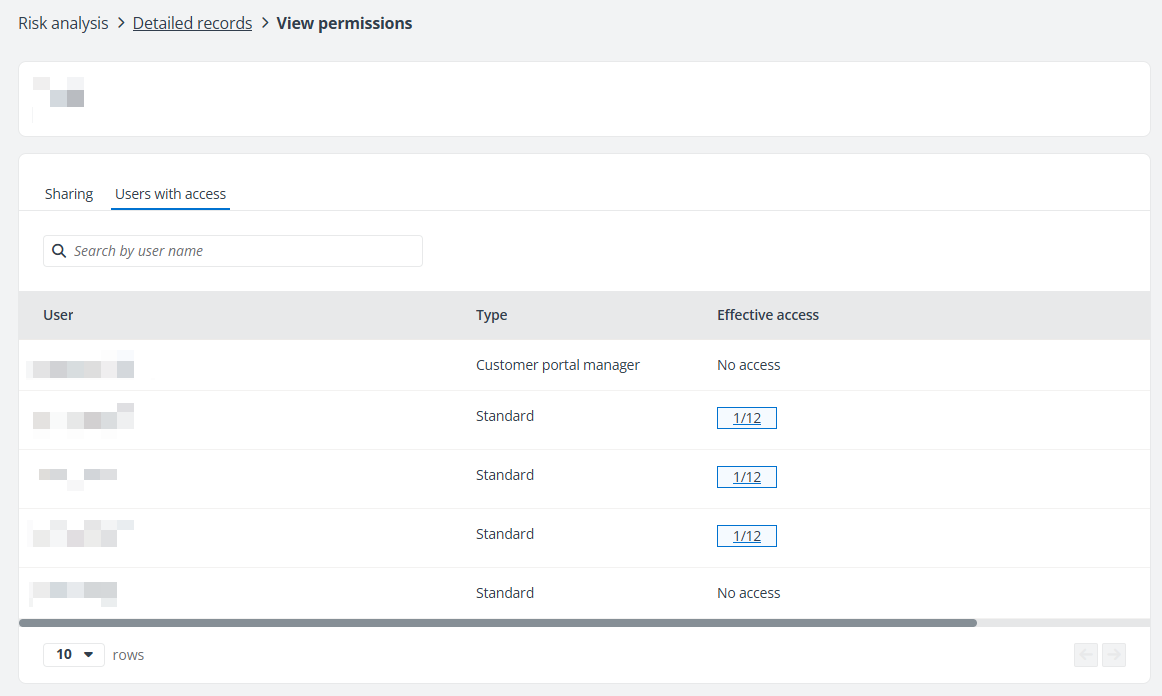
Click the ellipsis button to the right of each item in the table, the View permissions action is available. Click it to access the View permissions page of a record.
-
In the Sharing tab, you can view the shared access levels and remove specific shared access levels by selecting them and clicking Remove.
-
In the Users with access tab, you can view the users who have been granted access to the record.
-
If the user does not effective access to the record, No access is displayed. This may be due to the user does not having access to the object of the record.
-
With effective access to the record, you can view the number of fields to which the user has access and the total number of fields. Click the number link to view field permissions in the prompted window on the right.
-
Third-party Apps Report
On the Third-party apps page, all built-in views provided are displayed under All views. You can click the gray heart icon in the lower-right corner of a view card to add the view as a favorite view, and it will be displayed under My favorite views. To remove a view from favorites, click the red heart icon. You can view the statistics of each view and click the view card or number link to access the details page.
With Connected apps selected in the upper-right corner of the page, you are viewing the risk analysis report for third-party apps. With Packages selected, you are viewing the risk analysis report for packages.
View Connected Apps Report
All third-party apps in the tenant are the data scope of the report under each view, and each view shows the risk analysis statistics from different perspectives. You can view the completed statistics for all views below.
-
App name – The app name.
-
Description – The description of the app.
-
Status – The status of the app.
-
User count – The number of users who have connected to the app. Click the number link to access the Third-party apps > Details > User count page where the usage information is displayed. You can view the user name, the time of the initial connection, the time when the app is last used by the user, and the number of uses.
-
Permitted users – The permitted users of the app, Admin approved users are pre-authorized or All users may self-authorize.
-
Risk level – The risk level of the app.
-
Installed by – The user who installed the app.
-
Installed date – The date and time when the app was installed.
-
Initial connection – The date and time when the app was initially connected.
-
Last activity date – The last activity date and time of the app.
-
Last modified time – The last modified time of the app.
-
Certificate – The status whether the app has a certificate.
-
Certificate expiration date – The expiration date of the certificate.
-
Last discovered time – The time when this app is discovered.
-
Comments – The comments that were added to the app. If comments are added, the comments icon will be displayed. Click it, and the Comments window appears on the right pane. You can view the added comments and add a new comment by entering comment content in the text box and clicking Add. If no comment is added to the app, you can click Add to add a comment.
-
App policies – The policies that have been configured for the app. Click View details to view the policies in Salesforce. Alternatively, click the Copy button to the right to copy the URL of the connected app details page. N/A will be displayed if no policies have been configured for the app.
The following actions are available above the table on this page:
-
Save as new view – Click Save as new view, and the Save as new view window appears. Enter a name for the new view in the text box and click Save to save the new view. Selecting the Set as favorite option allows you to add the new view to your favorite views.
-
Filter – Click Filter in the upper-right corner of the table, and the Filter window appears in the right pane. All columns that are available for the filter are listed below. Click the down arrow button to the right of a column to show the text box or selectable options. Enter keywords in the text box and/or select desired options to define the filter conditions.
You can also click Reset to default to clear your input and selections and reset the filters to their default state.
Click Apply changes to filter items displayed in the table based on the configured filters.
-
Manage columns – Click Columns in the upper-right corner of the table, and the drop-down list where all available columns are displayed appears. Select the columns that you want to display in the table and click Apply to apply the column selection. You can also choose Select all to show all columns in the table.
-
Export – You can export the detailed records using one of the following methods:
-
Click Export for all above the table to export all apps of the current data scope.
-
Filter the apps and then click Export for all to export the report of the filtered apps.
-
Select one or multiple apps and then click Export for selected items to export the selected apps.
In the export window, a default report name is automatically filled in, and you can edit it if desired. Click Export in the window to start the export.
When the export process begins, you can monitor its progress by navigating to Job monitor > Download center or by clicking the Download center link in the prompted message.
-
-
Trust – Select one or multiple apps, click Trust above the table, enter your comment in the text box, and click OK to trust the selected apps.
You can view the Trusted icon displayed for apps in the trusted list, and the added comments are displayed in the Comments column with the comments icon. Click this icon, and the Comments window appears on the right pane. You can view the comment you added and add a new comment by entering your comment in the text box and clicking Add. You can also filter apps by trust status to view all apps in the trusted list, or the apps that are not in the trusted list.
NOTEThis action is only available for administrators.
-
Remove from trusted list – Select one or multiple apps that have been trusted, click Remove from trusted list above the table, enter your comment in the text box, and click OK to remove the apps from the trusted list. The Trusted icon will also be removed.
NOTEThis action is only available for administrators.
-
Refresh – Click Refresh to refresh the apps displayed in the table.
The following options are available in the ellipsis drop-down list for each app listed in the table:
-
Export – This option allows you to export the summary report of the current app. A default report name is automatically filled in, and you can edit it if desired. Click Export to start the export.
When the export process begins, you can monitor its progress by navigating to Job monitor > Download center or by clicking the Download center link in the prompted message.
-
View login activities – This option allows you to access the View Login Activities page of the app.
-
Trust – This option allows you to trust the app. Enter your comment in the text box and click OK to trust the app.
You can view the Trusted icon displayed for apps in the trusted list, and the added comments are displayed in the Comments column with the comments icon. Click this icon, and the Comments window appears on the right pane. You can view the comment you added and add a new comment by entering your comment in the text box and clicking Add. You can also filter apps by trust status to view all apps in the trusted list, or the apps that are not in the trusted list.
NOTEThis action is only available for administrators.
-
Remove from trusted list – This option allows you to remove the app from the trusted list. Enter your comment in the text box and click OK to remove the app from the trusted list. The Trusted icon will also be removed.
NOTEThis action is only available for administrators.
View Packages Report
All installed packages in the tenant are the full data scope of the report under each view, and each view shows the risk analysis statistics from different perspectives. You can view the completed statistics for all views below.
-
Package name – The package name.
-
Description – The description of the package.
-
Publisher – The publisher of the package.
-
Status – The status of the package.
-
Used licenses – The number of used licenses of the package.
-
Allowed licenses – The number of allowed licenses of the package.
-
Installed by – The user who installed the package.
-
Installed date – The date and time when the package was installed.
-
Last discovered time – The time when this package is discovered.
-
Last modified time – The last modified time of the package.
-
Expiration date – The expiration date of the package.
-
AppExchange ready – The status whether the package is an AppExchange ready package.
-
Comments – The comments that were added to the package. If comments are added, the comments icon will be displayed. Click it, and the Comments window appears on the right pane. You can view the added comments and add a new comment by entering comment content in the text box and clicking Add. If no comment is added to the package, you can click Add to add a comment.
The following actions are available above the table on this page:
-
View details – Click View details in the upper-right corner of the page to view the user list who have permissions to install packages on the Access > Users page.
-
Save as new view – Click Save as new view, and the Save as new view window appears. Enter a name for the new view in the text box and click Save to save the new view. Selecting the Set as favorite option allows you to add the new view to your favorite views.
-
Filter – Click Filter in the upper-right corner of the table, and the Filter window appears in the right pane. All columns that are available for the filter are listed below. Click the down arrow button to the right of a column to show the text box or selectable options. Enter keywords in the text box and/or select desired options to define the filter conditions.
You can also click Reset to default to clear your input and selections and reset the filters to their default state.
Click Apply changes to filter items displayed in the table based on the configured filters.
-
Manage columns – Click Columns in the upper-right corner of the table, and the drop-down list where all available columns are displayed appears. Select the columns that you want to display in the table and click Apply to apply the column selection. You can also choose Select all to show all columns in the table.
-
Export – You can export the detailed records using one of the following methods:
-
Click Export for all above the table to export all packages of the current data scope.
-
Filter the packages and then click Export for all to export the report of the filtered packages.
-
Select one or multiple packages and then click Export for selected items to export the selected packages.
In the export window, a default report name is automatically filled in, and you can edit it if desired. Click Export in the window to start the export.
When the export process begins, you can monitor its progress by navigating to Job monitor > Download center or by clicking the Download center link in the prompted message.
-
-
Trust – Select one or multiple packages, click Trust above the table, enter your comment in the text box, and click OK to trust the selected packages.
You can view the Trusted icon displayed for packages in the trusted list, and the added comments are displayed in the Comments column with the comments icon. Click this icon, and the Comments window appears on the right pane. You can view the comment you added and add a new comment by entering your comment in the text box and clicking Add. You can also filter packages by trust status to view all packages in the trusted list, or the packages that are not in the trusted list.
NOTEThis action is only available for administrators.
-
Remove from trusted list – Select one or multiple packages that have been trusted, click Remove from trusted list above the table, enter your comment in the text box, and click OK to remove the packages from the trusted list. The Trusted icon will also be removed.
NOTEThis action is only available for administrators.
-
Refresh – Click Refresh to refresh the packages displayed in the table.
The following options are available in the ellipsis drop-down list for each package listed in the table:
-
Export – This option allows you to export the summary report of the current package. A default report name is automatically filled in, and you can edit it if desired. Click Export to start the export.
When the export process begins, you can monitor its progress by navigating to Job monitor > Download center or by clicking the Download center link in the prompted message.
-
View setup audit trail activities – This option allows you to access the View Setup Audit Trail Activities page of the package.
-
Trust – This option allows you to trust the package. Enter your comment in the text box and click OK to trust the package.
You can view the Trusted icon displayed for packages in the trusted list, and the added comments are displayed in the Comments column with the comments icon. Click this icon, and the Comments window appears on the right pane. You can view the comment you added and add a new comment by entering your comment in the text box and clicking Add. You can also filter packages by trust status to view all packages in the trusted list, or the packages that are not in the trusted list.
NOTEThis action is only available for administrators.
-
Remove from trusted list – This option allows you to remove the package from the trusted list. Enter your comment in the text box and click OK to remove the package from the trusted list. The Trusted icon will also be removed.
NOTEThis action is only available for administrators.
View Login Activities
On the View login activities page, activities are listed in the table. The activities for the app of the users to whom you have permissions are displayed on this page.
Click Refresh to refresh the activities displayed in the table.
You can view the date when the initial configurations have been configured and applied for the tenant and the collection of audit data starts in the message above the page. By default, only the audit data in the last 3 months can be displayed on this page. This period can be configured in Database Settings if your tenant uses the custom Cosmos database.
You can filter the activities by clicking Filter in the upper-right corner. The Filter window appears with all available filters displayed. Configure the filters as required, and click Filter to filter activities and only display the matched activities in the table.
You can also click Clear all to clear the selection. Click Cancel to close the window without applying any changes.
Click Export and the Export window appears. A default report name is automatically filled in, and you can edit it if desired. Click Export to export activities.
View Setup Audit Trail Activities
On the View setup audit trail activities page, activities are listed in the table. The activities for the package of the users to whom you have permissions are displayed on this page.
Click Refresh to refresh the activities displayed in the table.
You can view the date when the initial configurations have been configured and applied for the tenant and the collection of audit data starts in the message above the page. By default, only the audit data in the last 3 months can be displayed on this page. This period can be configured in Database Settings if your tenant uses the custom Cosmos database.
You can filter the activities by clicking Filter in the upper-right corner. The Filter window appears with all available filters displayed. Configure the filters as required, and click Filter to filter activities and only display the matched activities in the table.
You can also click Clear all to clear the selection. Click Cancel to close the window without applying any changes.
Click Export and the Export window appears. A default report name is automatically filled in, and you can edit it if desired. Click Export to export activities.