
Home > Use Insights for Microsoft 365 > Search Center
Download this articleSearch Center
In Search Center, you can perform a Quick Search to search for a specific user or group to view their permissions to the objects in the configured data scope of Insights, or search for a specific object to view its detailed information.
Using Search Profiles, you can search for users and/or groups in batch or all external users in a specific domain to view their permissions to the data scope configured in the profile, or search for site collections in batch to view their information and the number of sensitive items in these site collections without having to recreate the search. You can configure schedules to run search profiles periodically and export the reports automatically after the scheduled searches are complete. You can also notify specific users when the searches are complete.
Quick Search
You can search for a user/group, a Microsoft 365 object, Power BI, or AI agent via quick search.
Search for a User/Group
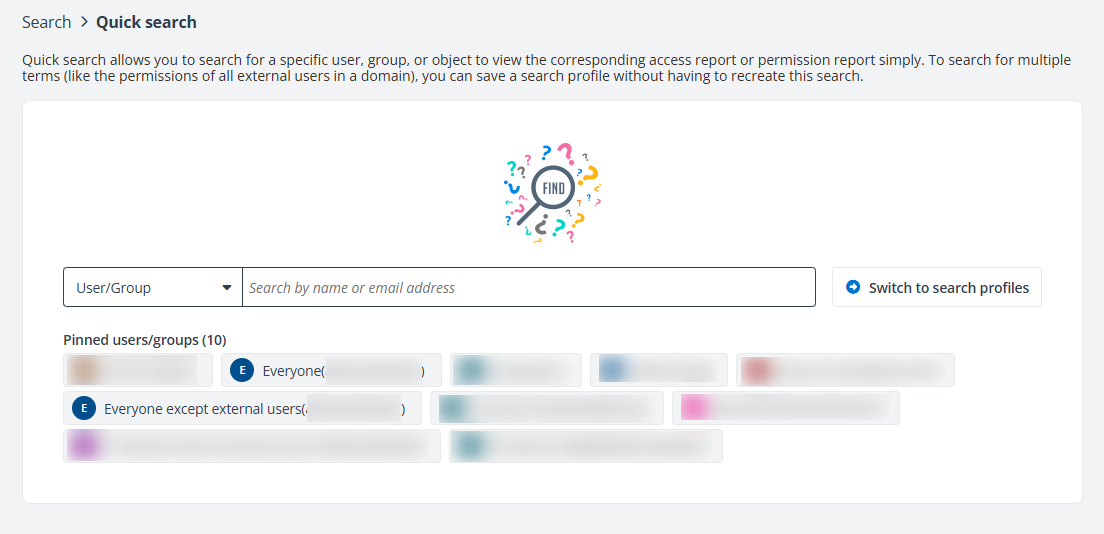
You can click a pinned user or group to view their permissions to the configured scope of Insights directly. You can also use the following steps to search for a user or group:
To unpin a user or group from Insights, hover your mouse over the user or group, and then click the Unpin from Insights button. The Pinned users/groups section is hidden when no users and groups are pinned to Insights.
-
Select User/Group from the drop-down list.
-
In the text box, enter the name or email address of the user or group, and the suggestion list appears.
-
Click the user or group you want to search from the suggestion list.
You can view the name of the user/group that you searched at the top of the search result. The search result contains several tabs: Known risk for Microsoft 365, where you can view the site collections that the user/group has direct access to in the table; Known risk for Power BI, where you can view the workspaces that the user/group has direct access to in the table; Group membership, where you can view the groups to which the user/group belongs to; Site membership, where you can view all sites where the user exists on the All People list; Microsoft 365 activities, where you can view the activities performed by the user/group in Microsoft 365.
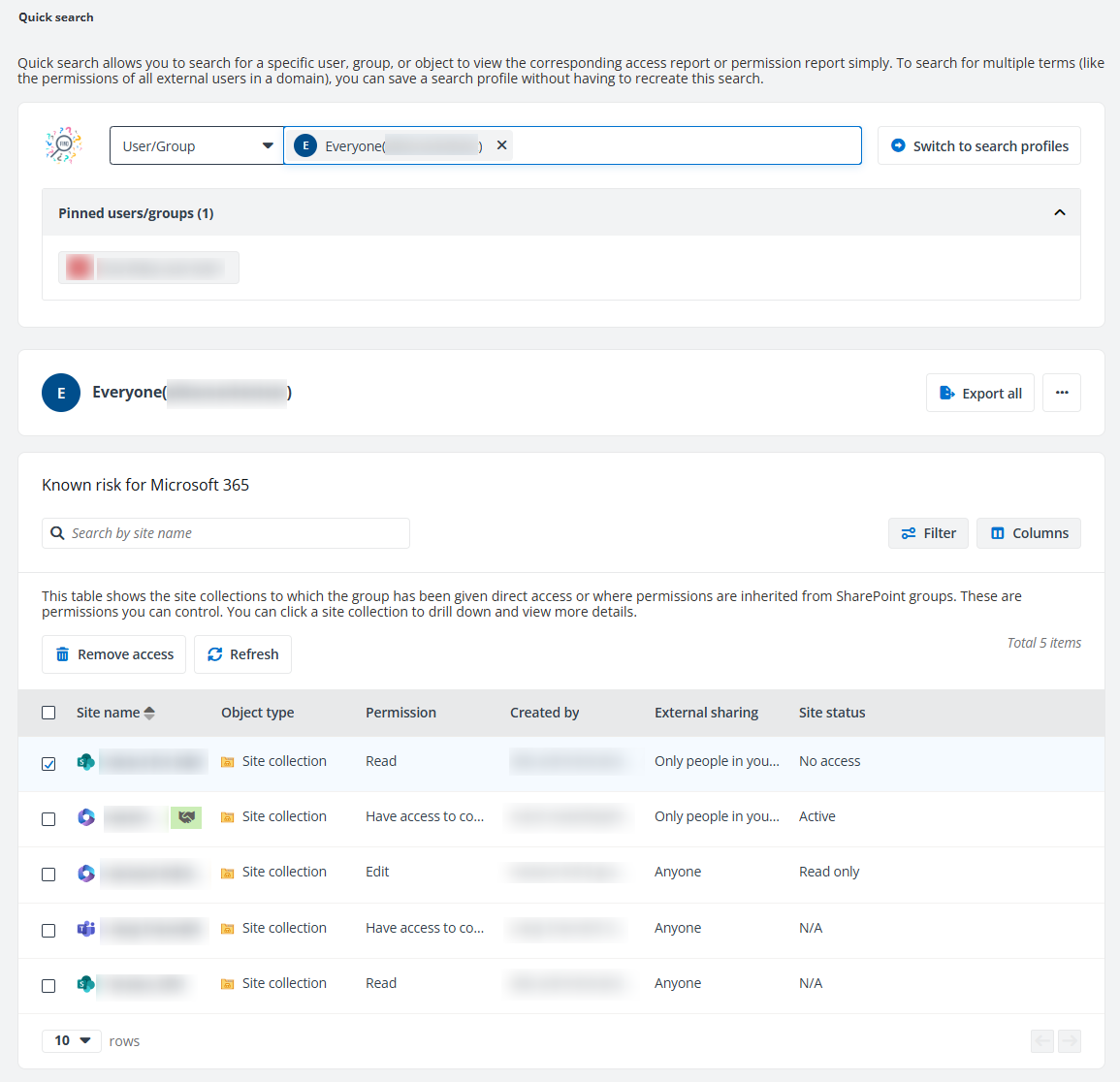
The following actions are available above the table of your search results.
-
Export all – Click Export all, and the Export window appears. A default report name is automatically filled in, and you can edit it if desired. Click Export to export the access report of the current user. When the export process begins, you can monitor its progress by navigating to Job monitor > Download center or by clicking the Download center link in the prompted message.
-
Take action – Click Take action and click Confirm user safe to remove risk and detections on the user to mark false positive.
NOTEClick Reset password to assign a temporary password to the user. The temporary password must be changed to something new during the next sign-in.
-
Remove user from Microsoft Entra – Click Take action and click Remove user from Microsoft Entra to remove the current user from Microsoft Entra ID.
-
Block from signing in – Click Take action and click Block from signing in to block the current user from signing in to Microsoft 365. The blocked users will not be calculated in the risk reports.
-
Pin to Insights – Click Pin to Insights to pin the user/group to the Pinned users/groups section of the Quick search page.
-
Remove all – Click Remove all to remove both the permissions directly given to the user or group, and those inherited from the parent node.
Remove user from Microsoft Entra and Block from signing in are only available when the user you search is an external user.
Click the ellipsis button in front of the site name or object name, and the actions for the site collection or object are available.
-
View details – The Details window appears in the right pane. The basic information of the site collection/object and the risk information, including risk level, exposure level, and sensitivity level of the site collection/object are all displayed. You can view the sensitivity info types that the object matches if the file is sensitive, and the sensitivity label that is applied to the site collection/object in Microsoft 365.
-
View permissions – The View permissions page is opened in a new tab. For details, refer to View Permissions.
-
View activities – The View activities page is opened in a new tab. For details, refer to View Activities.
-
Remove access – Remove the user or group’s access to the selected site.
Search for a Microsoft 365 Object
To view the detailed information of a Microsoft 365 object (from the site collection level to the item level) in the configured data scope of Insights, refer to the following steps to search for the object:
-
Select Microsoft 365 object from the drop-down list.
-
In the text box, enter the name or URL of the object, and the suggestion list appears.
-
Click the object you want to search from the suggestion list.
The related information of the object will be displayed in the table below. You can view the name of the object that you searched on the top of the search results.
Refer to the View Detailed Information of Site Collections section for details if you search for a site collection.
You can directly click Export and select one of the following export option to export the corresponding report of the object:
-
Only export summary report
-
Export both the summary report and permission report
-
Export both the summary report and link permission report
Select the Export activity report in a certain time range advanced option, and select Last 7 days, Last 1 month, Last 3 months, or Custom to define the time range during which user activity report you want to export. Click Export to start the export.
Refer to the View Detailed Information of Items/Files/Folders/Lists/Libraries/Sites section for details if you search for an item, file, folder, list, library, or site.
You can directly click Export and select one of the following export option to export the corresponding report of the object:
-
Only export the detailed record report
-
Export both the detailed record report and permission report
Click Export to start the export.
Search for a Workspace or Artifact
To view the detailed information of a workspace or artifact in the configured data scope of Insights, refer to the following steps to search for the workspace or artifact:
-
Select Power BI from the drop-down list.
-
In the text box, enter the name of the workspace or artifact, and the suggestion list appears.
-
Click the workspace or artifact you want to search from the suggestion list.
The related information of the workspace or artifact will be displayed in the table below. You can view the name of the workspace or artifact that you searched on the top of the search results.
Refer to the View Detailed Information of Workspaces section for details if you search for a workspace.
You can directly click Export and select one of the following export option to export the corresponding report of the workspace/artifact:
-
Only export summary report
-
Export both the summary report and permission report
Select the Export activity report in a certain time range advanced option, and select Last 7 days, Last 1 month, Last 3 months, or Custom to define the time range during which user activity report you want to export. Click Export to start the export.
Refer to the View Detailed Information of Artifacts section for details if you search for an artifact.
You can directly click Export and select one of the following export option to export the corresponding report of the object:
-
Only export the detailed record report
-
Export both the detailed record report and permission report
Click Export to start the export.
Search for an AI Agent
To view the detailed information of an AI agent in the configured data scope of Insights, refer to the following steps to search for the AI agent:
-
Select AI agent from the drop-down list.
-
In the text box, enter the name of the AI agent, and the suggestion list appears.
-
Click the AI agent you want to search from the suggestion list.
The related information of the AI agent will be displayed in the table below. You can view the name of the AI agent that you searched on the top of the search results.
Refer to the Agent Reports section for details.
Search Profiles
Using search profiles, you can search for users and/or groups in batch or all external users in a specific domain to view their permissions to the data scope configured in the profile, or search for site collections in batch to view their detailed information. You can configure schedules to run the search profiles periodically and export the reports automatically after the scheduled searches are complete. You can also notify specific users when the searches are complete.
Insights has converted all export schedules on the risk analysis workspaces report into search profiles with settings configured accordingly. Please note that if the interval of an export schedule is less than 1 week, it will be updated as 1 week, which is the shortest interval allowed for profiles.
You can navigate to Search center > Search profiles. Alternatively, you can click Switch to search profiles on the Quick search page to access the Search profiles page.
The following actions are available on the Search profiles page.
-
Filter – Click Filter to filter search profiles by filter conditions.
-
New profile – Click New profile on the ribbon to create a search profile. For details, refer to Create New Profiles.
-
Delete profile – Select one or multiple search profiles that you want to delete and click the Delete profile. Alternatively, you can delete a single search profile by clicking the ellipsis button to the right of the profile row, and then clicking Delete profile in the drop-down list.
-
View report – Select a profile and click View report on the ribbon to access the report generated by the corresponding search profile. Alternatively, click the ellipsis button to the right of a profile row, and then click View report in the drop-down list. Note that you can only view the report when the status of the profile is shown as Successful in the table. For details, refer to View Report.
-
View profile – Select a profile and click View profile on the ribbon to view details of the profile. Alternatively, click the ellipsis button to the right of a profile row, and then click View profile in the drop-down list. The profile details are displayed on the right pane.
-
Refresh – Click Refresh to refresh the search profiles displayed in the table.
Create New Profiles
Click New profile in the upper-left corner of the Search profiles page, and the New profile page appears.
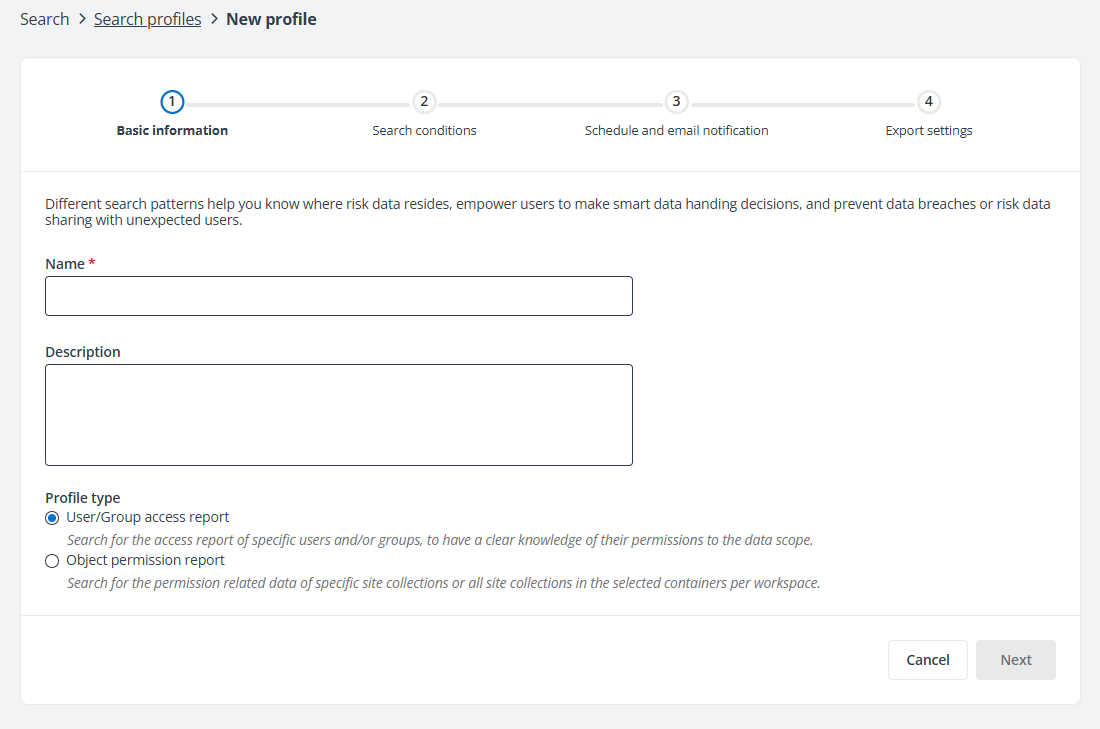
On this page, complete the following sections to create a profile:
Basic Information
Refer to the following steps to complete the information in this section:
-
Enter a profile name in the Name text box.
-
Enter a profile description in the Description text box.
-
Select a profile type to define for which you want the profile to search.
-
User/Group access report – Searches for the access report of specific users and/or groups, to have a clear knowledge of their permissions to the data scope.
-
Object permission report – Searches for the permission related data of specific site collections or all site collections in the selected containers per workspace.
-
-
Click Next to proceed to the Search conditions section.
Search Conditions
You can refer to the instructions below to configure the search conditions for the User/Group access report and Object permission report profile types respectively.
For the User/Group access report profile type, you are required to configure the User scope and Data scope of the profile:
-
User scope – Configure the user scope for the search profile.
NOTEOrphaned users will be excluded from the search profile report.
-
Specific users and groups – Enter the name, email address, or domain of the user or group you want to search for, and the suggestion list appears. Select the user or group that you want to search for. Multiple users and groups can be searched in batch, including the Everyone, Everyone except External Users, All Users (membership), and All Users (windows) groups.
Note that you must enter at least 2 characters that begin with @ to search users/groups by domain. For example, to search users/groups in contoso.com, you must enter at least @c.
-
Import users and groups – You can add users and groups in batch by importing a CSV file. Click Download template above the text box, add the desired users and groups to the downloaded file, and save the file. Click Import and select the file to import the users and groups in the file.
The number of users and groups that have been imported is displayed above the text box. Click the number to view the imported users and groups in the prompted window on the right pane.
-
External users in the domain – Select a domain from the drop-down list or search for a specific domain by entering keywords in the text box. External users in the domain will be the user scope of the search.
NOTEInsights has a maximum number of 500 external users. If this domain has more external users, Insights will choose a random set of users to report against.
-
Specific users that match conditions – Click Add condition to start configuring a condition. Select an option from the user or group property drop-down list and an option from the condition drop-down list, and then enter a value in the text box to define a condition. You can repeat the actions to add multiple conditions. Then, you can define the logical relationship of the conditions by clicking the All link in the upper-left corner of the conditions and clicking All or Any in the drop-down list.
NOTEInsights has a maximum number of 500 users. If more users match the conditions, Insights will choose a random set of users to report against.
-
-
Data scope – Configure the data scope in which you want to search for the permissions that the users and/or groups have.
-
Workspaces – Select the workspaces from where you want to search for the users and/or groups. Note that the workspaces to which you do not have permissions will be grayed out and cannot be selected.
-
Containers – Select the containers that you want to search per workspace to search for the users and/or groups in the containers. Alternatively, enter the name of the container, and the suggestion list appears. You can select multiple containers that you want to search from the suggestion list.
-
Specific site collections – Enter the domain names or site names in the URL of the site collection to which you have permissions.
-
Import site collections – You can add site collections in batch by importing a CSV file. Click Download template above the text box, add the desired site collections to the downloaded file, and save the file. Click Import and select the file to import the site collections in the file.
The number of site collections that have been imported is displayed above the text box. Click the number to view the imported site collections in the prompted window on the right pane.
NOTEAt most 500 site collections can be imported. If more site collections are configured in the CSV file, a random set of site collections will be imported.
-
For the Object permission report profile type, you are required to configure the Search scope of the profile. You can choose to search objects by specific site collections or containers.
-
Specific site collections – Enter the domain name or site name in the URL of the site collection that you want to search for the permission related data, and the suggestion list appears. Select the site collection that you want to search from the suggestion list. Multiple site collections will be searched in batch.
-
Import site collections – You can add site collections in batch by importing a CSV file. Click Download template above the text box, add the desired site collections to the downloaded file, and save the file. Click Import and select the file to import the site collections in the file.
The number of site collections that have been imported is displayed above the text box. Click the number to view the imported site collections in the prompted window on the right pane.
NOTEAt most 500 site collections can be imported. If more site collections are configured in the CSV file, a random set of site collections will be imported.
-
Containers – Select the containers that you want to search per workspace to search for all active site collections in the containers. Alternatively, enter the name of the container, and the suggestion list appears. You can select multiple containers that you want to search from the suggestion list. All active site collections in the selected containers will be searched in batch.
NOTEInsights has a maximum number of 2,000 site collections. If there are more site collections in the selected containers, Insights will choose a random set of site collections to report against.
Click Next to proceed to the Schedule and email notification section.
Schedule and Email Notification
In this section, you can configure the Schedule settings and Email notification for the profile.
You can refer to the instructions below to configure for the profile:
Select No schedule if you do not want to configure a schedule for the search profile or select Configure the schedule myself to configure the following schedule settings for the search profile:
-
Start date – Select a start date from the calendar for the scheduled searches.
-
Interval – Enter a number in the text box and select Week or Month as the time unit to define the interval.
-
End time – Configure when to end the scheduled searches.
-
No end time – Select this option to keep the scheduled searches until you manually stop them.
-
End by occurrences – Select this option and enter the number of occurrences for the scheduled searches.
-
End by – Select this option and select an end date from the calendar.
-
For the Email notification setting of the profile, select No notification if you do not want to send any email notifications for the search profile, or select Send email notification to specific recipients when the search completes and enter the email addresses of the desired recipients after the search is complete. Use semicolons to separate multiple email addresses.
Click Next to proceed to the Export settings section.
Export Settings
The results of the scheduled searches can be exported automatically by selecting the Automatically export the reports after the search completes checkbox.
-
For user/group access reports, the following export options are available:
-
Export permission related reports – Select an option for the corresponding permission report of the users and groups in the search scope:
-
Only export the summary report – Select this option to export the summary report of all users and groups in the search results.
-
Export both the summary report and site collection level access report – Select this option to export both the summary report and the site collection level access report of all users and groups in the search results.
-
Export both the summary report and access report to all objects in the data scope – Select this option to export both the summary report and the access report of all users and groups in the search results to all objects in the data scope that the users and groups have access.
-
Export the summary report and merge access report to all objects in the data scopefor users/groups – Select this option to export both the summary report and the merged access report of all users and groups in the search results to all objects in the data scope to which the users and groups have access.
-
-
Export user activity report in a certain time range – You can choose to export the activity report of the users and groups in the search scope.
-
Activity selection – Select All activities to export activities of all types. Alternatively, select Specific types, click Configure activity types, select the activity types that you want to export in the Configure activity types window, and click Save to only export the corresponding activities in the report. You can also search for a specific activity type by entering keywords in the search box.
NOTEUp to 20 activity types can be selected.
-
Time range – Enter a number in the text box and select Day, Week, or Month to define the time range. Activities within this time range will be exported.
-
-
-
For object permission reports, the following export options are available:
-
Export permission related reports – Select an option for the corresponding permission report of the objects in the search scope:
-
Only export summary report – Select this option to export the overview report of all site collections in the search scope.
-
Export both the summary report and permission report – Select this option to export both the summary report and the permission report of all site collections in the search scope.
-
Export the summary report and merge permission report for items – Select this option to export the summary report and merge the permission reports of all site collections in the search scope into one file.
-
-
Export activity report in a certain time range – You can choose to export the activity report of the objects in the search scope.
-
Activity selection – Select All activities to export activities of all types. Alternatively, select Specific types, click Configure activity types, select the activity types that you want to export in the Configure activity types window, and click Save to only export the corresponding activities in the report. You can also search for a specific activity type by entering keywords in the search box.
NOTEUp to 20 activity types can be selected.
-
Time range – Enter a number in the text box and select Day, Week, or Month to define the time range. Activities within this time range will be exported.
-
-
The results can also be exported to a specified library or folder. Select the Upload the reports to a specific document library or folder checkbox and enter the full URL of the desired document library or folder in the text box.
The following actions are available after configuring the settings in this section:
-
Click Cancel to close the page without saving the search profile.
-
Click Back to view or edit the basic information of the search profile.
-
Click Save to save the search profile. After you click Save, a message appears. You can click Go back tosearch profiles to go to the Search profiles page. You can only view the search report after you run the profile and the search completes.
-
Click Save and run now to save and run the search profile. After you click Save and run now, a message appears. You can click Go back tosearch profiles to go to the Search profiles page. You can view the search report after the search completes.
View Report
You can view details of User/Group Access report and Object Permission Report for the corresponding profile type when the search completes.
The following actions are available on the View report page:
-
View profile – Click View profile above the Search report section, and the View profile window appears in the right pane. You can view the profile information, including profile description, profile type, the last time when the profile is modified, the time when the last search was completed, and the search conditions configured in the profile. Click the Close button or click Close to close the window.
-
Edit profile – Click the ellipsis button to the right of View profile and click Edit profile from the drop-down list to edit the profile settings except the profile type. If you have edited a profile, you need to rerun the profile so that you can view the latest search report after the search completes.
NOTEThe profile type cannot be edited once you have saved a profile.
-
Run profile – If the profile has been saved but not run, you can click Run profile from the ellipsis drop-down list to run the profile and view the corresponding report after the search completes.
-
Rerun profile – If the profile has been saved and run, you can click Rerun profile from the ellipsis drop-down list to rerun the profile and view the latest report after the search completes.
User/Group Access report
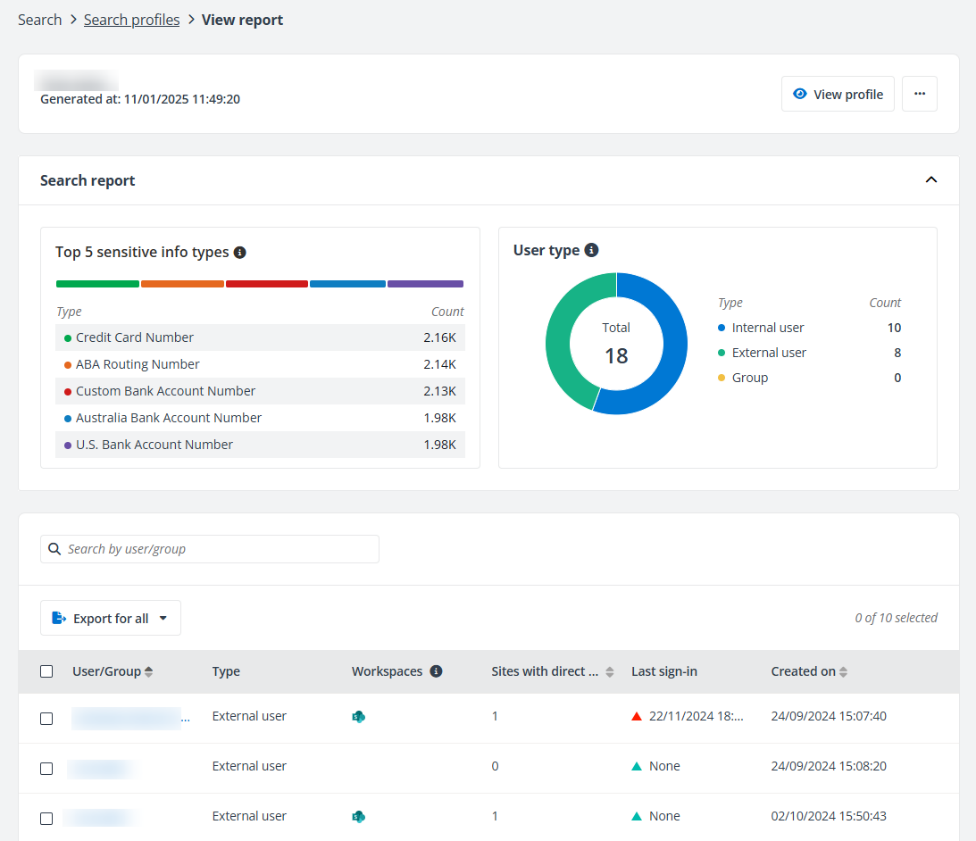
The Top 5 sensitive info types section displays the top 5 sensitive info types that the objects to which the searched users and/or groups have access match, and the number of objects that match each sensitive info type. The User type section displays the types of users and/or groups in the search results and the numbers. Hover your mouse over the circle to the left of the user types to view the number of users or groups in each user type in the search results.
In the table below the Search report section, you can view the details of all users and/or groups in the search results, including the user/group name, type, workspaces in which the site collections that the user/group has access to reside, number of site collections that the user/group has direct access, the date and time of the user or group’s last signed in, and the time when the user/group is created.
You can click a user/group name to view the detailed access report of the user/group. The site collections to which the user/group has been directly granted permissions are listed in the table. You can view the workplace, site name, permission, creator, and external sharing setting of each site collection. You can click the site name link to drill down, and the objects with unique permissions in the site collection are displayed. If the user/group has direct access to the site collection, the site collection itself will also be displayed with the granted permission levels.
For users and/or groups in the search results, the following actions are available:
-
Search for a User/Group – Enter keywords in the search box in the upper-right corner of the table and click the magnifying glass button or press Enter on the keyboard.
-
Export – You can export reports using one of the following methods:
-
Click Export for all to export the reports of all users and groups in the search results.
-
Select one or multiple users and/or groups and then click Export for selected items to export the reports of the selected users and/or groups.
In the export drop-down list, select Export summary report to export the summary report, or select Export access report to export both the summary report and access report for the users and groups.
In the export window, a default report name is automatically filled in, and you can edit it if desired.
-
Export both the summary report and site collection level access report – Select this option to export both the summary report and the site collection level access report of the users and groups.
-
Export both the summary report and access report to all objects in the data scope – Select this option to export both the summary report and the access report of the users and groups to all objects in the data scope of the search profile.
-
Export the summary report and merge access report to all objects in the data scope for users/groups – Select this option to export both the summary report and the merged access report of the users and groups to all objects in the data scope of the search profile.
The Export user activity report in a certain time range advanced option is also available if you select users to export. Select Last 7 days, Last 1 month, Last 3 months, or Custom to define the time range during which user activity report you want to export.
Click Export to start exporting the report.
When the export process begins, you can monitor its progress by navigating to Job monitor > Download center or by clicking the Download center link in the prompted message.
-
-
Export access report – Click Export access report from the ellipsis drop-down list to export the access report of the user/group.
-
Access report – Click Access report from the ellipsis drop-down list to access and view the access report page of the user/group.
Object Permission Report
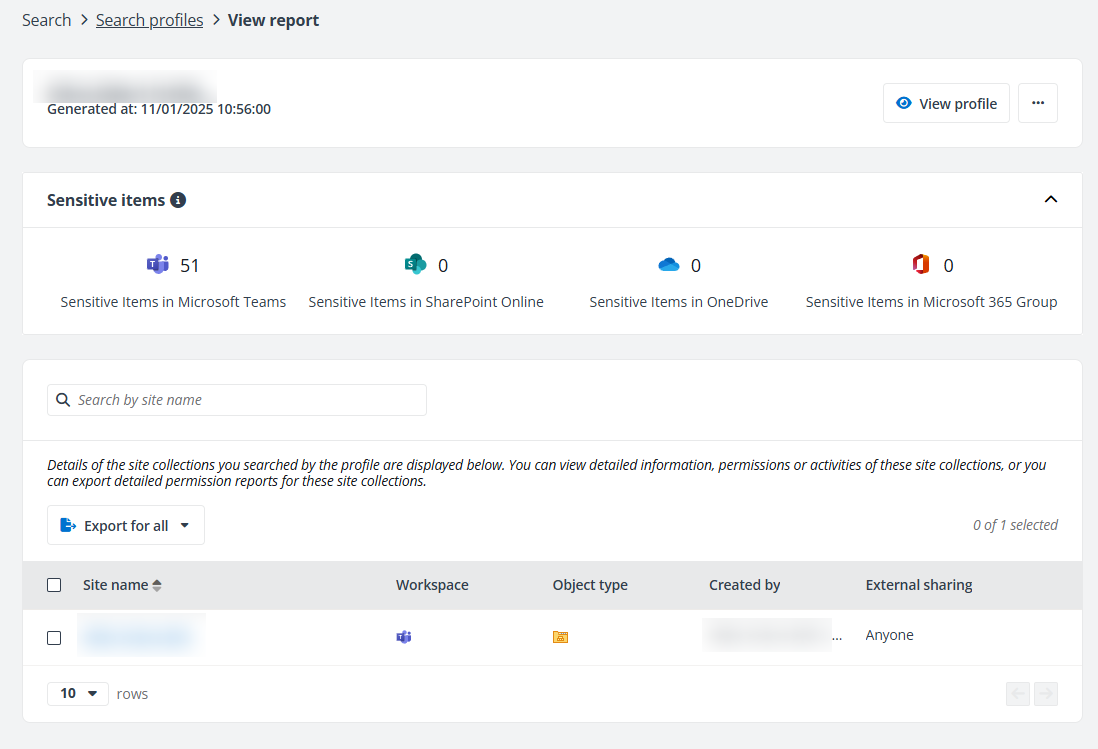
The Sensitive items section displays the number of sensitive items in the site collections you searched per workspace.
Details of the site collections you searched by the profile are displayed in the table below the Sensitive items section. You can view details of all site collections in the search scope, including the site names, workspace in which the site collection resides, object type, the user/group that created the site collection, and the external sharing setting of the site collection.
For site collections listed in the table, the following actions are available:
-
Search for a site collection – Enter keywords in the search box in the upper-right corner of the table and click the magnifying glass button or press Enter on the keyboard.
-
Export – You can export the overview and/or permission report of site collections using one of the following methods:
-
Click Export for all to export reports of all site collections in the search scope.
-
Select one or multiple site collections and then click Export for selected items to export reports of the selected site collections.
In the export drop-down list, select Export summary report to export the summary report, or select Export permission report to export both the summary report and permission report for the site collections.
In the export window, a default report name is automatically filled in, and you can edit it if desired.
-
Export both the summary report and permission report – Select this option to export both the summary report and the permission report of the site collections.
-
Export both the summary report and link permission report – Select this option to export both the summary report and the link permission report of the site collections.
-
The advanced options are available when you select items to export permission report.
-
Merge the permission report for items – Select this option to merge the permission reports into one report file.
-
Export activity report in a certain time range – Select Last 7 days, Last 1 month, Last 3 months, or Custom to define the time range during which activity report you want to export.
-
Click Export to start the export.
When the export process begins, you can monitor its progress by navigating to Job monitor > Download center or by clicking the Download center link in the prompted message.
-
-
View risk report – Click the site name to access the Risk analysis > Detailed records page of a site collection in a new tab.
-
Detailed information – Click the ellipsis button to the right of a site collection, and then click Detailed Information to view detailed information about the site collection.
-
View permissions – Click the ellipsis button to the right of a site collection, and then click View Permissions to view and manage the permissions of the site collection.
-
View activities – Click the ellipsis button to the right of a site collection, and then click View Activities to view the actions of the site collection.