
Home > User Guide > Archive a Salesforce Organization
Export to PDFArchive a Salesforce Organization
Cloud Backup for Salesforce® now supports data archiving to help you optimize your Salesforce storage usage. When data is archived, it is removed from your Salesforce environment but can be restored from Cloud Backup for Salesforce® whenever needed.
The archiving process moves Salesforce data to the recycle bin instead of permanently deleting it. Data in the recycle bin does not count against your subscription quota. If you prefer to permanently delete data immediately during the archive job and bypass the recycle bin, refer to Configure Archive Deletion Settings to enable hard deletion for organizations.
*Note: The recycle bin can hold up to 25 times your storage capacity in records. For instance, an organization with 2GB of storage can store up to 50,000 records in the recycle bin. However, the recycle bin has a maximum limit of 10,000 records. If 20,000 records are deleted, only the most recent 10,000 records will be retained, and any additional records will be automatically removed.
Manage Inactive Data Analysis
AvePoint Cloud Backup for Salesforce® supports Inactive data analysis to help identify data that is no longer actively used or frequently accessed. The feature is currently in public preview. On the top of the Archive > Inactive data analysis page, you can select an organization to view the generated inactive data analysis report of the organization based on the last analysis job.

In the section with summary cards, the following are provided based on the last analysis job:

-
Inactive data count – Displays the total count of inactive data.
-
Inactive data size – Displays the total size of inactive data.
-
Inactive data storage usage – Displays the percentage of inactive data size relative to the total size in Salesforce.
-
Total data storage usage – Displays the percentage of all data size used relative to the total size in Salesforce.
-
Inactive file count – Displays the total count of inactive files.
-
Inactive file size – Displays the total size of inactive files.
-
Inactive file storage usage – Displays the percentage of inactive file size relative to the total size in Salesforce.
-
Total file storage usage – Displays the percentage of all file size used relative to the total size in Salesforce.
In the section for detailed information, you can select objects from the drop-down list above the table to view the detailed usage of inactive data/files in the table and their growth over time in the chart. By default, all objects within the scope of the last analysis job will be pre-selected.
Click Manage policies to be redirected to the Manage Policies page, where you can manage archive policies for the organization. To create/edit archive policy for a specific object, click the More commands button next to the object, then select Create archive policy/Edit archive policy.
Note that the Total count may be delayed compared to the data in Salesforce due to Salesforce API limitations.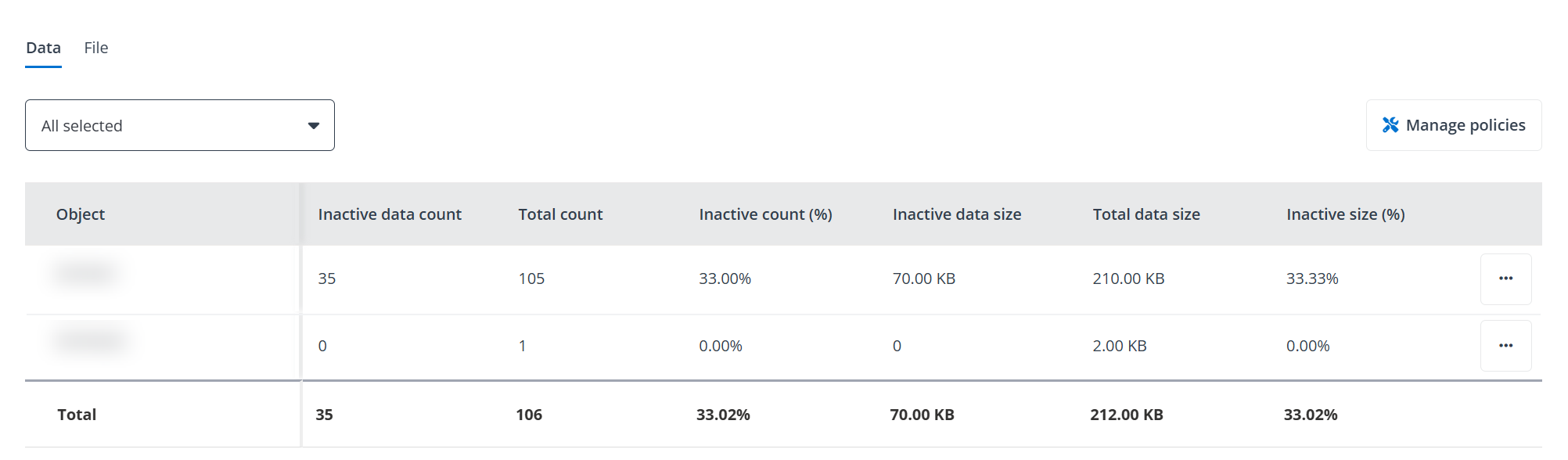
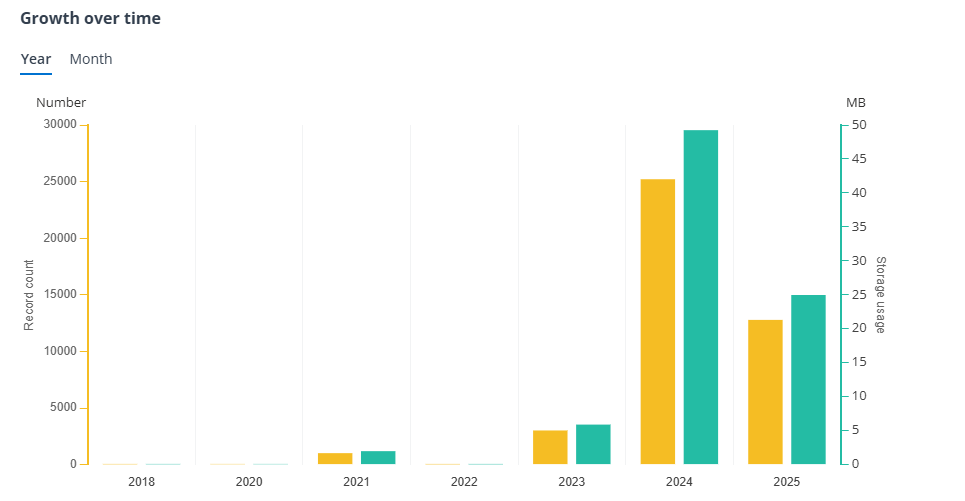
In the Growth over time chart, there are two tabs: Year and Month. You can hover your mouse over each bar for specifics. For the monthly report, data for the last 24 months will be displayed, and you can select the time range from the drop-down list.
Run Inactive Data Analysis
To run an inactive data analysis job, complete the following steps:
-
Click Archive in the left navigation.
-
Click Inactive data analysis.
-
On the Inactive data analysis page, you can select the organization to view the corresponding inactive data analysis report.
-
Click the Run analysis button.
-
On the Run analysis page, complete the following configurations:
-
Organization – Select the organization for which you want to run analysis.
-
Object – Select the objects for which you want to run analysis.
-
Conditions – Configure the conditions for the analysis. You can specify whether records must meet all or any of the configured criteria to be archived. By default, the condition is All of these criteria are true, meaning that records must meet all the configured criteria to be identified as inactive data. You can click All to change the condition to Any of these criteria are true. In this case, records that meet any of the configured criteria will be identified as inactive data.
Follow the steps to configure conditions for the analysis:
-
Select the Field, and configure the Value to define the conditions to filter the records.
-
Click the Add icon next to the condition and repeat the steps above to add more conditions. To remove a condition, click the Remove icon.
-
-
-
Once completed, click Run to run an analysis job.
Manage Archive Policies
On the top of the Archive > Archive policies page, you can select an organization for a comprehensive view of the archive policies and storage usage for your organization. For all archive policies in the organization, click the Archive policies button. The Archive page is automatically refreshed daily, and the object list used to create archive policies is also be updated. You can also click the Refresh button next to the last updated time to manually retrieve the latest archive information and object list for the selected organization.

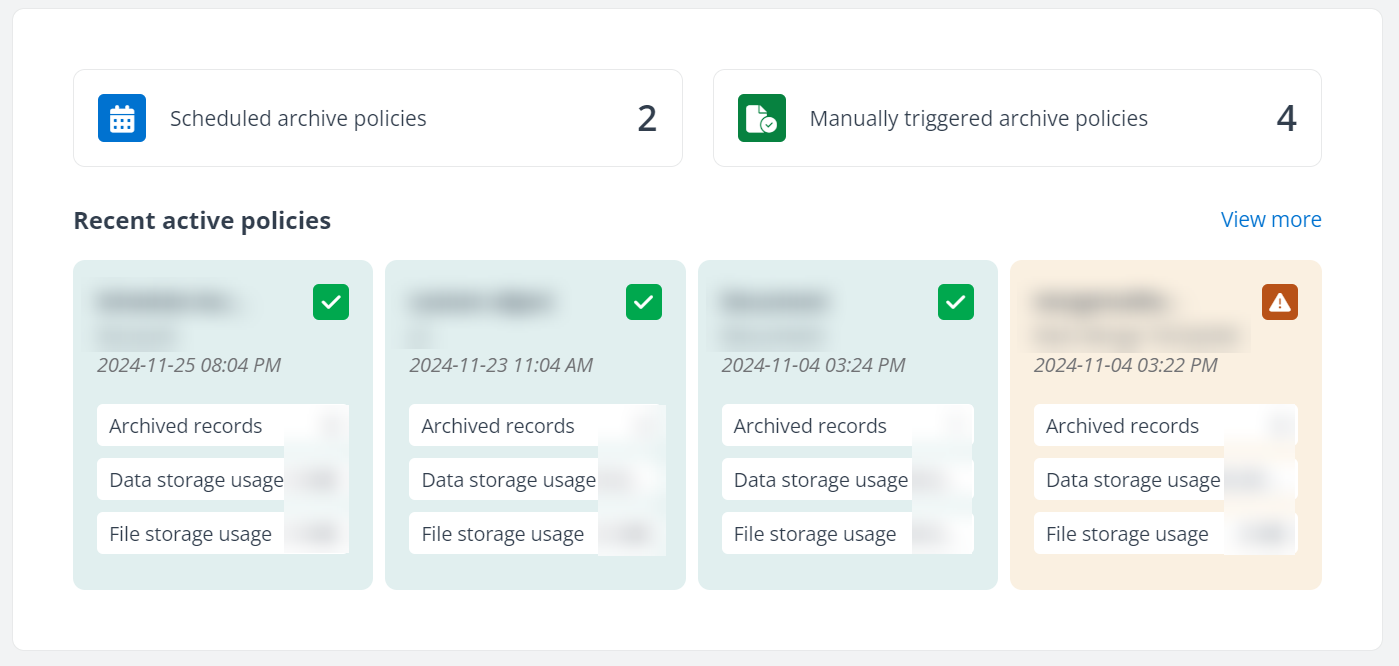
In the section for archive policies, you can view the total count of active policies with or without schedule enabled. The four most recent archive policies for the selected organization are listed, ordered by the last job completion time. Each policy displays the total number of records and data/file storage size archived by the policy. You can click View more for all archive policies in the organization.
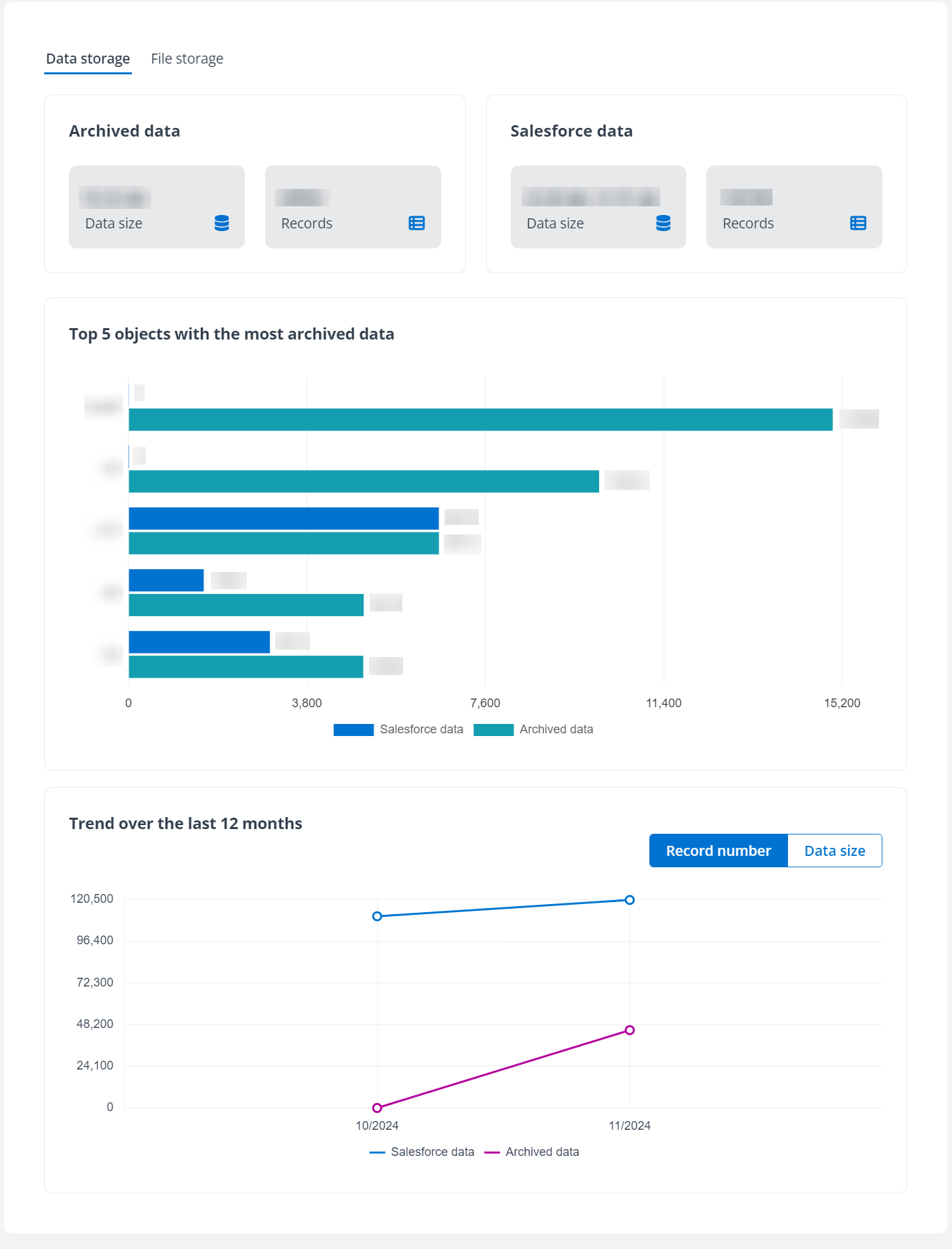
In the section for storage usage, there are two tabs: Data storage and File storage. In each tab, you can view the data size and record number separately for data archived by AvePoint and for current data in the Salesforce environment. For the Trend over the last 12 months, you can click on points in the chart to get information for each corresponding month. In the Data storage tab, the top 5 objects with the most archived data are also listed, along with the number of records archived and those currently in the Salesforce environment.
Create an Archiving Policy
Complete the following steps to create an archive policy. With a trial subscription, you can create up to 5 policies.
-
Click Archive in the left navigation.
-
Click Archive policies.
-
On the Archive policies page, select the organization for which you want to create archive policies.
-
Click the Archive policies button next to the selected organization or click View more in the Recent active policies section to navigate to the Manage policies page.
-
On the Manage policies page, click the Create button above the table. The Create an archive policy panel appears.
-
In the General information step, enter a name for the policy. You can also enter a Description for future reference.
-
Click Next to configure the data scope.
-
In the Organization field, select the organization for which you are creating the archive policy. Note that the organization cannot be changed once saved.
-
From the Object drop-down list, select the object for which you want to archive data. Note that the object cannot be changed once saved, and each object can only be included in one archive policy.
If the object you select is Content Document, you need to select a parent object. Its related content documents will be archived.
Note that if the Content Document has multiple parent links, those links might be lost when the document is archived. This means the document may no longer point to other parents still in Salesforce.
-
Two methods are provided to filter the records for archiving: Archive conditions and SOQL query.
Note that if the object you select is Content Document, records can only be filtered by Archive conditions.
-
Archive conditions – In the Archive conditions section, click Add new conditions. You can specify whether records must meet all or any of the configured criteria to be archived. By default, the condition is All of these criteria are true, meaning that records must meet all configured criteria to be archived. You can click All to change the condition to Any of these criteria are true. In this case, records that meet any of the configured criteria will be archived.
-
Follow the steps to configure conditions for the archive policy:
-
Select the Field and Operator, and configure the Value to define the archive conditions to filter the records.
-
Click the Add icon next to the condition and repeat the steps above to add more conditions. To remove a condition, click the Remove icon.
-
-
SOQL query – Click Switch to SOQL query and enter SOQL query in the text box. Ensure that the source object in the query matches the object you selected.
-
-
Configure the following settings:
-
Archive related child objects – Turn on/off the toggle to define whether to archive records of the first-level child objects of the selected object.
If you turn on the toggle, click Add child object to add a child object to the policy and select a Lookup field. You can continue to click Add child object to add more objects.
Note that in certain cases, when a record is deleted, Salesforce logic requires that all related records must also be deleted. In such instances, all related records will be removed together.
-
Include related Content Document – Turn on/off the toggle to define whether to archive related content documents of the selected object.
-
Skip archiving for previously restored records – Turn on/off the toggle to define whether to skip archiving for previously restored records.
-
Maximum number of records permitted in one archive job – Set a limit on the number of records archived in a single job to enhance performance and manage Salesforce API limits. The default is 10,000 records, with a maximum of 2 million records.
-
-
Click Next to configure archive settings.
-
In the Retention policy section, select a condition and configure the period. Archived data that meets the condition will be deleted.
-
Turn on/off the Enable scheduled archiving toggle to define whether to set a schedule for the policy. Once enabled, select the frequency, start date, and time for running the policy.
-
Click Next to go to the Overview page and review the policy settings.
-
You can take the following actions:
-
Save & Run – Save the archive policy and start an archive job according to the policy.
-
Save & Simulate – Save the archive policy and start a simulation job according to the policy. This can help avoid unintended changes in your Salesforce environment and ensure that you are only removing the data that you want.
-
Save – Save the archive policy.
-
Back – Return to the previous page.
-
Cancel – Close the panel without saving any configurations.
To manually run archive job for an existing policy, select the policy in the Manage policies page, and click the Archive button above the table. Note that the job will not start if there is already a running job for the organization.
To run a simulation job for existing policies, select the policies and click the Simulate button.
You can also click the Edit or Delete button to edit or delete the policy. Note that the organization and object selected for the policy cannot be changed.
-