
Home > Auto Discovery > Scan Profiles > Auto Discovery for Power Platform
Download this articleAuto Discovery for Power Platform
To manage scan profiles for scanning your Power Platform objects into AvePoint Online Services, navigate to Auto discovery > Scan profiles. On the Scan profiles page, you can create and edit scan profiles. For details on the other actions of managing scan profiles, see Manage Scan Profiles.
To create/edit a scan profile, refer to the following steps to configure settings in the Create scan profile / Edit scan profile wizard:
-
Choose object types – In the Tenant drop-down list, select a tenant for which the scan profile is created. Then, select the object types to be included in a scan profile for Power Platform.
The table below lists the services and apps which can scan Power Platform objects:
Service App type App setup method Scan object types Cloud Backup for Microsoft 365 delegated app Modern mode Power App, Power Automate, and Power BI Cloud Governance Cloud Governance for Power Platform Modern mode Environment, Power App, Power Automate, and Power BI Cloud Governance custom app with delegated permissions Custom mode Environment, Power App, Power Automate, and Power BI EnPower EnPower for Power Platform Modern mode Environment, Connection, Power App, Power Automate, Power BI, Solution, and Power Pages EnPower custom app with delegated permissions Custom mode Environment, Connection, Power App, Power Automate, Power BI, Solution, and Power Pages Fly Fly for Power Platform Modern mode Environment, Power App, and Power Automate Insights Insights for Power Platform Modern mode Power BI Required license/role:
-
The Power Platform Administrator role must be assigned to the consent user of the app profiles for scanning Environments, Connections, Power Apps, Solutions, Power Automate, or Power Pages objects.
-
The Power BI license and Fabric Administrator role must be assigned to the consent user of the app profiles for scanning Power BI objects.
-
To scan Power Pages objects, at least one Power Platform license must be assigned to the user account used to grant consent in the app profile.
NOTEFor details on creating app profiles, refer to Configure Default AvePoint App Profiles for Microsoft Tenants and Configure Custom Azure App Profiles.
Click Next to proceed.
-
-
Profile settings – Refer to the information below to configure the profile settings:
-
Name – Enter a name for the profile.
-
Description – Enter an optional description for the profile.
-
Auto-grant system administrator role to all your Power Platform environments – This setting is only available to the following object types: Power App, Power Automate, Solution, and Power Pages.
By default, it is disabled. Once enabled, during the scan job, users who consented to related apps will be granted the system administrator role for all your Power Platform environments.
Additional configurations are required after enabling this option. For details, refer to Additional Operations after You Enable the Auto-Grant System Administrator Role Option.
-
Scan personal workspaces (for Power BI only) – If you want to scan personal workspaces, turn on this toggle.
-
Enable daily scan – If you want to run this scan profile every day, turn on this toggle. The default start time of the daily scan job is displayed, and you can customize the start time when necessary.
-
Notify recipients via email when objects are moved or removed – Objects will be automatically moved to other containers when they match the containers’ rules. If you want to enable this notification, turn on the toggle. Then, select an email recipient profile from the Notification profile drop-down list. Whenever objects are moved to other containers or removed from AOS containers, the recipients in the selected profile will receive email notifications. If necessary, click Create email recipient profile to create one. For more instructions on configuring email recipient profiles, refer to Email Recipient Profile.
Click Next to proceed or click Previous to go back to the previous page.
-
-
Configure containers and rules – Refer to the information below to choose a scan mode:
-
Express mode will scan objects into default containers. This mode is the simplest way to get started.
-
Advanced mode will scan objects dynamically to containers defined by business rules you configure. If you select the advanced mode, follow the instructions below to configure containers and rules for each object type:
-
To add a rule, click Add. The Add rule pane appears on the right of the page.
-
Select a container – Select a container from the drop-down list. If necessary, click Create container to create one. For details on configuring containers, refer to Manage Containers.
-
Rule – Select All objects in one container or Specified objects in one container as the rule for this container.
NOTEIf you have configured criteria for the Specified objects in one container rule, you can click Rule for excluded objects to configure an additional rule for the objects that do not meet the criteria. If you select the All objects in one container rule, you will not be allowed to add other rules.
-
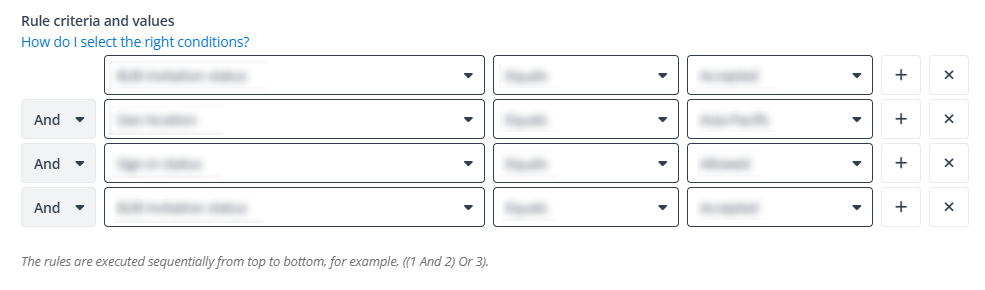
Rule criteria and values – If you select Specified objects in one container, follow the instructions below to configure Rule criteria and values to define specified objects.
-
To set a criterion, select an option from the drop-down list, and then configure values in the textbox. For more information on the supported criteria, refer to Supported Criteria in Auto Discovery Rules.
-
To add a criterion, click the plus button; to delete a rule, click the close button.
-
With multiple criteria, you must select And (objects that meet all criteria will be scanned into the container) or Or (objects that meet any of the criteria will be scanned into the container) as the logic for the criteria.
NOTEThe rules are executed sequentially from top to bottom, for example, ((1 And 2) Or 3).
-
-
Click Add at the bottom of the Add rule right pane to add the configured rule.
-
If you add multiple containers, set a container’s priority by selecting a number from the Priority drop-down list.
-
If you select the Specified objects in one container option, for the condition when the scan profile discovers objects that don’t meet the criteria configured in rules, you can click Rule for excluded objects to configure an additional rule. The default option of the additional rule is Do not add them to any containers. If you change the rule to Add them to one container, select a container from the drop-down list. Then, click Save.
-
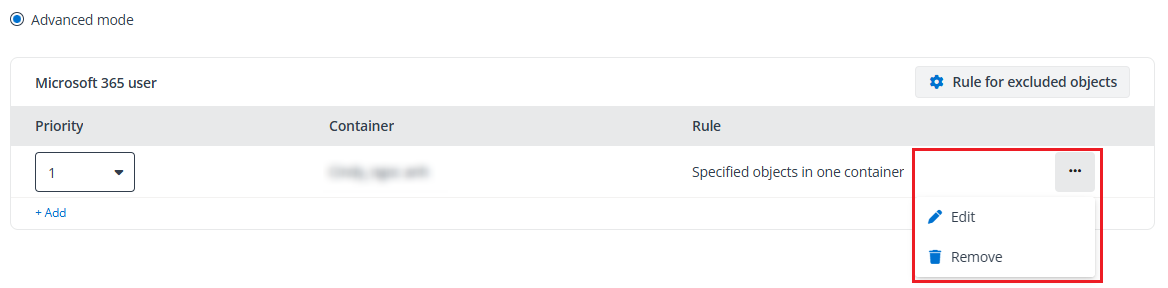
If you want to edit or remove a rule, hover the mouse on the rule, click the more options button, and then click Edit or Remove.
-
Click Next to proceed or click Previous to go back to the previous page.
-
-
Have an overview of the settings in the scan profile, and take one of the following actions:
-
If you want to save your configurations in the scan profile, click Save.
-
If you want to run the scan profile immediately, click Save and run.
-
If you want to go back to the previous page, click Previous.
-