
Home > Use ReCenter for Microsoft 365 > Recover Your Microsoft 365 Data > Microsoft 365 Groups
Download this articleMicrosoft 365 Groups
Based on your scenario, refer to the instructions in the following sections.
Recover Archived Group Data from AvePoint Opus
To recover files in Microsoft 365 Groups, refer to the instructions below based on your scenario.
Recover a file by clicking a stub in the Group team site
To restore or export an archived file by clicking a stub, follow the instructions below:
-
Go to a Group team site and click the stub of an archived file. A stub can be one of the following file types:
NOTEYou can only recover files archived from the Groups in your organization’s Microsoft 365 tenant. If you click the stub of a file archived from a Group in another Microsoft 365 tenant, the ReCenter restore page will not be available to you.
-
.url file – Click the file name to open the restore page of ReCenter in a new tab.
-
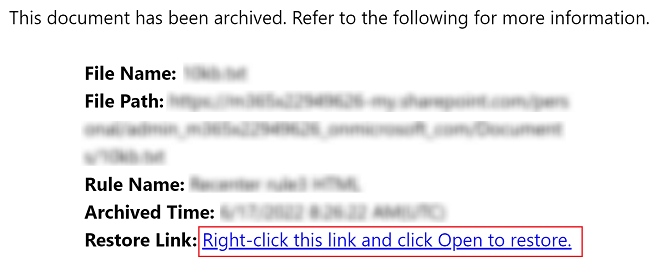
.aspx file – Click the file name to open the page for accessing ReCenter, and click the restore link.

-
.html file – Click the file name to open the page for accessing ReCenter, right-click the restore link to open the restore page in a new tab.

-
.txt file – Click the file name to open the page for accessing ReCenter. Ctrl + click the restore link to open the restore page in a new tab.

-
-
On the restore page of ReCenter, you can click Export to export and download the file to a local path. To restore archived data from AvePoint Opus, refer to the following steps:
-
Click Restore and select to restore the file to its original location or a different stub location.
-
If you select Restore to original location, jump to Step 3.
-
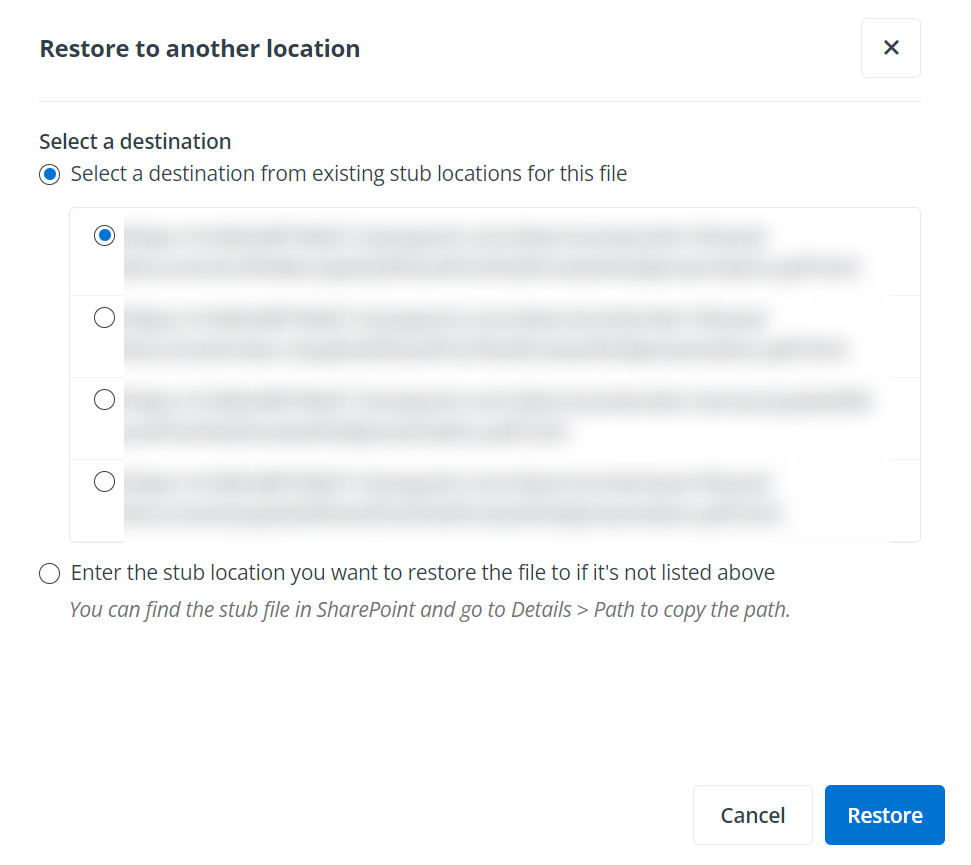
If you select Restore to another location, the Restore to another location panel appears.
-
-
In the Restore to another location panel, you can select a destination from existing stub locations for this file. If the stub location you desired is not listed, select the other option and enter the stub location you want to restore the file to. You can find the stub file in SharePoint and go to Details > Path to copy the path.
NOTEAdministrators can control whether users are allowed to restore stub files to another location and configure if users can choose or manually input a destination location in the Restore settings of AvePoint Opus.

-
Click Restore to restore the file.
-
-
Follow the instructions below to check the restored file or download the exported file.
-
After the restore job completes, you can go to the file location by clicking Take me there or clicking the URL on the page.
 NOTE
NOTE-
A stub will be removed after the file is successfully restored.
-
Both content and security of the file will be restored.
-
By default, sharing links for the content won’t be restored. Administrators can go to Restore Settings in AvePoint Opus to enable the restoration of sharing links.
-
If the administrator has disabled the option for end-users to restore data from the archives, the restore job will fail.
-
If a file with the same name already exists in the original location, a sequential number suffix (for example, _1) will be added to the name of the restored file.
-
-
After the export job is completed, follow the steps below to download the exported content:
NOTEThe exported content of a job will be available for download within 7 days. You can also go to Request history to Download content of an export job and Get a password to decrypt the downloaded content.

-
Click Download content on the restore page.
-
Once the content has been downloaded, the Get password page will appear. Click Copy to copy the password, and use the password to decrypt the downloaded content. You can also click Get password from the Download drop-down list to open this page.

-
-
-
Simple job reports are recorded in Request history where you can view job reports and download exported data. For more details, refer to View Request History and Download Exported Data.
Search and recover files in the Groups where you are an owner or a member
Go to the ReCenter portal, and follow the steps below to restore or export files from a Microsoft 365 Group where you are one of the Group owners or members:
-
In AvePoint Opus, the administrator can configure the end-user restore setting to control whether to allow Group owners and members to restore/export data from ReCenter.
-
Groups with dynamic membership are now supported and can be searched in ReCenter.
-
Click the Microsoft 365 Groups tile.
-
When you click the Group field, this field will list all Groups that you have joined. To search for a Group, you can enter keywords based on the Group name, and then select that Group from the drop-down list.

-
To search for documents in a Group, choose one of the following methods:
-
If you want to search for documents by their names, enter keywords in the search box.
-
If you want to narrow your search by additional conditions, click Advanced to expand the search panel and configure the following conditions:
-
Document name – Enter keywords of a document name.
-
Folder name or location – Enter keywords of a folder name, or enter a folder location (example: folder name\subfolder name).
-
Created by – Enter keywords of the creator’s email address.
-
Modified by – Enter keywords of the editor’s email address.
-
Created date (from) / Created date (to) – Specify a time range.
-
Archived date – Specify an archived time range. The default time range is the past month.
-
-
For customers with the eDiscovery function in preview in AvePoint Opus, if you want to perform a full-text search across data archived by AvePoint Opus, click Advanced to expand the search panel.
-
Multiple-condition search – To search across data archived by AvePoint Opus, configure the following conditions:
-
Document name – Enter keywords of a document name.
-
Content (only for archived data) – Enter keywords related to the document content. Note that this field is only for data archived by AvePoint Opus. Ensure the site URL you have configured has been added to the Inclusion list in AvePoint Opus.
-
Folder name or location – Enter keywords of a folder name, or enter a folder location (example: folder name\subfolder name).
-
Created by – Enter keywords of the creator’s email address.
-
Modified by – Enter keywords of the editor’s email address.
-
Created date – Specify a created time range.
-
Archived date – Specify an archived time range. The default time range is the past month.
-
-
Full-text search (only for archived data) – To search across data only archived by AvePoint Opus, ensure the site URL you have configured has been added to the Inclusion list in AvePoint Opus, and configure the following conditions:
-
Keywords – Enter keywords for full-text search. The field now supports custom metadata as well.
-
Folder name or location – Enter keywords of a folder name, or enter a folder location (example: folder name\subfolder name).
-
Created by – Enter keywords of the creator’s email address.
-
Modified by – Enter keywords of the editor’s email address.
-
Created date – Specify a created time range.
-
Archived date – Specify an archived time range. The default time range is the past month.
-
-
Click Search to search for the archived data. If you want to reset the search conditions, click Reset.
-
-
The search results are listed in the table under the Archived data tab. A maximum of 2000 search results can be displayed.
NOTEEnd users can click Export search results to run a search result export job if they have any of the following permissions: Search, Restore, or Export. To restrict the capability to export search results, administrators should ensure none of these permissions are assigned to users in the Restore settings of AvePoint Opus.
-
Select the checkboxes next to the documents that you want to recover. If you want to select all documents, select the top checkbox next to Document name in the table.
-
Click Restore to restore selected documents to their original locations, or click Export to export and download them to a local path.
NOTE-
A stub will be removed after the file is successfully restored.
-
Both content and security of the file will be restored.
-
By default, sharing links for the content won’t be restored. Administrators can go to Restore Settings in AvePoint Opus to enable the restoration of sharing links.
-
If the administrator has disabled the option for end-users to restore data from the archives, the restore job will fail.
-
If a file with the same name already exists in the original location, a sequential number suffix (for example, _1) will be added to the name of the restored file.
-
-
Once the restore or export job starts, you can go to Request history to view the progress of the job. In Request history, you can also view jobs’ simple reports, and click the Download content icon next to an export job to download the exported data. Note that the exported data of a job will be available for download within 7 days. For more details, refer to View Request History and Download Exported Data.
Recover Backup Group Data from Cloud Backup for Microsoft 365
Go to the ReCenter portal, and follow the steps below to recover files from a Group where you are one of the Group owners or members:
In Cloud Backup for Microsoft 365, the administrator can configure the end-user restore setting to control whether to allow Group owners and members to preview, restore or export Microsoft 365 Groups backup data from ReCenter.
-
Click the Microsoft 365 Groups tile.
-
Select whether you want to find the backup data of a Microsoft 365 Group team site or a Microsoft 365 Group mailbox.
-
When you click the Group field, this field will list all Groups that you have joined. To search for a Group, you can enter keywords based on the Group name, and then select that Group from the drop-down list.

-
To search for documents choose one of the following methods:
-
If you want to search for documents in Group team site by their names, or search for Group mailbox items by subject, enter keywords or subject in the search box.
-
If you want to narrow your search by additional conditions, click Advanced to expand the search panel and configure the following conditions:
-
Enter keywords of a Document name in Group team site or enter Subject keywords of a Group mailbox item in Group mailbox.
-
Folder name or location – Enter keywords of a folder name, or enter a folder location (example: folder name\subfolder name).
-
Created by – Enter keywords of the creator’s email address.
-
Modified by – Enter keywords of the editor’s email address.
-
Created date (from) / Created date (to) – Specify a time range.
-
Click Search to search for the backup data. If you want to reset the search conditions, click Reset.
-
-
The search results are listed in the table under the Backup data tab. A maximum of 2000 search results can be displayed.
You can do the following:
-
By default, the items listed in the search results table are the latest backup data. If your desired items are not in the table and the message Continue to search for more backup data by clicking here. is displayed at the bottom of the table, click here to continue with the search.
-
If you want to modify the search conditions, click the Advanced search button to expand the advanced search panel and configure the search conditions. You can click the Cancel button to clear the current search conditions.
-
Click the document name of a file to preview the file content. In the preview window, use the buttons located in the upper-right corner to restore, download, or print for the file. When downloading the file, set a password. This password will be required to open the downloaded file.
By default, the Generate public link button is not available in the preview window. Administrators can enable this option by navigating to the End-user restore settings in Cloud Backup for Microsoft. When generating a public link, set both an expiration date and a password to ensure security.
The following file types are supported by the preview function: Word (DOC, DOCX, RTF, DOT, DOTX, and DOTM), Excel (XLS, XLSX, XLSB, XLT, XLTX, CSV, and TSV), PowerPoint (PPT, PPTX, PPS, POT, PPSX, PPTM, PPSM, POTX, and POTM), and PDF.
NOTEFiles that have sensitivity labels with encrypted data, contain archived data, or exceed 10 MB in size cannot be previewed.
-
-
Select the checkboxes next to the documents that you want to recover. If you want to select all documents, select the top checkbox next to Document name or Subject in the table.
-
Click Restore to restore selected documents to their original locations, or click Export to export and download the selected documents to a local path.
NOTE-
Both content and security of the selected items will be restored.
-
The current and previous versions will all be restored.
-
By default, sharing links for the content won’t be restored. When necessary, administrators can enable the restore of sharing links in Cloud Backup for Microsoft 365.
-
If the last modified time of the conflicting destination content is the same, the restore will be skipped; if the last modified time is different, the conflicting destination content will be kept, and the backup data of the conflicting content will be added to the destination with a sequential number suffix (for example, _1) added to the file name.
-
-
Once the restore/export job starts, you can go to Request history to view the progress of the job. In Request history, you can also view simple job reports and download exported data. For more details, refer to View Request History and Download Exported Data.