
Home > Standalone Tool > Data Export Service > Restore Backup Data via This Tool
Download this articleRestore Backup Data via This Tool
Follow the instructions below to restore the backup data using the standalone tool.
-
Extract the package and find the StandaloneTool.exe file.
-
Double-click the StandaloneTool.exe application file. The AvePoint Cloud Backup for Google Workspace Standalone Tool window appears.
-
Click Decrypt and export backup data.
-
In the Backup data location step, select the data type that you want to export.
-
Select the storage type and configure the storage information by referring to the following instructions.
Microsoft Azure Blob Storage:
-
Access point – Enter the URL for the Blob Storage Service. The default URL is https://blob.core.windows.net.
-
Container name – Enter the name for the container you wish to access.
-
Account name – Enter the corresponding account name to access the specified container.
-
Account key – Enter the corresponding account key to access the specified container.
-
Extended parameters – Refer to the instructions below to configure Extended parameters, and note that if you have multiple parameters to enter, use the semicolon (;) to separate the parameters.
-
RetryInterval – Customize the retry interval when the network connection is interrupted. You are allowed to enter any positive integer from 0 to 2147483646 (the unit is in milliseconds). For example, RetryInterval=30000 means that it will try to reconnect every 30000 milliseconds.
If you do not configure this parameter, the value is 30000 milliseconds by default.
-
RetryCount – Customize the reconnection times after the network connection is interrupted. You are allowed to enter any positive integer from 0 to 2147483646. For example, RetryCount=10 represents when the network connection is interrupted, it can reconnect at most 10 times.
If you do not configure this parameter, the value is 6 by default.
-
Amazon S3:
-
Bucket name – Enter a name for the bucket you want to access or create.
-
Access key ID – Enter the corresponding access key ID to access the specified bucket. You can view the access key ID from your AWS account.
-
Secret access key – Enter the corresponding secret key ID to access the specified bucket. You can view the secret key ID from your AWS account.
-
Storage region – Select the storage region of this bucket from the drop-down list.
-
Extended parameters – Refer to the instructions below to configure Extended parameters, and note that if you have multiple parameters to enter, use the semicolon (;) to separate the parameters.
-
RetryCount – Customize the reconnection times after the network connection is interrupted. Enter any positive integer from 0 to 2147483646. For example, RetryCount=6 represents when the network connection is interrupted, and it can reconnect at most 6 times.
If you do not configure this parameter, the value is 6 by default.
-
RetryMode – Customize the retry mode for the requests not being completed successfully. If this parameter is not configured or configured incorrectly, the Legacy will be applied as the default value. You can also set the value to Standard or Adaptive. Standard represents the standardized request retry strategy which is consistent across all SDKs; Adaptive represents an experimental request retry strategy that builds on the Standard strategy and introduces congestion control through client-side rate limiting.
-
Amazon S3-Compatible Storage:
-
Bucket name – Enter a name for the bucket you want to access or create.
-
Access key ID – Enter the corresponding access key ID to access the specified bucket.
-
Secret access key – Enter the corresponding secret access key to access the specified bucket.
-
Endpoint – Enter the URL used to connect to the place where you want to store the data.
-
Extended parameters – Refer to the instructions below to configure Extended parameters, and note that if you have multiple parameters to enter, use the semicolon (;) to separate the parameters.
-
RetryCount – Customize the reconnection times after the network connection is interrupted. Enter any positive integer from 0 to 2147483646. For example, RetryCount=6 represents when the network connection is interrupted, it can reconnect at most 6 times.
If you do not configure this parameter, the value is 6 by default.
-
RetryMode – Customize the retry mode for the requests not being completed successfully. If this parameter is not configured or configured incorrectly, the Legacy will be applied as the default value. You can also set the value to Standard or Adaptive. Standard represents the standardized request retry strategy which is consistent across all SDKs; Adaptive represents an experimental request retry strategy that builds on the Standard strategy and introduces congestion control through client-side rate limiting.
-
Google Cloud Storage:
-
Service account email – Enter the email address of a service account that has the permission to access your bucket.
-
Project ID – Enter the ID of a project that is associated with your bucket.
-
Private key – Enter a private key that is associated with the service account.
-
Bucket name – Enter a bucket name.
-
Extended parameters – Refer to the instructions below to configure Extended parameters, and note that if you have multiple parameters to enter, use the semicolon (;) to separate the parameters.
-
Projection – Customize the projections that can be specified as options in various operations. You can set this value to Full if you want to include all properties, or set this value to NoAcl if you want to omit the ACL (Access Control List) property.
-
PredefinedAcl – Customize a pre-defined ACL of the bucket for simple access control scenarios. The following values are available for this parameter:
-
AuthenticatedRead – This value represents that the object owner gets owner access and all authenticated users get reader access.
-
Private – This value represents that the object owner gets owner access.
-
ProjectPrivate – This value represents that the object owner gets owner access, and project team members get access according to their roles.
-
PublicRead – This value represents that the object owner gets owner access, and all users get reader access.
-
PublicReadWrite – This value represents that the object owner gets owner access, and all users get writer access.
-
PredefinedDefaultObjectAcl – Customize predefined access control lists (ACLs) that can be specified when creating or updating objects. The following values are available for this parameter:
-
AuthenticatedRead – This value represents that the object owner gets owner access and all authenticated users get reader access.
-
BucketOwnerFullControl – This value represents that the object owner gets owner access and all authenticated users get reader access.
-
BucketOwnerRead – This value represents that the object owner gets owner access and project team owners get reader access.
-
Private – This value represents that the object owner gets owner access.
-
ProjectPrivate – This value represents that the object owner gets owner access and project team members get access according to their roles.
-
PublicRead – This value represents that the object owner gets owner access and all users get reader access.
-
Prefix – Set this value to the string which the bucket name starts with.
-
IBM Storage Protect - S3:
-
Bucket name – Enter the bucket name you wish to access.
-
Access key ID – Enter the corresponding access key ID to access the specified bucket.
-
Secret access key – Enter the corresponding secret key ID to access the specified bucket.
-
Endpoint – Enter the URL used to connect to the place where you want to store the data.
Note that the URL must begin with ‘’http://’’ or ‘’https://’’.
-
Extended parameters – Refer to the instructions below to configure Extended parameters, and note that if you have multiple parameters to enter, use the semicolon (;) to separate the parameters.
-
Use_PathStyle – The default value of this parameter is true to ensure the Cloud Backup for Google Workspace can work with your storage properly.
-
RetryCount – Customize the reconnection times after the network connection is interrupted. Enter any positive integer from 0 to 2147483646. For example, RetryCount=6 represents when the network connection is interrupted, and it can reconnect at most 6 times.
If you do not configure this parameter, the value is 6 by default.
-
RetryMode – Customize the retry mode for the requests not being completed successfully. If this parameter is not configured or configured incorrectly, the Legacy will be applied as the default value. You can also set the value to Standard or Adaptive. Standard represents the standardized request retry strategy which is consistent across all SDKs; Adaptive represents an experimental request retry strategy that builds on the Standard strategy and introduces congestion control through client-side rate limiting.
-
Allow_Insecure_SSL – By default, the storage client expects an SSL certificate issued by a public trusted certificate authority over HTTPS transport to ensure integrity. A self-signed certificate on the storage server side will fail the certificate validation. If you choose to use a self-signed certificate, you can set the Allow_Insecure_SSL to true in the Extended parameters to bypass the certificate validation.
-
Cert_thumbprint – If you use a self-signed certificate on the storage server side and you want to pass the certificate validation with a specific thumbprint, set the value to the thumbprint string.
By default, the Cert_thumbprint parameter is not configured.
-
IBM Cloud Object Storage:
-
Bucket name – Enter the bucket name you wish to access.
-
Access key ID – Enter the corresponding access key ID to access the specified bucket.
-
Secret access key – Enter the corresponding secret key ID to access the specified bucket.
-
Endpoint – Enter the URL used to connect to the place where you want to store the data.
Note that the URL must begin with “http://” or “https://”.
-
Extended parameters – Refer to the instructions below to configure Extended parameters, and note that if you have multiple parameters to enter, use the semicolon (;) to separate the parameters.
-
RetryCount – Customize the reconnection times after the network connection is interrupted. Enter any positive integer from 0 to 2147483646. For example, RetryCount=6 represents when the network connection is interrupted. It can reconnect at most 6 times.
If you do not configure this parameter, the value is 6 by default.
-
RetryMode – Customize the retry mode for the requests not being completed successfully. If this parameter is not configured or configured incorrectly, the Legacy will be applied as the default value. You can also set the value to Standard or Adaptive. Standard represents the standardized request retry strategy which is consistent across all SDKs; Adaptive represents an experimental request retry strategy that builds on the Standard strategy and introduces congestion control through client-side rate limiting.
-
-
-
Click Next.
-
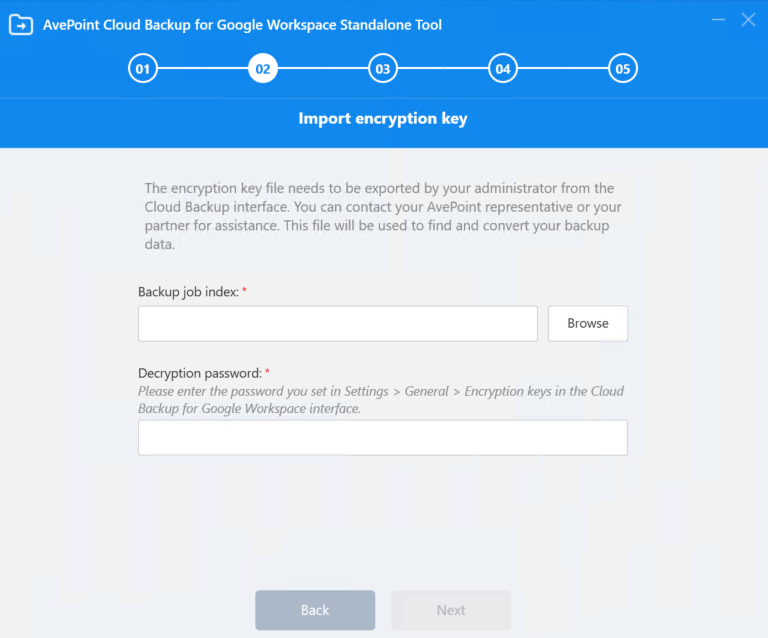
In the Import encryption key step, click Browse to browse and select the ZIP file of the encryption keys, and enter the password you set in AvePoint Cloud Backup for Google Workspace to access the encryption keys. This export tool will find the backup data from your storage and convert it to plain file format.
-
Click Next.
-
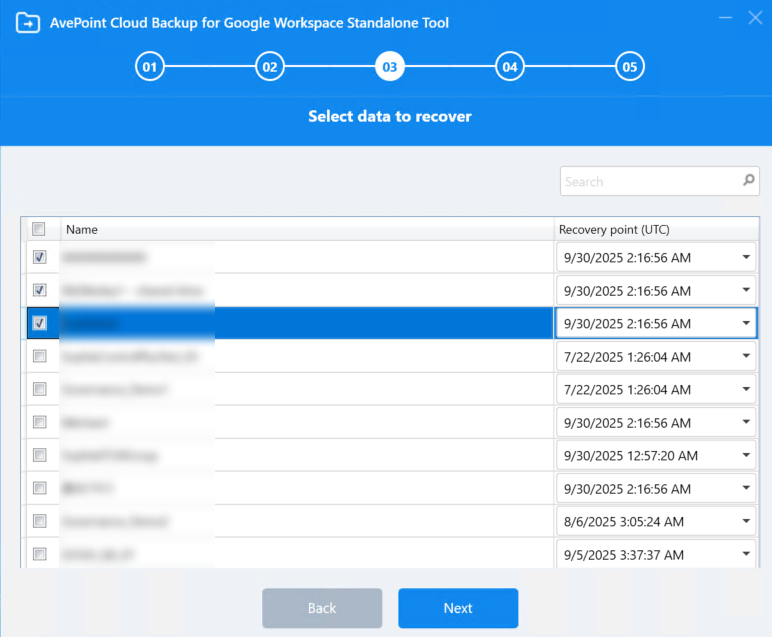
In the Select data to recover step, select the items to revert them to the state of the selected recovery point.
-
Click Next.
-
In the Select export location step, click Browse to select a disk or folder to store the exported data. If your organization uses a BYOS subscription, you can choose to export the data to the Original BYOS location.
-
Click Next to start the export job.