Home > Granular Backup & Restore > Back Up Your Data
Download this articleBack Up Your Data
Granular Backup and Restore offers full and incremental backup capabilities for SharePoint Online, OneDrive for Business, Microsoft 365 group team sites (including Microsoft Teams sites), enabling you to build backup plans and schedules that focus on frequently backing-up high priority data to improve operations and storage efficiency. To back up your data:
Launch Granular Backup and Restore
To launch Granular Backup and Restore, complete the following steps:
-
Log into AvePoint Online Services and navigate to Classic DocAve Backup. The DocAve tab displays all modules on the left side of the window.
-
From the DocAve tab, click Data Protection to view the backup modules.
-
Click Granular Backup & Restore to launch this module.
Configure Auto Discovery
Prior to building backup plans in Granular Backup and Restore in Classic DocAve Backup, you must register the objects in your Microsoft 365 environment.
If you want to scan and add Microsoft 365 objects, navigate to AvePoint Online Services > Auto discovery and configure registration profiles. For details, refer to Manage Auto Discovery.
Auto Discovery provides the service account profile and app profile authentication methods to scan objects. If you choose the app profile authentication method to scan objects, the app token within the app profile will be used to back up or manage data. However, this method has some limitations on data and functionalities. For details about the limitations, refer to Appendix A - SharePoint Online Data Types and Appendix B - Supported and Unsupported Functionalities.
Perform a Backup
There are several ways to configure and perform a granular backup. Once you select the content you want, you can run backups using either an Ad Hoc Backup or the Plan Builder.
Ad Hoc backups are a quick, easy way to run a backup as needed. They back up the selected content immediately without scheduling, using default settings that are configured just before running the backup.
The Plan Builder, however, allows you to define and refine the type, schedule, and other options for a backup so you can set it and forget it.
Run an Ad Hoc Backup
Ad Hoc backups are a quick, easy way to run a backup as needed. They back up the selected content immediately without scheduling, using Default Settings configured just before running the backup.
To perform an Ad Hoc Backup, follow the steps below:
-
Launch Granular Backup and Restore. For more information, see Launch Granular Backup and Restore.
-
On the ribbon, in the Backup tab, click Ad Hoc Backup.
-
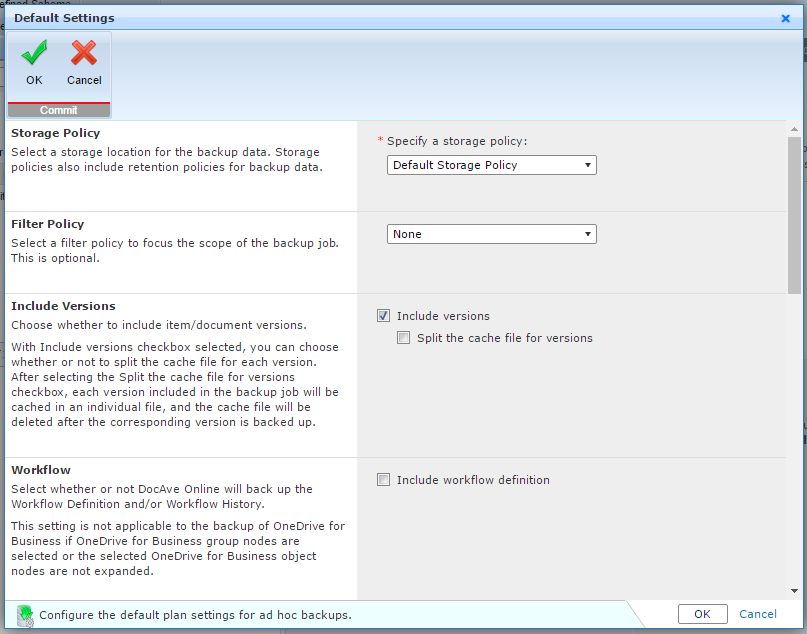
Select Default Settings. The Default Settings page will appear.
-
Configure the options on the Default Settings page. On this page, you can choose the storage and filter policies, as well as other options for your Ad Hoc backups.
NOTEThe Include versions function limits full backups to 50 previous versions and limits incremental backups to 10 previous versions.
-
Click OK. The Default Settings page will close.
-
Select the objects you’d like to back up from the scope tree on the left panel.
-
If a OneDrive for Business group node is selected, only the Documents library, the related metadata, and the related permissions will be backed up. If the Site Notebook feature is activated, the Site Assets library, the related metadata, and the related permissions will also be backed up.
-
If the Select All checkbox under a OneDrive for Business group node is selected or if one or multiple OneDrive for Business object nodes are selected, the OneDrive for Business objects will be backed up as follows:
-
If a OneDrive for Business object is expanded, the entire OneDrive for Business object will be backed up.
-
If a OneDrive for Business object is not expanded, only the Documents library, the related metadata, and the related permissions will be backed up. If the Site Notebook feature is activated, the Site Assets library, the related metadata, and the related permissions will also be backed up.
NOTEIf OneDrive for Business group nodes are selected, or the selected OneDrive for Business object nodes are not expanded, the backup settings for workflow, list view, Information Rights Management, and Managed Metadata Service are not applicable to OneDrive for Business objects.
-
-
-
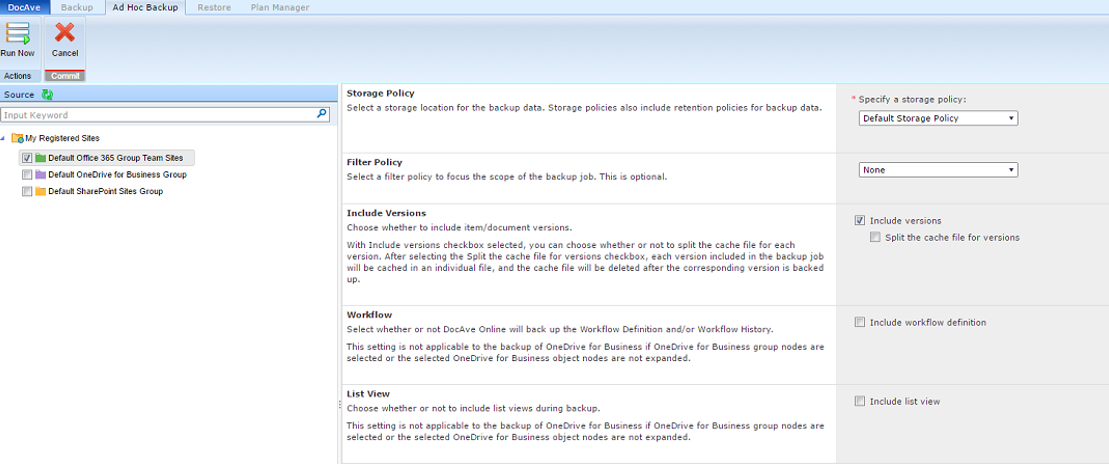
On the ribbon, in the Backup tab, click Ad Hoc Backup, and then select Ad Hoc Backup. The default settings will appear in the right panel.
-
Click Run Now on the ribbon.
After you click Run Now, the Ad Hoc Backup will be added to the job queue. To view its details about the backup job’s progress, click Job Monitor on the ribbon. Note that the Date Range for backup jobs in Job Monitor is Last 30 Days by default.
Create a Backup with the Plan Builder
The Plan Builder allows you to set the schedule, the type of backup, or if you want to use the Predefined Schemes features.
When configuring a backup plan, there are two backup types: Full or Incremental.
-
Full Backups – Back up all the selected data each time a backup is performed. Unlike incremental backups, all full backup files are independent of one another and do not have any dependencies on other back up data files. Additionally, since each of the backups is comprehensive, full back up jobs take the longest to complete of the available options.
-
Incremental Backups – Back up only the content that has been updated since the last backup, drastically reducing the size of the backup file created.
To create a backup plan, follow the steps below:
-
Launch Granular Backup and Restore. For more information, see Launch Granular Backup and Restore.
-
Select the objects you’d like to back up from the scope tree on the left panel.
-
If a OneDrive for Business group node is selected, only the Documents library, the related metadata, and the related permissions will be backed up. If the Site Notebook feature is activated, the Site Assets library, the related metadata, and the related permissions will also be backed up.
-
If the Select All checkbox under a OneDrive for Business group node is selected or if one or multiple OneDrive for Business object nodes are selected, the OneDrive for Business objects will be backed up as follows:
-
If a OneDrive for Business object is expanded, the entire OneDrive for Business object will be backed up.
-
If a OneDrive for Business object is not expanded, only the Documents library, the related metadata, and the related permissions will be backed up. If the Site Notebook feature is activated, the Site Assets library, the related metadata, and the related permissions will also be backed up.
-
-
-
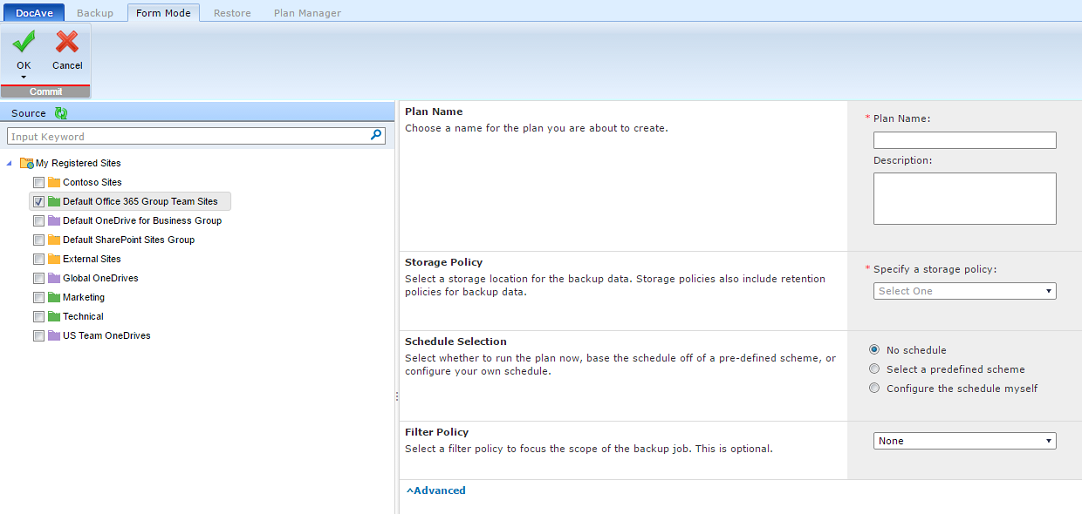
On the ribbon, in the Backup tab, click Plan Builder. The Plan Builder will appear on the right panel.
-
Enter a Plan Name.
-
Select a Storage Policy from the drop-down list.
-
Select a schedule type. You can choose:
-
No Schedule – Select this option if you want to run this backup manually without creating a schedule for it.
-
Select a predefined scheme – Select this option to choose a predefined schedule scheme or create a new predefined scheme. There are two default schemes: Weekly Scheme and Monthly Scheme. The Weekly Scheme performs a full backup every Saturday and incremental backups every day except Saturdays. The Monthly Scheme performs a full backup every four weeks starting at the Start Time you set and incremental backups every day.
You can click on the items in the schedule summary box to edit the schedule.
-
Configure the schedule myself – Select this option to configure a customized schedule, and run the backup job by schedule. Click Add Schedule to set up a schedule.
-
-
Select a Filter Policy.
-
Click Advanced. The advanced backup options will appear. These settings are optional. Here you can choose to: backup versions, workflows, and list views; enable or disable Information Rights Management, Managed Metadata Service, system update, and incremental backup job settings; as well as the data compression and encryption types. If you want to enable data encryption and need to create a security profile, refer to the Create a Security Profile section in AvePoint Cloud Management User Guide.
NOTEThe backup settings for workflow, list view, Information Rights Management, and Managed Metadata Service are not applied to OneDrive for Business objects if the OneDrive for Business group nodes are selected, or the selected OneDrive for Business object nodes are not expanded in the job.
-
Click OK, and select either:
-
OK, which adds the job to the schedule.
-
OK and Run Now, which immediately runs the backup by adding it to the job queue.
-
-
After the backup job plan has been created, you can edit, delete, test run, run, and view its details in the Plan Manager.
Manage Your Backup Plans
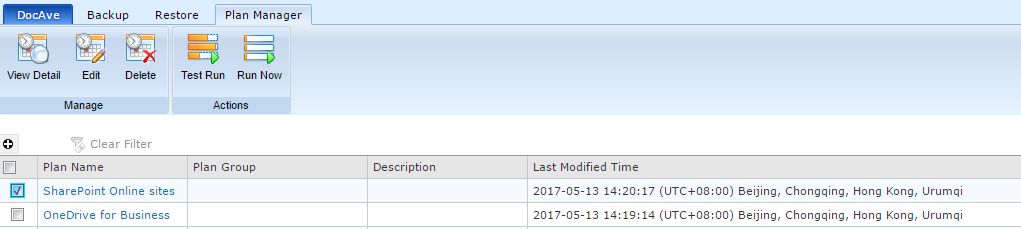
After creating a backup plan, you can edit, delete, test run, run, and view its details in the Plan Manager. Navigate to the Plan Manager, by selecting the Plan Manager tab on the ribbon.
To manage a plan or view its details, select the plan name. Click View Detail on the ribbon, and the View Detail page will appear.