
Home > What Can I Do as a User?
Download this articleWhat Can I Do as a User?
The following sections list the activities that a user can perform in Confide.
View My Projects
The My projects page displays the projects that you have access to. Projects are organized into three tabs for easy navigation: All, Active, and Inactive. You can click a project to open that specific project. A project is accessible to you after you are invited to the project with permissions assigned.
You can also search for a project by entering keywords of the project name or description in the search box.
Dashboard
As Users, you can view different dashboards depending on whether task trackers have been enabled in the tenant that hosts the projects.
Dashboard with Task Trackers
You can use the project dashboard to keep a close eye on changes to a project.
-
Completed tasks – Displays the percentage of completed tasks within all tasks assigned to you in this project.
-
Open tasks – Displays the number of open tasks assigned to you. You can click the arrow button next to the number to go to the My tasks page to view the task list.
-
New tasks – Displays the number of new tasks assigned to you, but that have not been processed yet. You can click the arrow button next to the number to go to the My tasks page to view the task list.
-
Due this week – Displays the number of tasks assigned to you and will be due this week. You can click the arrow button next to the number to go to the My tasks page to view the task list.
-
Recent activities – Displays the latest 10 activities that you have performed, including uploading files, viewing files, and downloading files.
-
Favorite files – Displays the latest 20 files you have added to favorites. If there are more than 20 favorite files, you can click View more to load another 20 files.
-
New files – Displays the 20 newly uploaded files that you have access to. If there are more than 20 new files, you can click View more to load another 20 files.
In the Your tasks list, all your open tasks are displayed by default. You can click the Open tasks drop-down list to view completed or all tasks in the current project. You can also click the Filter button to filter tasks. Configure request types, due date, requestors, categories, and priorities, and then click Apply. Tasks that meet the configured filter criteria are displayed.
You can find the following information of the tasks in the list:
-
Title – The title of the task. You can click the title link to view the task details.
-
Folder – The folder that is associated with this task.
-
Requestor – The requestor of the task.
-
Type – The type of the task.
-
Category – The category of the task.
-
Due date – The due date of the task.
-
Priority – The priority of the task.
-
File icon – Indicates if any file has been uploaded for this task.
-
Chat icon – Indicates if there is any chat for this task.
Dashboard without Task Trackers
You can use the project dashboard to keep a close eye on changes to a project.
-
Files you may be interested in… – Displays the files you have access to in your project.
NOTEThis part appears when you open the dashboard for the first time after being invited to a project. You can check out the files and folders you have access to by clicking the project library link.
-
Your recent activities – Displays the latest 6 activities that you have performed, including uploading files, viewing files, and downloading files.
-
Your favorite files – Displays the latest 6 files you have added to favorites. You can click See all to navigate to the Favorite files folder on the Project library page to view all new files.
-
New files – Displays the 10 newly uploaded files that you have access to. You can click See all to navigate to the New files folder on the Project library page to view all new files.
If there are more than 10 new files, you can click View more to load another 10 files.
-
New tasks – Displays 10 newly created tasks assigned to you, but that have not been processed yet. You can click See all to navigate to the My tasks page.
If there are more than 10 new tasks, you can click View more to load another 10 tasks.
-
Project overview – Displays the general information of this project.
Manage Files in Project Library
Each project has a library which is a collection of folders and subfolders for storing files.
All files
Switch between Folder and Overview tabs on the All files page to find and manage the files detailed below:
-
Folder – Folder structure is displayed. Select a folder from the left pane, and then all files within this specific folder are displayed on the right pane.
-
Overview – All files within the project are displayed and grouped by file status. Select a group from the left pane, and then files that meet the specific status are displayed on the right pane.
You can locate and drag the middle section to adjust the width of the left and right panes.
To search for folders and files by name, enter a keyword in the search text box, and then press Enter on your keyboard. Search results are displayed.
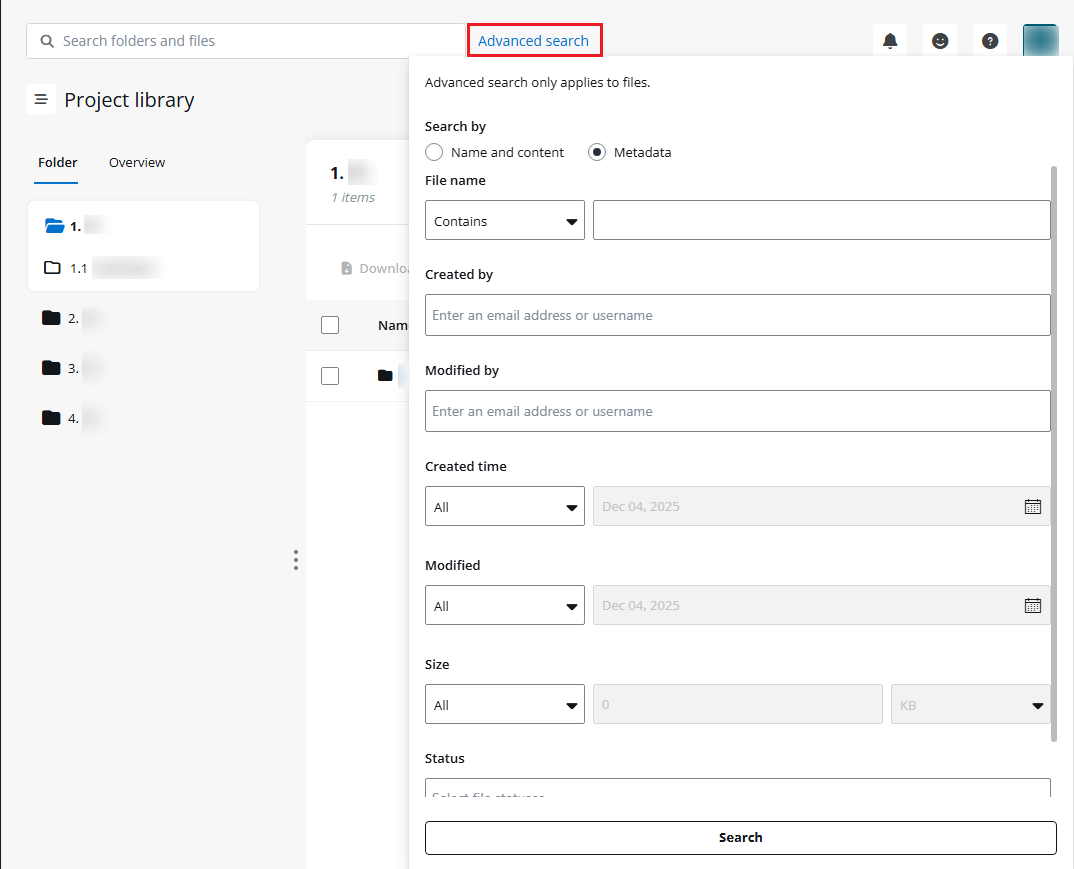
Alternatively, click Advanced search to the right of the search text box. You can choose to search by name and content or metadata.
-
Name and content – Select the Contains or Does not contain condition and enter a keyword to add a search condition. Multiple conditions can be added, and you can set the relationship of conditions. Click Search to start the search. Both file names and content will be searched for the keywords.
-
Metadata – All file properties that can be used for search are listed below. Configure the search conditions as required and click Search to start the search. You can click Clear all to remove all configured search conditions if needed.
To filter folders or files, click the Filter button. Configure item type, owner, modified time, the user who modified the item, and/or status, and then click Apply. Folders or files that meet the configured filter criteria are displayed.
Under the Folder tab, you can click Export file report to export the file report for this project. All folders and files in the project library to which you have permission will be exported along with their basic information.
Select a folder from the left pane, and all subfolders are displayed under the folder on the left pane. You can perform the following operations to manage subfolders and files in the selected folder or subfolder on the right pane. Note that what you can do depends on the permissions that you have on the specific folder and file.
-
Add subfolder – Click New, and then select Folder from the drop-down list. Enter a subfolder name, and then click Add to add the subfolder.
You can also drag and drop folders containing subfolders and files from your local drive to the right pane to add subfolders. The subfolders will be displayed in the left pane.
NOTETo add subfolders, make sure you have the Edit permission to the folder. If you are about to delete the subfolders you have added, contact the project administrator for assistance.
-
Drag and drop files – You can drag and drop files from your local drive to Confide.
-
New – Click New to create a new file. Select Word Document, Excel Worksheet, or PowerPoint Presentation, enter a name for this new file, and then click Create. You are redirected to a new tab to edit the file content.
-
Upload – Click Upload to upload folders or files. In the drop-down list, click File to only upload files or click Folder to upload folders and files within.
NOTEUploading folders require Edit permission.
A progress bar appears above the table to indicate the progress.
Note the following:
-
The newly uploaded files are in the New status. The status will be automatically changed to Unopened after you sign out and sign in again and then open the folder again.
-
If a folder/file with the same name already exists, you can select to skip uploading the folder/file or keep both folders/files. If you select to keep both folders/files, the newly uploaded folder/file will be renamed by appending a sequential number in brackets to its name. For files, you can also choose to replace the existing file.
-
-
View – Click a file name to view the file online. You can view files of the following types online: .pdf, .ppt, .pptx, .xls, .xlsx, .xlsb, .xlsm, .doc, .docx, .mp4, .webm, .ogg, .gif, .jpeg, .jpg, and .png.
If you are shared with the Edit permission, you can access the Editing mode of a file by clicking the file name. You can edit files of the following types online: Word, Excel, and PPT.
NOTEIf you still use Office 2003 or an earlier version, you will be limited to viewing Word, Excel, or PPT files online, even if you are shared with the Edit permission.
-
Download – Select files, and then click Download to download the selected files. Files will be downloaded to the default download location of your current browser. If you select multiple files to download, a ZIP file containing all of the selected files will be downloaded.
You can also download folders together with files within the whole project or download a specific folder together with the files within.
-
To download folders together with files within the whole project, click Download above the files table and then select Download all files. Click OK in the confirmation window. A ZIP file named after the project name will be downloaded.
-
To download a specific folder together with the files within, click Download above the files table and then select Download main folder. Select a folder from the drop-down list, and then click Download. A ZIP file named after the folder name will be downloaded.
-
-
Move – Select files that you want to move, and then click Move. Select a destination folder where the files will be moved, and then click Move. After being moved, files will inherit permissions from the destination folder.
-
Share – Select the folder or file that you want to share, and click Share. Complete the following information in the Share window to share the selected folder or file with the user.
Define the Access condition by selecting one of the following options:
NOTEThe Access condition setting is only available when Secure access link sharing in project is enabled for the project by the Project Admin or Project Lead.
-
Add user to project group – Select this option to add the user to a user group which has permission to the selected folder or file. The user will be added to the project and inherit the group permissions.
-
Email address/username – To invite an internal user, enter the partial or full email address or username in the text box, and then search results are displayed. Select the user that you want to add from the search results.
To invite an external user, enter the full email address of the user, and then click the Check button to confirm the entered email address. Specify the First name and Last name of this user in the corresponding text boxes.
For the external user with whom you have shared permissions, the user will be displayed in the search results, and you can select the user directly without having to confirm the email address.
NOTEThe first name and last name cannot be changed once you specify them. If you want to update the first name and/or the last name of the user, you need to delete the user and add the user again.
-
Sent invitation email – Select or clear the checkbox to indicate whether to send an invitation email to the user with the defined email address that you entered above. In the invitation email, the invited user will find the Confide environment URL to access Confide.
-
Add to group – Select the user group to which the user will be added and inherit permissions.
After configuring the sharing settings, click Share to share the folder or file with the user.
-
-
Verify access code – Select this option to require the user to enter an access code to access the shared folder or file.
-
Email address/username – To invite an internal user, enter the partial or full email address or username in the text box, and then search results are displayed. Select the user that you want to add from the search results.
To invite an external user, enter the full email address of the user, and then click the Check button to confirm the entered email address. For the external user with whom you have shared permissions, the user will be displayed in the search results, and you can select the user directly without having to confirm the email address.
-
Expiration date – Specify the expiration date for the shared folder or file.
-
Permission – Select the permission to grant for the shared folder or file.
-
After configuring the sharing settings, click Generate link to generate a secure access link to the folder or file. You can click Send by email to share the link with the user via email.
-
-
Rename – Select a folder to which you have the edit permission, and click Rename. Enter a new name for the folder, and then click Save to save the changes.
-
Export file report – Select one or multiple folders and files, and click Export file report to export report for the selected folders and files.
-
Change file status – Select files, and then click Change file status to change file status. Select a new status from the drop-down list, and then click Save.
Note the following:
-
All users in a project can change the file status of the files where they have access. File status is user-based. Your updated file status will not affect the status seen by other users.
-
The file status will be automatically changed from New or Unopened to Reviewing after users open or download a file.
If your file is opened in read-only mode and you have the Edit permission, click Edit to make edits.
-
-
Generate download link – With the generate anonymous download link in project permission granted, you can generate download links to the files and folders to which you have the Download or Edit permission.
-
Select a file or folder, and click Generate download link to generate a link to the file or folder.
-
Select an expiration date for the link.
-
Select to generate a link with a random password or a reusable password.
-
Click Generate link, and the link and password are displayed below.
-
Click the Copy button next to the link or password to copy it to your clipboard. Then, you can share the link and password with others. Users can download the shared file or files in the shared folder via the link and password.
You can also share the link with others via the system default email client by clicking Send by email.
-
-
Generate upload link – With the generate anonymous upload link in project permission granted, you can generate upload links to the folders to which you have the Upload or Edit permission.
-
Select a folder and click Generate upload link to generate a link to the folder. Users can upload files to the folder via the link.
-
Select an expiration date for the link.
-
With the corresponding permission granted, you can select to enable anti-virus scan for all files or skip anti-virus scan for files that are greater than 2 GB.
-
Select to generate a link with a random password or a reusable password.
-
Click Generate link, and the link and password are displayed below.
-
Click the Copy button next to the link or password to copy it to your clipboard. Then, you can share the link and password with others. Users can upload files to the folder via the link and password.
You can also share the link with others via the system default email client by clicking Send by email.
-
-
Add to favorites – Select files, and then click Add to favorites to add the files to the Your favorite files list on your dashboard and the Favorite files folder in the project library. You can also hover your mouse over a file and click the gray star button next to the file name to add it to your favorites.
-
Remove from favorites – Select files, and then click Remove from favorites to remove the files from the Your favorite files list on your dashboard and the Favorite files folder in the project library. You can also hover your mouse over a file and click the yellow star button next to the file name to remove it from favorites.
-
Delete – Select folders or files, and then click Delete folder to delete the selected folders or Delete to delete the selected files. Select Delete in the confirmation window. A progress bar appears above the table to indicate the progress.
-
Version history – Select a file or click the ellipsis button of a file and click Version history to view its history versions. On the Version history page, you can perform the following actions:
-
Restore – Select a previous version and click Restore to restore it to the latest version.
-
Save as copy – Select a previous version and click Save as copy to save it as a copy. In the Save as copy panel, update the file name if necessary. Then, select a folder for the copy and click Save.
-
Delete – Select one or more previous versions and click Delete to delete them.
-
Delete all versions – Click Delete all versions to delete all previous versions. The latest version will be preserved.
-
Manage sharing
On the Manage sharing page, you can view all files and folders to which you have generated anonymous links in the Shared anonymous links tab and view all files and folders to which you have generated secure access links in the Shared secure access links tab.
Shared anonymous links
In the Shared anonymous links tab, the files and folders for which you have generated links are listed in the table. You can view the file or folder name, path, the link to the file or folder, link type, password type, expiration date of the link, the user who generates the link, the link ID, and the modified date of the link.
The following actions are available in this tab:
-
Search – The search box on the upper-right corner allows you to find your desired folder or file. Enter the partial or full text of the name, or the link of the object in the search text box, and then click the magnifying glass button. All matching items are displayed.
-
Filter – To filter items, click the Filter button. Configure the filter criteria, and then click Apply. Items that meet the configured filter criteria are displayed.
-
Manage shared link – Select a link record and click Manage shared link, and you can view the expiration date of the link.
-
Copy link and password – Select a link record and click Copy link and password to copy the link, as well as the password used to access the link.
-
Delete – Select one or multiple link records and click Delete to delete the links.
-
Copy link ID – Select a link record and click Copy link ID to copy the link ID to your clipboard.
-
Generate download link – You can generate new download links to files or folders based on the existing links.
-
Select a link record, and click Generate download link to generate a new link to the file or folder.
-
Select an expiration date for the link.
-
Select to generate a link with a random password or a reusable password.
-
Click Generate link, and the link and password are displayed below.
-
Click the Copy button next to the link or password to copy it to your clipboard. Then, you can share the link and password with others. Users can download the shared file or files in the shared folder via the link and password.
You can also share the link with others via the system default email client by clicking Send by email.
-
-
Generate upload link – You can generate new upload links to folders based on the existing links.
-
Select a folder and click Generate upload link to generate a link to the folder. Users can upload files to the folder via the link.
-
Select an expiration date for the link.
-
With the corresponding permission granted, you can select to enable anti-virus scan for all files or skip anti-virus scan for files that are greater than 2 GB.
-
Select to generate a link with a random password or a reusable password.
-
Click Generate link, and the link and password are displayed below.
-
Click the Copy button next to the link or password to copy it to your clipboard. Then, you can share the link and password with others. Users can upload files to the folder via the link and password.
You can also share the link with others via the system default email client by clicking Send by email.
-
-
View – Click a file name to view the file online. You can view files of the following types online: .pdf, .ppt, .pptx, .xls, .xlsx, .xlsb, .xlsm, .doc, .docx, .mp4, .webm, .ogg, .gif, .jpeg, .jpg, and .png.
Shared secure access links
In the Shared secure access links tab, the files and folders for which you have generated secure access links are listed in the table. You can view the file or folder name, path, the link to the file or folder, the user who generates the link, the shared permission, the number of users with whom the link is shared, the expiration date of the link, and the modified date of the link.
The following actions are available in this tab:
-
Search – The search box on the upper-right corner allows you to find the desired folder or file. Enter the partial or full text of the name in the search text box, and then click the magnifying glass button. All matching items are displayed.
-
Filter – To filter items, click the Filter button. Configure the filter criteria, and then click Apply. Items that meet the configured filter criteria are displayed.
-
Manage shared link – Select a link record and click Manage shared link, and you can view and edit the expiration date of the link.
-
Copy link – Select a link record and click Copy link to copy the link to the folder or file.
-
Delete – Select one or multiple link records and click Delete to delete the links.
-
Copy link ID – Select a link record and click Copy link ID to copy the link ID to your clipboard.
-
View – Click a folder name to access the My files page with all subfolders and files in the folder listed. Click a file name to view the file online. You can view files of the following types online: .pdf, .ppt, .pptx, .xls, .xlsx, .xlsb, .xlsm, .doc, .docx, .mp4, .webm, .ogg, .gif, .jpeg, .jpg, and .png.
Integration with Outlook
Confide is integrated with Outlook, and you can perform the following actions if you are signed in to Confide while using Outlook.
-
Upload Email Attachments to Confide – You can upload the attachments of emails to desired Confide folders in Outlook.
-
Insert Confide Files to Emails – You can insert Confide file links in Outlook emails.
Before using the following features, if your administrator has not deployed the AvePoint Confide for Outlook app for you, you need to complete the steps below to add the app to your Outlook.
Upload Email Attachments to Confide
In Outlook, you can refer to the following steps to upload email attachments to Confide:
-
Open an email with attachments that you want to upload to Confide.
-
Click AvePoint Confide in the Confide Add-in group on the ribbon. The AvePoint Confide page will appear in the right pane.
If you are using the Outlook web app, click the More apps button in the upper-right corner, and select the AvePoint Confide app.
-
Select the Confide project where you want to upload the attachments, and then click Next.
-
Select the folder where you want to upload the attachments, and then click Next. The upload status of each file is displayed.
NOTEMake sure you have the Edit or Upload permission to the selected folder.
-
If any file fails to be uploaded, you can click the retry button to try again.
Insert Confide Files to Emails
In Outlook, you can refer to the following steps to insert the links of Confide files to emails:
-
On the email page, click AvePoint Confide in the Confide Add-in group on the ribbon. The AvePoint Confide page will appear in the right pane.
If you are using Outlook web app, click More apps in the Add-ins group on the ribbon, and select the AvePoint Confide app.
-
In the right pane, select the project from which you want to upload the files, and then click Next.
-
Select the folder from which you want to insert the file links, select the files you want to insert, and then click Insert. The links to the selected files will be inserted into the email.
NOTEMake sure you have at least the View permission to the selected files.
Submit Requests
On the Project library page and the My tasks page, you can submit the following requests:
-
Review request – Submit this request if you need someone to review files.
-
Document request – Submit this request if you need someone to provide files.
-
Other request – Submit this request if you have requirements other than those mentioned above.
Submit a Review Request
Refer to the following steps to submit a review request:
-
Click New request.
-
Complete the following information:
-
Request type – Select Review request from the drop-down list.
-
Request title – Enter a request title.
-
Category – Enter or select a request category.
-
Folder – Click the Select folder button to select a folder. Folders where you have at least the Request permission will be displayed.
NOTEIf you are on the Project library page, the currently selected folder is automatically filled in.
-
Related files – Click the Select files icon to select files.
NOTEFiles where you have at least the View permission will be displayed.
-
Assigned to – Select groups or individuals to assign this request to.
NOTEUsers and groups that have at least the View permission to the folder defined above will be displayed.
-
Due date – Click the Calendar button to configure a due date for this request. An email notification will be sent to the assignees you defined above 7 days, 3 days, and 1 day before the due date.
-
Workstream – Enter or select a workstream.
-
Preliminary request – Choose Yes or No.
-
Initial reviewer – Enter keywords to search for an individual user by username or email address.
-
Date requested – Click the Calendar button to configure a requested date.
-
Description – Explain what you want and why.
-
Additional information – Provide any additional information or remarks related to the request.
-
-
Click Submit to submit the request. A task of the Pending status is created and assigned to the assignee with an email notification.
Submit a Document Request
Refer to the following steps to submit a document request:
-
Click New request.
-
Complete the following information:
-
Request type – Select Document request from the drop-down list.
-
Request title – Enter a request title.
-
Category – Enter or select a request category.
-
Folder – Click the Select folder button to select a folder. Folders where you have at least the Request permission will be displayed.
NOTEIf you are on the Project library page, the currently selected folder is automatically filled in.
-
Assigned to – Select groups or individuals to assign this request to.
NOTEUsers and groups that have the Edit or Upload permission to the folder defined above will be displayed.
-
Due date – Click the Calendar button to configure a due date for this request. An email notification will be sent to the assignees you defined above 7 days, 3 days, and 1 day before the due date.
-
Workstream – Enter or select a workstream.
-
Preliminary request – Choose Yes or No.
-
Initial reviewer – Enter keywords to search for an individual user by username or email address.
-
Date requested – Click the Calendar button to configure a requested date.
-
Description – Explain what you want and why.
-
Additional information – Provide any additional information or remarks related to this request.
-
-
Click Submit to submit the request. A task of the Pending status is created and assigned to the assignee with an email notification.
Submit an Other Request
Refer to the following steps to submit another request:
-
Click New request.
-
Complete the following information:
-
Request type – Select Other request from the drop-down list.
-
Request title – Enter a request title.
-
Category – Enter or select a request category**.**
-
Folder – Click the Select folder button to select a folder. Folders where you have at least the Request permission will be displayed.
NOTEIf you are on the Project library page, the currently selected folder is automatically filled in.
-
Assigned to – Select groups or individuals to assign this request to.
NOTEUsers and groups that have at least the View permission to the folder defined above will be displayed.
-
Due date – Click the Calendar button to configure a due date for this request. An email notification will be sent to the assignees you defined above 7 days, 3 days, and 1 day before the due date.
-
Workstream – Enter or select a workstream.
-
Preliminary request – Choose Yes or No.
-
Initial reviewer – Enter keywords to search for an individual user by username or email address.
-
Date requested – Click the Calendar button to configure a requested date.
-
Description – Explain what you want and why.
-
Additional information – Provide any additional information or remarks related to the request.
-
-
Click Submit to submit the request. A task of the Pending status is created and assigned to the assignee with an email notification.
Manage My Tasks
On the My tasks page, you will find the tasks that have been assigned to you. On the Submitted requests page, your submitted requests are displayed. If you are a project administrator, you will be able to find all submitted requests within the project. A tag is displayed next to My tasks in the left navigation when there is a new task assigned to you that you have not opened yet.
Task-related updates will be collected and sent to you in email notifications every three hours.
You will find the following information on the My tasks & Submitted requests pages:
-
In the left pane, tasks are displayed in a list view in ascending order by the due date, with completed tasks displayed at the bottom.
For newly submitted tasks that you have not opened yet, there is a tag next to the task title. The tag will disappear once you open the task.
-
Select a task from the left pane. In the middle pane, details of the selected task are displayed.
-
Select a task from the left pane. In the right pane, the request title and request details of the selected task are displayed.
Below the request title and request details, you will find a group chat. To chat with others, enter a comment, and then click the Send button to send the comment. Within 5 minutes after your comment is sent, you can click the ellipsis button next to it and select to edit or delete the comment.
Based on urgency, the due date will be displayed in different colors as below:
-
Red – The request is due today, or it has already been overdue.
-
Black – The request will be due later than today.
For requests you submitted, you can click Edit request in the upper-right corner to edit the request information and assignee.
Manage a Review Request
Refer to the following steps to manage a review request:
-
From the request list, search for the request that you want to manage.
-
Click the request to open it. The request details are displayed in the middle pane.
-
Click Accept. The request status is changed to Reviewing.
-
Find the files that you need to review in the Attached files field.
If you are the owner of the file or have the Edit permission to the file, you can click the Delete button to delete the file from the folder.
-
After your review, click Complete. The request status is changed to Completed.
After a request is completed, you can click Reopen to reopen the request. The request status is reverted to Pending.
If you are not the assignee of the request you submitted, you only need to complete or reopen the request.
Manage a Document Request
Refer to the following steps to manage a document request:
-
From the request list, search for the request that you want to manage.
-
Click the request to open it. The request details are displayed in the middle pane.
-
Click Accept. The request status is changed to In progress.
-
Find the related files in the Attached files field.
If you are the owner of the file or have the Edit permission to the file, you can click the Delete button to delete the file from the folder.
-
After preparing the files, click Provide files. The request status is changed to Reviewing.
-
Click Complete if no modification is required. The request status is changed to Completed.
After a request is completed, you can click Reopen to reopen the request. The request status is reverted to Pending.
If you are not the assignee of the request you submitted, you only need to complete or reopen the request.
Manage an Other Request
Refer to the following steps to manage another request:
-
From the request list, search for the request that you want to manage.
-
Click the request to open it. The request details are displayed in the middle pane.
-
Click Accept. The request status is changed to In progress.
-
After the request is completed, click Complete. The request status is changed to Completed.
After a request is completed, you can click Reopen to reopen the request. The request status is reverted to Pending.
If you are not the assignee of the request you submitted, you only need to complete or reopen the request.
Submit Q&As
On the Project library page and the Q&A page, you can submit a Q&A to ask questions regarding a folder to other users who can access this folder.
Refer to the following steps to submit a Q&A:
-
Click New Q&A.
-
Complete the following information:
-
Title – Enter the title of the Q&A. You can enter your question here.
-
Folder – Click the Select folder button to select a folder. Folders where you have at least the View permission will be displayed.
NOTEThe currently selected folder is automatically filled in.
-
Description – Explain your question in detail.
-
-
Click Submit to submit the Q&A. A Q&A of the Open status is created and assigned to the assignee with an email notification.
Manage Q&As
On the Q&A page, you will find the Q&A of the folders that you can access. If you are a project administrator, you will be able to find all Q&As within the project.
Q&A-related updates will be collected and sent to you in email notifications every three hours.
You will find the following information on the Q&A pages:
-
In the left pane, the folder structure of the project library is displayed.
-
Select a folder from the left pane. In the middle pane, Q&As about the folder are displayed in a list view in ascending order by the submitted date, with resolved Q&As displayed at the bottom.
-
Select a Q&A from the middle pane. In the right pane, you will find a group chat. To chat with others, enter a comment, and then click the Send button to send the comment.
For a Q&A you have submitted, you can click the ellipsis button next to a message, and then click Mark as answer to mark the message as the answer to your question. You can also right-click a marked message, and then click Do not mark as answer to indicate that you do not want to mark the message as the answer.
If you want to resolve the Q&A you submitted after you get the answer, you can click Resolve. The Q&A status is changed to Resolved.
After the Q&A you submitted is resolved, you can click Reopen to reopen the Q&A. The Q&A status is reverted to Open.
Share Center
Share center is a central location for users to share files that are not associated with any projects. The files will reside in a secure location only available to Confide users and anyone that they share them with.
If you are a user with access to Share center, you can manage the content you want to share, share content with others and manage the sharing permissions, and view the content that is shared with you in Share center.
Manage Objects
On the My files page, you can manage your folders and files for sharing and collaboration. You can view their modified date, the user who modified them, and the sharing status.
-
Search – The search box on the upper-right corner allows you to find the desired folder or file. Enter the partial or full text of the name, or the link of the object in the search text box, and then click the magnifying glass button. All matching items are displayed.
-
New folder – Click New Folder, enter a name for the folder, and click Add to create a new folder.
-
Upload – Click Upload to upload folders or files. In the drop-down list, click File to only upload files or click Folder to upload folders and files within. Alternatively, you can upload files by dragging them from File Explorer and dropping them to the table.
If a folder/file with the same name already exists, you can select to skip uploading the folder/file or keep both folders/files. If you select to keep both folders/files, the newly uploaded folder/file will be renamed by appending a sequential number in brackets to its name. For files, you can also choose to replace the existing file.
-
Share – Select the files and/or folders that you want to share, and click Share. In the Share window, complete the following settings:
-
Choose the access condition for the shared user.
-
Require sign-in – The shared user needs to sign in before they can access the shared content.
-
Verify access code – The shared user needs to complete the verification with email address and access code before they can access the accessed content.
-
-
To invite an internal user, enter the partial or full email address or username in the text box, and then search results are displayed. Select the user that you want to add from the search results.
To invite an external user, enter the full email address of the user, and then click the Check button to confirm the entered email address. For the external user with whom you have shared permissions, the user will be displayed in the search results and you can select the user directly without having to confirm the email address.
-
Choose whether to send an invitation email to the user.
NOTEThis is only available when you select the Require sign-in access condition above.
-
Select the permission that you want to grant to the user, View, Download, or Edit.
NOTEEdit permission is not available when you select the Verify access code option above.
-
Select an expiration date from the calendar.
-
Click Share to share the files and folders with the user or click Generate link to generate the secure access link.
-
Once you generate the link, you can copy the link directly or click Send by email to share the link via email.
-
-
Download – Select the files and folders that you want to download, and click Download to download them locally.
-
Rename – Select a folder and click Rename to rename the folder.
-
Generate upload link – You can generate upload links to folders.
-
Select a folder and click Generate upload link to generate a link to the folder. Users can upload files to the folder via the link.
-
Select an expiration date for the link.
-
Select to allow users with the link to upload files to the current folder, or upload files to subfolders which will be named by their names.
-
With corresponding permission granted, you can select to enable anti-virus scan for all files or skip anti-virus scan for files that are greater than 2 GB.
-
Select to generate a link with a random password or a reusable password.
NOTEThe link password options are only available only when administrators enable the Reusable password setting. Otherwise, the generated link uses a random password.
If you choose to generate a link with a reusable password, you can select an existing reusable password from the drop-down list. If you have no reusable password, click New password to create a new one. Complete the following information in the New password window, and click Save to create the reusable password.
-
Name – Enter a unique name for the reusable password.
-
Password – Click Auto generate to randomly generate a reusable password or manually enter a password. The password must be between 8 and 20 characters and use a combination of the following characters: uppercase letters, lowercase letters, numbers, and symbols.
Click the Show password icon to view the password, and then click the Hide password icon to obscure the password, replacing each character with a dot.
-
Description – Enter an optional description for the reusable password.
-
-
Click Generate link, and the link and password are displayed below.
-
Click the Copy button next to the link or password to copy it to your clipboard. Then, you can share the link and password with others. Users can upload files to the folder via the link and password.
You can also share the link with others via the system default email client by clicking Send by email.
-
-
Generate download link – You can generate a download link to files or folders.
-
Select a file or folder, and click Generate download link to generate a link to the file or folder.
-
Select an expiration date for the link.
-
Select to generate a link with a random password or reusable password.
NOTEThe link password options are only available only when administrators enable the Reusable password setting. Otherwise, the generated link uses a random password.
If you select to generate a link with a reusable password, you can select an existing reusable password from the drop-down list. If you have no reusable password, click New password to create a new one.
-
Click Generate link, and the link and password are displayed below.
-
Click the Copy button next to the link or password to copy it to your clipboard. Then, you can share the link and password with others.
You can also share the link with others via the system default email client by clicking Send by email.
Users can download the shared file or the content in the shared folder via the link and password, and view content of the following file types online: PDF, Word, Excel, and PPT.
-
-
Delete – Select the files and folders that you want to delete and click Delete to delete them from this page.
-
View – Click a folder name to view all subfolders and files in the folder. Click a file name to view the file online. You can view files of the following types online: PDF, Word, Excel, and PPT.
-
Version history – Select a file or click the ellipsis button of a file and click Version history to view its history versions. On the Version history page, you can perform the following actions:
-
Restore – Select a previous version and click Restore to restore it to the latest version.
-
Save as copy – Select a previous version and click Save as copy to save it as a copy. In the Save as copy panel, update the file name if necessary. Then, select a folder for the copy and click Save.
-
Delete – Select one or more previous versions and click Delete to delete them.
-
Delete all versions – Click Delete all versions to delete all previous versions. The latest version will be preserved.
-
Manage Sharing
On the Manage sharing page, you can view all files and folders that you have shared permissions with others in the Shared permissions tab, view all files and folders to which you have generated secure access links in the Shared secure access links tab, view all files and folders to which you have generated anonymous links in the Shared anonymous links tab, and view all reusable passwords you generated in the Reusable passwords tab.
The Reusable passwords tab is only available when administrators enable the Reusable password setting. The Shared secure access links and Shared anonymous links tabs are only available when you are assigned with the corresponding share center permissions.
Shared permissions
In the Shared permissions tab, the number of users with whom the file or folder is shared is displayed in the Shared with column and clickable. Click a number link to view the user list.
The following actions are available in this tab:
-
Search – The search box on the upper-right corner allows you to find the desired folder or file. Enter the partial or full text of the name in the search text box, and then click the magnifying glass button. All matching items are displayed.
-
Filter – To filter items, click the Filter button. Configure the filter criteria, and then click Apply. Items that meet the configured filter criteria are displayed.
-
Manage sharing – Select a file or folder and click Manage sharing, and the Manage sharing window appears on the right pane with all shared users listed.
-
Add user – Click Add user to share the file or folder with a new user.
-
Edit – Click the Edit button to the right of a user to edit the shared permission and expiration date.
-
Delete – Click the Delete button to the right of a user to stop sharing with the user.
-
-
Download – Select the files and folders that you want to download, and click Download to download them locally.
-
Generate upload link – You can generate upload links to folders.
-
Select a folder and click Generate upload link to generate a link to the folder. Users can upload files to the folder via the link.
-
Select an expiration date for the link.
-
Select to allow users with the link to upload files to the current folder, or upload files to subfolders which will be named by their names.
-
With corresponding permission granted, you can select to enable anti-virus scan for all files or skip anti-virus scan for files that are greater than 2 GB.
-
Select to generate a link with a random password or a reusable password.
NOTEThe link password options are only available when administrators enable the Reusable password setting. Otherwise, the generated link uses a random password.
If you choose to generate a link with a reusable password, you can select an existing reusable password from the drop-down list. If you have no reusable password, click New password to create a new one. Complete the following information in the New password window, and click Save to create the reusable password.
-
Name – Enter a unique name for the reusable password.
-
Password – Click Auto generate to randomly generate a reusable password or manually enter a password. The password must be between 8 and 20 characters and use a combination of the following characters: uppercase letters, lowercase letters, numbers, and symbols.
Click the Show password icon to view the password, and then click the Hide password icon to obscure the password, replacing each character with a dot.
-
Description – Enter an optional description for the reusable password.
-
-
Click Generate link, and the link and password are displayed below.
-
Click the Copy button next to the link or password to copy it to your clipboard. Then, you can share the link and password with others. Users can upload files to the folder via the link and password.
You can also share the link with others via the system default email client by clicking Send by email.
-
-
Stop sharing – Select the files and folders that you want to stop sharing, and click Stop sharing to remove the user permissions to the files and folders.
-
Generate download link – You can generate download links to files or folders.
-
Select a file or folder, and click Generate download link to generate a link to the file or folder.
-
Select an expiration date for the link.
-
Select to generate a link with a random password or a reusable password.
NOTEThe link password options are only available only when administrators enable the Reusable password setting. Otherwise, the generated link uses a random password.
If you choose to generate a link with a reusable password, you can select an existing reusable password from the drop-down list. If you have no reusable password, click New password to create a new one.
-
Click Generate link, and the link and password are displayed below.
-
Click the Copy button next to the link or password to copy it to your clipboard. Then, you can share the link and password with others.
You can also share the link with others via the system default email client by clicking Send by email.
Users can download the shared file or the content in the shared folder via the link and password, and view content of the following file types online: PDF, Word, Excel, and PPT.
-
-
View – Click a folder name to access the My files page with all subfolders and files in the folder listed. Click a file name to view the file online. You can view files of the following types online: .pdf, .ppt, .pptx, .xls, .xlsx, .xlsb, .xlsm, .doc, .docx, .mp4, .webm, .ogg, .gif, .jpeg, .jpg, and .png.
Shared secure access links
In the Shared secure access links tab, you can view the name and path of each folder or file, the link, shared permission, the number of users with whom the folder or file is shared, expiration date of the link, and the modified date of the folder or file.
The following actions are available in this tab:
-
Search – The search box on the upper-right corner allows you to find the desired folder or file. Enter the partial or full text of the name in the search text box, and then click the magnifying glass button. All matching items are displayed.
-
Filter – To filter items, click the Filter button. Configure the filter criteria, and then click Apply. Items that meet the configured filter criteria are displayed.
-
Manage shared link – Select a link record and click Manage shared link, and you can view and edit the expiration date of the link.
-
Copy link – Select a link record and click Copy link to copy the link to the folder or file.
-
Delete – Select one or multiple link records and click Delete to delete the links.
-
Copy link ID – Select a link record and click Copy link ID to copy the link ID to your clipboard.
-
View – Click a folder name to access the My files page with all subfolders and files in the folder listed. Click a file name to view the file online. You can view files of the following types online: .pdf, .ppt, .pptx, .xls, .xlsx, .xlsb, .xlsm, .doc, .docx, .mp4, .webm, .ogg, .gif, .jpeg, .jpg, and .png.
Shared anonymous links
In the Shared anonymous links tab, you can view the link to each folder or file, the link type, password type, expiration date of the link, and the modified date of the folder or file.
The following actions are available in this tab:
-
Search – The search box on the upper-right corner allows you to find the desired folder or file. Enter the partial or full text of the name in the search text box, and then click the magnifying glass button. All matching items are displayed.
-
Filter – To filter items, click the Filter button. Configure the filter criteria, and then click Apply. Items that meet the configured filter criteria are displayed.
-
Manage shared link – Select a link record and click Manage shared link, and you can view and edit the expiration date of the link, the folder structure, and anti-virus scan settings if you select a folder link.
-
Copy link and password – Select a link record and click Copy link and password to copy the link to the folder or file, as well as the password used to access the link.
-
Delete – Select one or multiple link records and click Delete to delete the links.
-
Copy link ID – Select a link record and click Copy link ID to copy the link ID to your clipboard.
-
Generate upload link – You can generate new upload links to folders based on the existing folder links.
-
Select a link record and click Generate upload link to generate a new link to the folder. Users can upload files to the folder via the link.
-
Select an expiration date for the link.
-
Select to allow users with the link to upload files to the current folder, or upload files to subfolders which will be named by their names.
-
With corresponding permission granted, you can select to enable anti-virus scan for all files or skip anti-virus scan for files that are greater than 2 GB.
-
Select to generate a link with a random password or a reusable password.
NOTEThe link password options are only available when administrators enable the Reusable password setting. Otherwise, the generated link uses a random password.
If you choose to generate a link with a reusable password, you can select an existing reusable password from the drop-down list. If you have no reusable password, click New password to create a new one. Complete the following information in the New password window, and click Save to create the reusable password.
-
Name – Enter a unique name for the reusable password.
-
Password – Click Auto generate to randomly generate a reusable password or manually enter a password. The password must be between 8 and 20 characters and use a combination of the following characters: uppercase letters, lowercase letters, numbers, and symbols.
Click the Show password icon to view the password, and then click the Hide password icon to obscure the password, replacing each character with a dot.
-
Description – Enter an optional description for the reusable password.
-
-
Click Generate link, and the link and password are displayed below.
-
Click the Copy button next to the link or password to copy it to your clipboard. Then, you can share the link and password with others. Users can upload files to the folder via the link and password.
You can also share the link with others via the system default email client by clicking Send by email.
-
-
Generate download link – You can generate new download links to files or folders based on the existing links.
-
Select a link record, and click Generate download link to generate a new link to the file or folder.
-
Select an expiration date for the link.
-
Select to generate a link with a random password or a reusable password.
NOTEThe link password options are only available when administrators enable the Reusable password setting. Otherwise, the generated link uses a random password.
If you choose to generate a link with a reusable password, you can select an existing reusable password from the drop-down list. If you have no reusable password, click New password to create a new one.
-
Click Generate link, and the link and password are displayed below.
-
Click the Copy button next to the link or password to copy it to your clipboard. Then, you can share the link and password with others.
You can also share the link with others via the system default email client by clicking Send by email.
Users can download the shared file or the content in the shared folder via the link and password, and view content of the following file types online: PDF, Word, Excel, and PPT.
-
-
View – Click a folder name to access the My files page with all subfolders and files in the folder listed. Click a file name to view the file online. You can view files of the following types online: .pdf, .ppt, .pptx, .xls, .xlsx, .xlsb, .xlsm, .doc, .docx, .mp4, .webm, .ogg, .gif, .jpeg, .jpg, and .png.
Reusable passwords
In the Reusable passwords tab, you can view all reusable passwords you created with their names, descriptions, and modified dates.
Click New password to create a new reusable password. Complete the following information, and click Save to create the reusable password.
-
Name – Enter a unique name for the reusable password.
-
Password – Click Auto generate to randomly generate a reusable password or manually enter a password. The password must be between 8 and 20 characters and use a combination of the following characters: uppercase letters, lowercase letters, numbers, and symbols.
Click the Show password icon to view the password, and then click the Hide password icon to obscure the password, replacing each character with a dot.
-
Description – Enter an optional description for the reusable password.
You have the option to modify or remove any existing reusable password.
If you update the reusable password used to generate anonymous links, you can select it and click Copy password to copy the new password to your clipboard for sharing with others. Users will only be able to access the links with this new password. If you delete the reusable password, the anonymous links will become inaccessible.
Shared With Me
On the Shared with me page, all folders and files shared with you are listed in the table. You can view by whom the file or folder is shared, the shared permission, the shared date, the expiration date, the date when the file or folder is modified, and the user who modified it.
Based on the shared permissions to the folders and files, the following actions are available:
-
Search – The search box on the upper-right corner allows you to find the desired folder or file. Enter the partial or full text of the name in the search text box, and then click the magnifying glass button. All matching items are displayed.
-
Filter – To filter items, click the Filter button. Configure the filter criteria, and then click Apply. Items that meet the configured filter criteria are displayed.
-
New folder – Click New Folder, enter a name for the folder, and click Add to create a new folder.
NOTEThis action is only available in the shared folder to which you have Edit permission.
-
Rename – Select a folder and click Rename to rename the folder.
NOTEThis action is only available in the shared folder to which you have Edit permission.
-
Upload – Click Upload to upload folders or files. In the drop-down list, click File to only upload files or click Folder to upload folders and files within. Alternatively, you can upload files by dragging them from File Explorer and dropping them to the table.
NOTEThis action is only available in the shared folder to which you have Edit permission.
-
Download – Select files and folders, and click Download to download them locally.
-
Delete – Select files and folders, and click Delete to delete them from the share center.
-
View – Click a folder name to view all subfolders and files in the folder.
Click a file name to view the file online. You can view files of the following types online: .pdf, .ppt, .pptx, .xls, .xlsx, .xlsb, .xlsm, .doc, .docx, .mp4, .webm, .ogg, .gif, .jpeg, .jpg, and .png.
If you are shared with the Edit permission, you can access the Editing mode of a file by clicking the file name. You can edit files of the following types online: Word, Excel, and PPT.
-
Version history – Select a file or click the ellipsis button of a file and click Version history to view its history versions. On the Version history page, you can perform the following actions:
-
Restore – Select a previous version and click Restore to restore it to the latest version.
-
Save as copy – Select a previous version and click Save as copy to save it as a copy. In the Save as copy panel, update the file name if necessary. Then, select a folder for the copy and click Save.
-
Delete – Select one or more previous versions and click Delete to delete them.
-
Delete all versions – Click Delete all versions to delete all previous versions. The latest version will be preserved.
-